A Blueprint of Order: The Architectural Vision of Franz Ehrlich
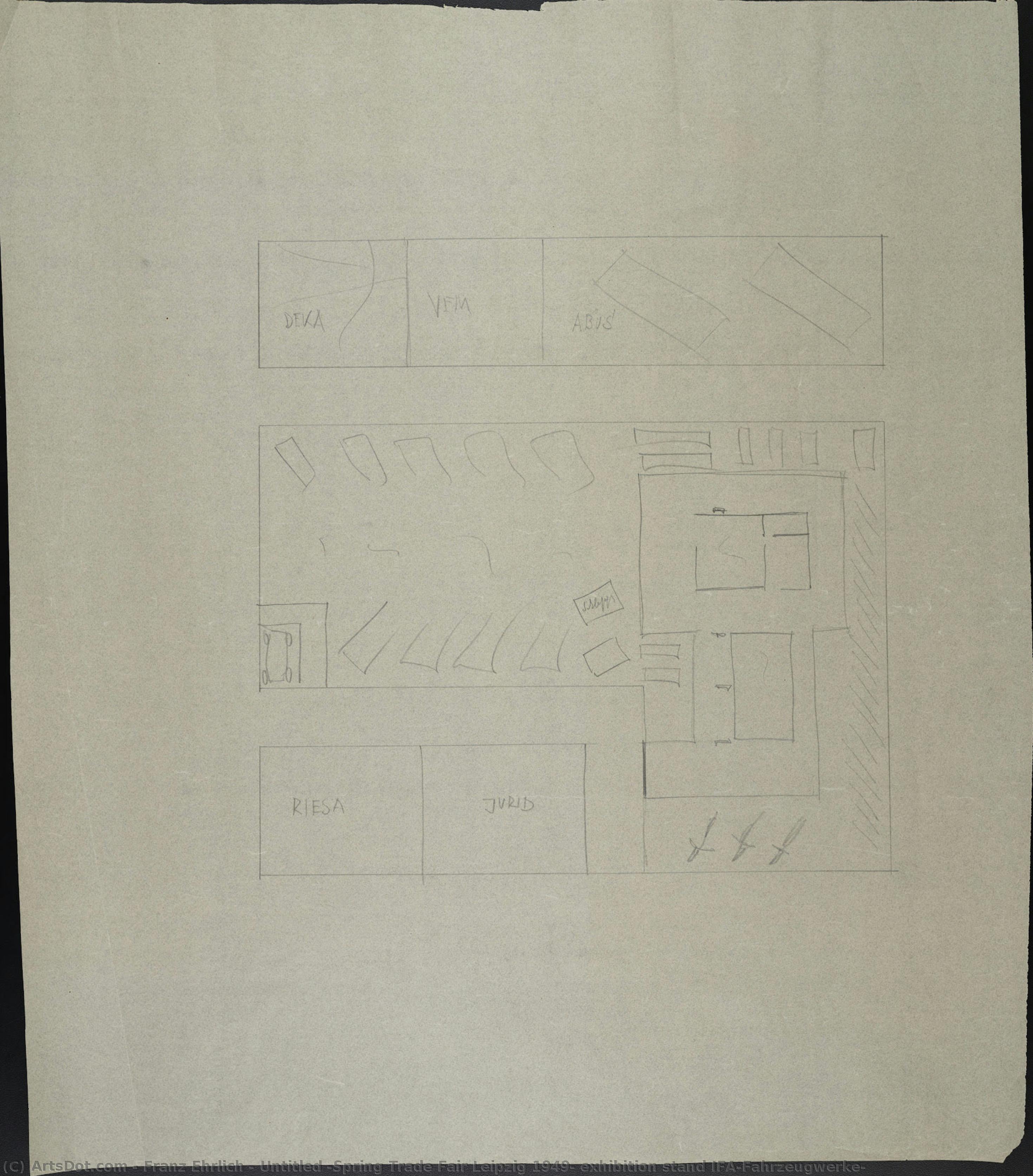
In the delicate interplay of line and shadow, Untitled (Spring Trade Fair Leipzig 1949, exhibition stand IFA-Fahrzeugwerke) offers a profound glimpse into a moment of reconstruction and meticulous planning. Created by the German master Franz Ehrlich, this architectural drawing serves as more than just a technical schematic; it is a silent witness to the post-war era's yearning for structure and renewal. Through the precise application of pencil on paper, Ehrlich captures the skeletal essence of an exhibition stand, transforming a functional floor plan into a captivating study of geometric harmony. The monochrome palette, rendered in varying shades of gray, evokes the somber yet hopeful atmosphere of 1949 Leipzig, where the rebuilding of industry and identity was underway.
The composition is a masterclass in spatial arrangement, utilizing an overhead perspective that flattens the room into a rhythmic dance of rectangles and lines. Every element—from the carefully placed chairs to the outlines of tables—is meticulously delineated, creating a sense of profound order. There is a quiet, meditative quality to the way Ehrlich uses density of line to suggest depth and shadow, providing a subtle weight to the furniture within the void of the architectural space. For the discerning collector or interior designer, this piece offers a sophisticated aesthetic that celebrates the beauty of minimalism and the elegance of structural clarity.
The Bauhaus Legacy and Historical Resonance
To understand the soul of this work, one must look toward the artist's profound connection to the Bauhaus movement. Having studied at this legendary institution in Dessau, Ehrlich carried the avant-garde principles of functionalism and geometric purity into his professional practice. This drawing is a direct descendant of that lineage, where the distinction between fine art and technical design dissolves into a singular pursuit of clarity. The piece embodies the Bauhaus ethos: that beauty is found in the efficient, the purposeful, and the well-structured.
Beyond its formal qualities, the work carries a heavy historical weight. Created in the wake of immense global upheaval, the drawing represents the "Spring Trade Fair Leipzig 1949," a period when the world was attempting to reassemble itself from the fragments of conflict. The technical precision of the IFA-Fahrzeugwerke stand design reflects a drive toward industrial stability and organized progress. For those who appreciate art that bridges the gap between historical narrative and modern aesthetic, this reproduction provides an intellectual depth that transcends mere decoration.
An Aesthetic for the Modern Interior
For the contemporary connoisseur of fine art, Ehrlich’s work offers a timeless versatility. Its monochromatic nature and clean, geometric lines make it an ideal centerpiece for modern, minimalist, or industrial-style interiors. The drawing does not demand attention through loud colors or chaotic forms; instead, it commands respect through its quiet confidence and structural integrity. It serves as a sophisticated anchor in a room, providing a sense of calm and intellectual rigor.
Integrating a high-quality reproduction of this piece into a curated space allows for a dialogue between history and modernity. Whether placed in a professional studio, a corporate gallery, or a private study, the work invites contemplation on the nature of design and the enduring human impulse to create order from chaos. It is an exquisite choice for those seeking to surround themselves with art that is as much a piece of history as it is a masterpiece of graphic precision.