A Portrait of Serenity Amidst Winter’s Embrace
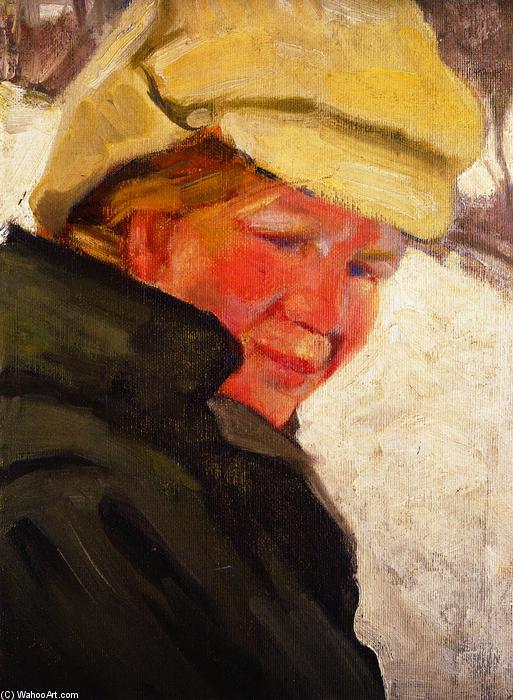
In the quiet stillness of 1906, Franz Marc captured a moment that transcends mere portraiture, offering instead a window into the spiritual soul of Expressionism. Maria Franck in a White Cap is far more than a depiction of a woman in winter attire; it is a profound meditation on purity and the enduring strength of the human spirit. As the viewer encounters Maria’s gentle, smiling face, there is an immediate sense of warmth that defies the frigid landscape surrounding her. The painting serves as a cornerstone of Marc's early career, embodying his fervent quest to find meaning within the natural world and his belief that art could act as a conduit for transcendent experience.
The composition masterfully balances the intimate with the infinite. Maria is portrayed with remarkable tenderness, her features softened by a rosy glow that suggests an inner vitality. Behind her, the jagged, snow-capped mountains rise like silent sentinels, a recurring motif in Marc’s oeuvre that speaks to his fascination with the primal and the pure. This juxtaposition of the human subject against the monumental scale of the Alps creates a breathtaking tension, inviting the observer to contemplate the relationship between our fleeting mortal existence and the eternal resilience of nature.
The Language of Color and Texture
To behold this work is to experience the tactile energy of the Expressionist movement. Marc eschewed the meticulous, often sterile realism of his predecessors, opting instead for a bold simplification of form that prioritizes emotional truth over photographic accuracy. His technique is characterized by a heavy impasto, where the paint is applied in thick, rhythmic layers. This creates a palpable, sculptural surface on the canvas, mirroring the rugged, uneven textures of the mountainous terrain and injecting a sense of dynamic movement into the composition.
The color palette is both symbolic and deeply evocative. The stark white of Maria’s cap acts as a beacon of innocence, standing in sharp contrast to the dark, heavy fabric of her coat, which represents the weight of earthly concerns. This interplay of light and shadow—of luminosity against darkness—reflects the broader artistic impulse of the era: to confront the anxieties of a rapidly industrializing world with a renewed sense of spiritual clarity. For the collector or interior designer, this piece offers a sophisticated balance of high-contrast drama and soothing tonal harmony, making it a versatile centerpiece for spaces that value both intellectual depth and aesthetic warmth.
A Legacy of Spiritual Resonance
Historically, this painting emerged from a period of profound psychological shift in Germany. As artists like Marc grappled with the alienation brought about by modern life, they sought refuge in the symbolic power of nature and color. In Maria Franck in a White Cap, we see the seeds of what would later become the Der Blaue Reiter movement—a search for a "spiritual" art that could bypass the intellect to touch the heart directly. The painting does not merely show us a winter day; it invites us to feel the crispness of the air and the quietude of the soul.
For those seeking to adorn their homes with fine art, this reproduction offers an opportunity to possess a fragment of art history. It is a piece that commands attention through its emotional gravity rather than mere ornamentation. Whether placed in a sunlit gallery or a cozy, contemplative study, the painting brings with it an atmosphere of peace and a reminder of the beauty found in moments of stillness. It remains a timeless testament to Franz Marc’s ability to transform the physical world into a landscape of pure, unadulterated feeling.