Franz Marc's "Peaceful Country": A Symphony of Color and Spirit
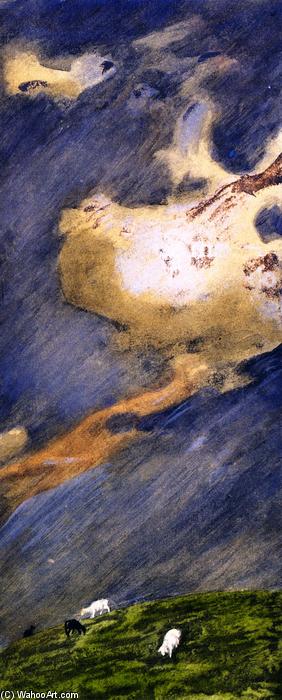
Franz Marc’s “Peaceful Country,” a masterful watercolor depicting a flock of sheep grazing beneath a brooding sky, is more than just a charming pastoral scene; it’s a profound meditation on the relationship between humanity and nature, rendered with the raw emotional intensity that defined the heart of German Expressionism. Painted in 1905, this work exemplifies Marc's core artistic philosophy – a fervent belief that animals possessed a deeper spiritual truth, a purity of existence untainted by human anxieties. The painting’s immediate impact lies in its luminous color palette; deep blues and greens dominate, evoking the tranquility of the landscape while simultaneously hinting at an underlying melancholy. This isn’t a simple depiction of sheep; it's an embodiment of Marc’s desire to capture the soul of the animal world.
Technique and Style: The Expressionist Vision
Marc’s technique is characterized by bold, expressive brushstrokes and a deliberate flattening of perspective. He eschewed traditional academic realism in favor of a style that prioritized emotional impact over photographic accuracy. Notice how the sheep are not rendered with meticulous detail but rather as simplified forms, imbued with a sense of movement and vitality. The watercolor medium itself – known for its ability to create subtle gradations of tone and luminous washes – is perfectly suited to Marc’s vision. He utilizes color not merely to represent reality but to convey feeling, creating a vibrant, almost otherworldly atmosphere. This approach aligns squarely with the burgeoning Expressionist movement, which sought to express subjective emotions and inner experiences through art.
Symbolism and Spiritual Intent
“Peaceful Country” is steeped in symbolism, reflecting Marc’s deeply held spiritual beliefs. The sheep themselves are central to the painting's meaning; they represent innocence, humility, and a connection to the earth. Their scattered arrangement across the hillside suggests a lack of hierarchy or dominion – a deliberate rejection of anthropocentric views. The cloudy sky, often interpreted as representing the unknown or the divine, adds to the painting’s contemplative mood. Marc frequently employed animals in his work as symbols of spiritual regeneration and rebirth, believing they held a key to unlocking deeper truths about existence. This piece is a testament to his conviction that art could serve as a pathway to spiritual enlightenment.
Historical Context: A Moment of Transition
Created during a period of significant artistic and intellectual ferment in Germany, “Peaceful Country” reflects the broader trends of the early 20th century. Marc was part of a group of artists who were challenging traditional notions of beauty and representation, seeking to express their innermost feelings through art. The painting’s influence can be seen in the work of other Expressionist painters such as Emil Nolde and Kirchner, all of whom shared Marc's commitment to exploring the spiritual dimension of existence. The painting’s creation coincided with a growing interest in folklore and mythology, themes frequently explored by Marc within his artistic practice.
Emotional Impact and Artistic Legacy
"Peaceful Country" continues to resonate with viewers today due to its profound sense of serenity and its evocative portrayal of the natural world. It's a painting that invites contemplation and encourages us to reconnect with our own inner selves. Franz Marc’s work, including this seminal piece, has left an indelible mark on the history of art, paving the way for future generations of artists who sought to use their creativity as a means of exploring the complexities of human experience.