A Window Into Soulful Reflection
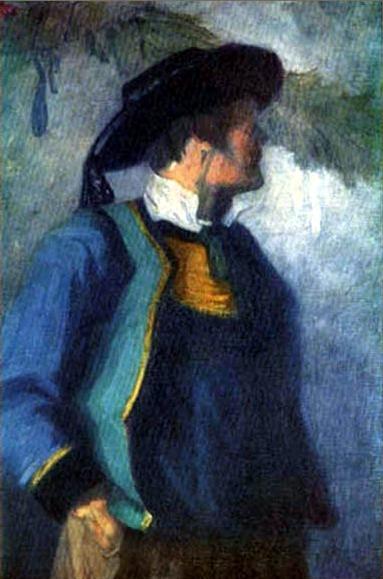
In the quietude of 1905, a pivotal moment in art history was captured on canvas through Franz Marc’s Self-portrait. This work is far more than a mere likeness of the artist; it serves as a profound distillation of artistic and spiritual contemplation. At first glance, the composition appears deceptively simple, presenting a solitary figure set against the backdrop of a stylized tree. Yet, beneath this surface lies a complex tapestry of meaning that continues to resonate with modern viewers. Marc did not merely seek to depict his physical form; he aimed to translate his deepest spiritual convictions into a visual language, inviting us to peer through the canvas and into the very essence of his inner world.
The painting stands as a cornerstone of German Expressionism, a movement defined by its rejection of academic precision in favor of raw, emotional truth. Unlike the Impressionists, who sought to capture the fleeting dance of light upon a landscape, Marc prioritized the psychological state. Through his lens, we see a man caught in a moment of deep introspection, his posture and gaze suggesting a sense of reverence for the natural world. For collectors and enthusiasts of fine art, this piece offers a rare glimpse into the formative years of an artist who would eventually redefine the boundaries of color and spirit.
The Language of Color and Texture
Technically, the Self-portrait is a masterclass in expressionist boldness. Marc abandoned meticulous detail, opting instead for flattened planes of color and gestural brushwork that imbue the scene with an urgent, palpable energy. The application of paint is notably thick, utilizing impasto to create a textured surface that catches the light and adds a physical dimension to the emotional intensity of the subject. This tactile quality makes the painting feel alive, as if the artist's very movements are still etched into the pigment.
The palette chosen by Marc is deeply symbolic, moving beyond mere decoration to serve his spiritual narrative. The dominant hues of deep blues and vibrant yellows are carefully orchestrated; the blue embodies a sense of tranquility and profound contemplation, while the yellow signifies enlightenment and a divine radiance. For an interior designer, these colors offer a sophisticated balance of calm and energy, making such a reproduction a commanding focal point in any curated space. The interplay between the cool tones of the figure's coat and the luminous accents creates a visual rhythm that draws the eye inward, much like the artist’s own journey toward spiritual clarity.
A Legacy of Spiritual Renewal
To understand this work, one must consider the intellectual ferment of early 20th-century Germany. Emerging in a period marked by existential questioning and a search for new meaning, Marc’s work reflects a desire for spiritual renewal. His fascination with the purity of nature—and eventually the symbolic power of animals—finds its roots here, in this early exploration of the self within the landscape. The tree in the background is not merely a natural element but a structural anchor that provides depth and connects the human subject to the eternal cycles of life.
Owning a high-quality reproduction of this masterpiece allows one to bring a piece of this historical tension into the home. It is an invitation to pause, to reflect, and to find beauty in the intersection of humanity and nature. Whether placed in a quiet study or a grand living gallery, Marc’s Self-portrait serves as a constant reminder of the power of art to transcend the physical and touch the eternal.