A Symphony of Light and Power: Frederic Edwin Church’s Niagara
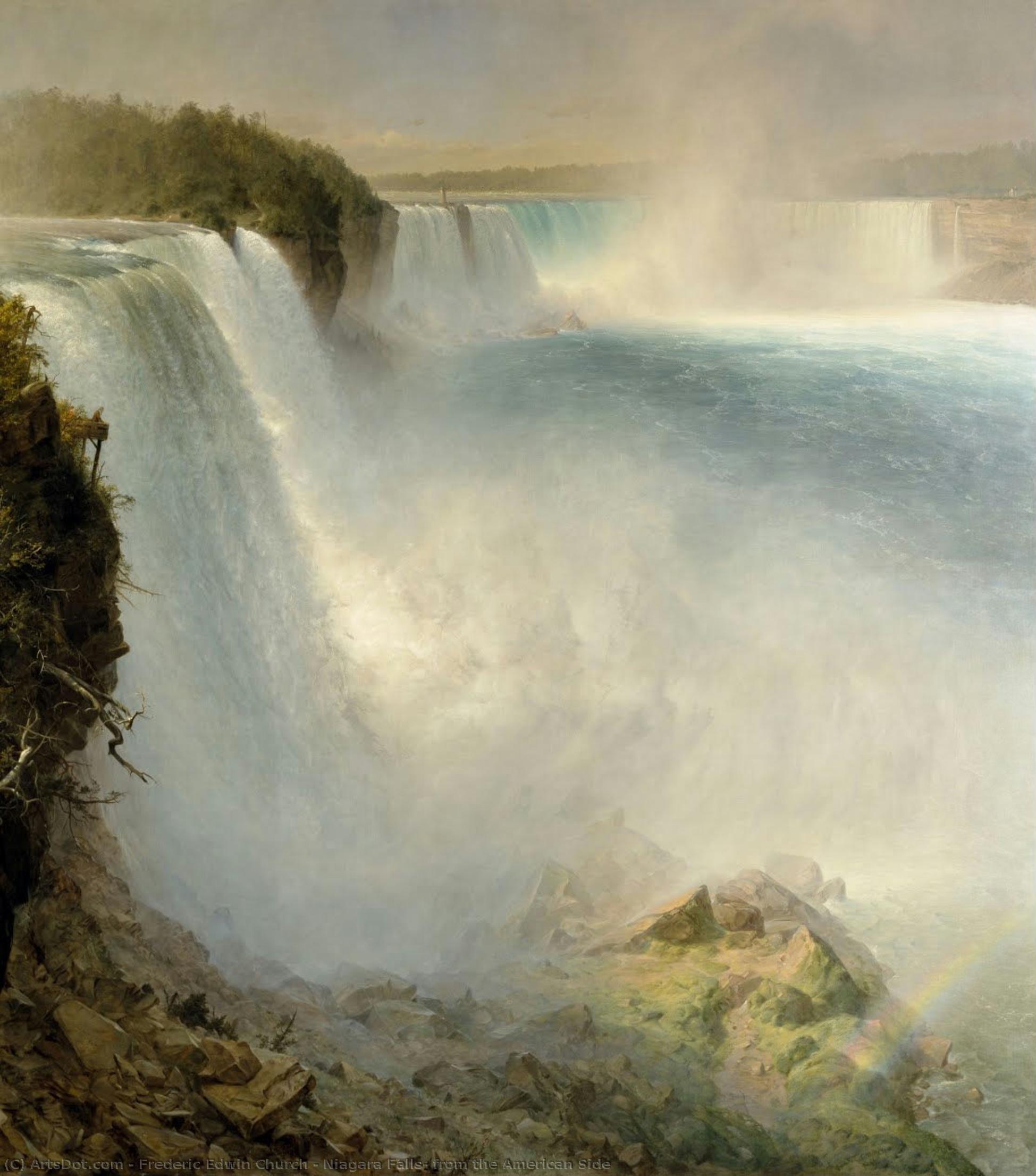
Frederic Edwin Church's "Niagara Falls, from the American Side," painted in 1867, isn’t merely a depiction of a waterfall; it’s an immersive experience, a testament to the burgeoning Luminist movement and a profound meditation on nature’s sublime power. Church, a pivotal figure within the Hudson River School, sought not simply to represent the landscape but to capture its very essence – the feeling of awe and wonder evoked by encountering something truly grand. This canvas transcends a simple topographical rendering; it's an invitation into a world saturated with light, movement, and an almost palpable energy.
The painting immediately draws the eye to the cascading torrent of Niagara Falls, rendered not as a static spectacle but as a dynamic force. Church masterfully employs a technique known as “luminism,” characterized by intense highlights and deep shadows that create a dramatic effect. He utilizes thick impasto – applying paint in heavy layers – particularly around the water’s surface, giving it an almost tangible texture and suggesting its relentless motion. The spray of the falls is captured with delicate precision, illuminated by shafts of sunlight that pierce through the mist, creating shimmering rainbows and ethereal glows. This careful manipulation of light isn't just aesthetic; it serves to heighten the sense of drama and emphasize the waterfall’s overwhelming power.
The American Sublime: Context and Inspiration
To understand “Niagara Falls,” one must consider the context of its creation – the rise of Luminism and the broader concept of the "American Sublime." Following the Romantic movement in Europe, artists like Church sought to capture a uniquely American experience of nature. The Sublime, as articulated by philosophers like Edmund Burke, describes an emotional response to vast, awe-inspiring landscapes that simultaneously inspire terror and delight. Niagara Falls perfectly embodies this idea: its immense scale and raw power evoke both a sense of vulnerability and a profound appreciation for the natural world.
Church’s fascination with Niagara was deeply personal. He visited the falls repeatedly throughout the 1850s, meticulously studying their appearance under various lighting conditions. He wasn't simply sketching; he was conducting scientific observations, documenting the water’s flow and analyzing its composition. This dedication to detail is evident in the painting’s remarkably accurate portrayal of the geological formations surrounding the falls – the rugged cliffs, the verdant trees clinging precariously to the rocks, and the distant, hazy outline of the American shore.
Symbolism and Emotional Resonance
Beyond its technical brilliance, “Niagara Falls” is rich in symbolism. The rainbow arcing through the mist represents hope and promise, a fleeting beauty born from the raw power of nature. The trees, rendered with meticulous detail, symbolize resilience – their roots firmly embedded in the earth, mirroring the enduring strength of the American landscape. The painting also subtly explores themes of man versus nature, as the small figures on the shore stand dwarfed by the immensity of the falls, reminding us of our own insignificance within the grand scheme of things.
Ultimately, “Niagara Falls” is a deeply emotional work. It’s not just about depicting a waterfall; it's about conveying the feeling of being overwhelmed by its beauty and power. The painting invites viewers to step into the scene, to feel the spray on their faces, to hear the roar of the water, and to experience the profound sense of wonder that Church so skillfully captures. It remains a powerful testament to the enduring allure of the American wilderness and a cornerstone of American landscape art.