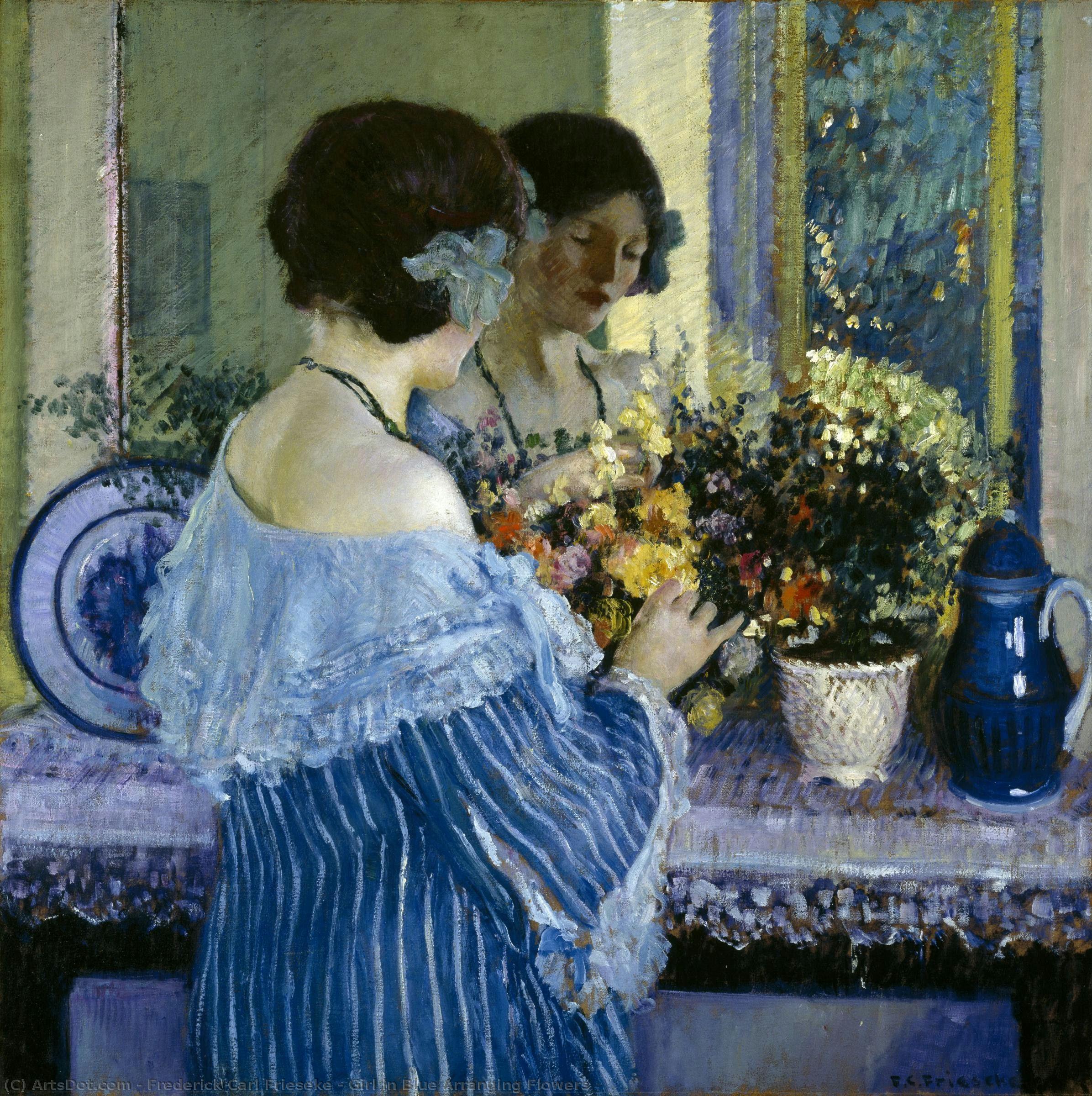
A Moment of Quiet Contemplation: Frederick Carl Frieseke's "Girl in Blue Arranging Flowers"
Frederick Carl Frieseke’s “Girl in Blue Arranging Flowers,” painted in 1915, is more than a portrait; it’s a carefully constructed tableau of domestic beauty and introspective emotion. This oil on canvas captures a young woman lost in the delicate act of arranging flowers within a richly appointed interior – a scene that speaks to the burgeoning ideals of femininity and leisure at the turn of the 20th century. The painting's immediate impact lies in its masterful use of light, an essential element of Frieseke’s signature Impressionistic style. An unseen source illuminates the room with a soft, diffused glow, highlighting the textures of the velvet drapery, the smooth curves of the woman’s skin, and the reflective surfaces of the mirror, creating a sense of ethereal beauty.
Impressionist Technique and Layered Detail
Frieseke's technique is characterized by visible brushstrokes and a deliberate layering of paint to build up form and texture. This approach, typical of Impressionism, prioritizes capturing the fleeting effects of light and atmosphere over precise detail. The artist skillfully employs broken color – applying small strokes of pure pigment side-by-side – to create shimmering surfaces and an illusion of movement. The canvas itself is alive with subtle gradations of tone, achieved through meticulous glazing techniques, a hallmark of Frieseke’s approach. This layering not only adds depth but also contributes to the painting's overall luminosity, drawing the viewer into the scene.
Symbolism and Narrative Depth
Beyond its aesthetic qualities, “Girl in Blue Arranging Flowers” is rich with symbolic meaning. The flowers themselves – a classic motif in art – represent beauty, fragility, and perhaps even remembrance or sentimentality. The mirror, strategically placed, introduces an element of duality, reflecting the woman’s image and inviting contemplation on self-awareness. The luxurious setting suggests wealth and privilege, while the act of arranging flowers speaks to a refined sensibility and appreciation for the finer things in life. This painting resonates with the broader cultural context of its time – a period marked by increasing leisure time for women and an emphasis on domesticity and artistic pursuits.
Historical Context and Artistic Influence
Painted in 1915, this work firmly places Frieseke within the heart of American Impressionism. Following his relocation to Paris in 1898, Frieseke was profoundly influenced by the French avant-garde, particularly the works of Claude Monet and Pierre Renoir. His style evolved from a more academic approach to one that embraced spontaneity, light, and color. Frederick Carl Frieseke’s “Girl in Blue Arranging Flowers” stands as a testament to his artistic journey – a beautiful and evocative painting that continues to captivate viewers with its luminous beauty and quiet contemplation.
- Artist: Frederick Carl Frieseke
- Date: 1915
- Medium: Oil on Canvas
- Size: 81 x 81 cm