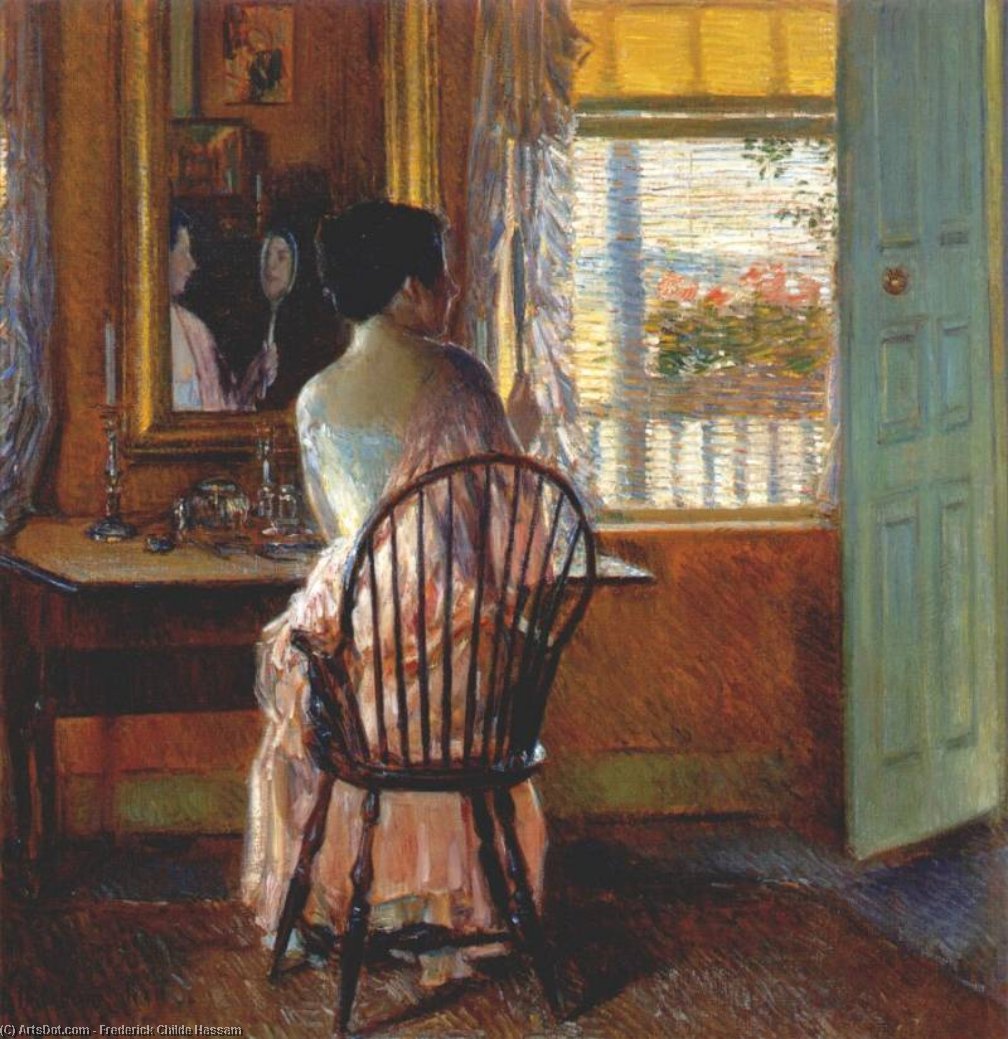
Discover "Morning Light" by Hassam – an Impressionistic masterpiece capturing domestic beauty & introspection. Explore soft brushstrokes, warm tones, & a symbolic mirror in this serene 1914 artwork.
Frederick Childe Hassam's "Morning Light": A Portrait of Introspection
Frederick Childe Hassam’s “Morning Light,” painted in 1914, is more than just a depiction of a woman at her vanity; it’s a carefully constructed meditation on beauty, solitude, and the elusive nature of self-reflection. Executed in the style of American Impressionism, a movement that sought to capture fleeting moments of light and atmosphere rather than precise detail, this work exemplifies Hassam's unique ability to infuse everyday scenes with profound emotional resonance. The painting immediately draws the viewer into a softly lit interior, dominated by warm tones – ochres, rose pinks, and muted greens – creating an intimate and slightly melancholic mood that speaks to the quiet contemplation at its core.
- Subject Matter: The central figure, a woman seated before a vanity table, is rendered with a delicate grace. Her posture suggests a moment of stillness, her gaze lost in reflection.
- Composition: The composition cleverly utilizes the mirror as a key element, creating a visual echo and reinforcing the theme of introspection. Light streams through a window to the right, illuminating the woman’s back and the surrounding furniture, while shadows deepen within the room, adding depth and volume.
- Technique: Hassam's masterful brushwork is immediately apparent. Loose, visible strokes create a textured surface, particularly in the wooden furniture and drapery, contributing to the painting’s sense of realism despite its Impressionistic style. The layering of paint allows for subtle gradations of light and shadow, enhancing the overall atmosphere.
A Pioneer of American Impressionism
Frederick Childe Hassam's artistic journey is intrinsically linked to the development of American Impressionism. Born in Boston in 1859, he initially pursued illustration before dedicating himself to capturing the essence of American life and landscape. Unlike many European artists of his time who sought formal training abroad, Hassam cultivated his skills through independent study and direct observation – a crucial element in his distinctive style. His early work for publications like *Harper’s Weekly* honed his ability to depict narrative scenes with sensitivity and detail, qualities that would later inform his artistic vision. His brief sojourn in Paris in 1886 exposed him to the techniques of French Impressionism, but it was ultimately his deep connection to America – its landscapes, urban life, and people – that fueled his most significant contributions.
Symbolic Layers: Mirrors, Roses, and Light
Beyond its aesthetic qualities, “Morning Light” is rich in symbolic meaning. The mirror, a recurring motif in Hassam’s work, represents self-awareness and the act of looking inward – a profound exploration of identity and perception. The roses visible through the window could symbolize beauty, fleeting moments, or perhaps even lost love. Most importantly, the play of light is central to the painting's emotional impact. The strong highlights on the woman’s back and the window area contrast dramatically with the deep shadows within the room, creating a sense of drama and emphasizing the subject’s vulnerability and introspection. This masterful use of light and shadow elevates the scene beyond a simple portrait, transforming it into a powerful symbol of human emotion.
Historical Context and Artistic Significance
"Morning Light," painted in 1914, reflects the burgeoning interest in domesticity and personal reflection that characterized American art at the turn of the century. Hassam’s work aligns with the broader Impressionist movement's focus on capturing fleeting moments and subjective experiences. His ability to imbue ordinary scenes with emotional depth cemented his place as a leading figure in American art, influencing generations of artists who followed. This painting stands as a testament to Hassam’s artistic vision and his profound understanding of the human condition.