Explore Frederick Childe Hassam's captivating Impressionist paintings (1859-1935). Known for vibrant city & coastal scenes, he pioneered American Impressionism and captured the essence of his time.
A Pioneer of American Impressionism: The Life and Art of Frederick Childe Hassam
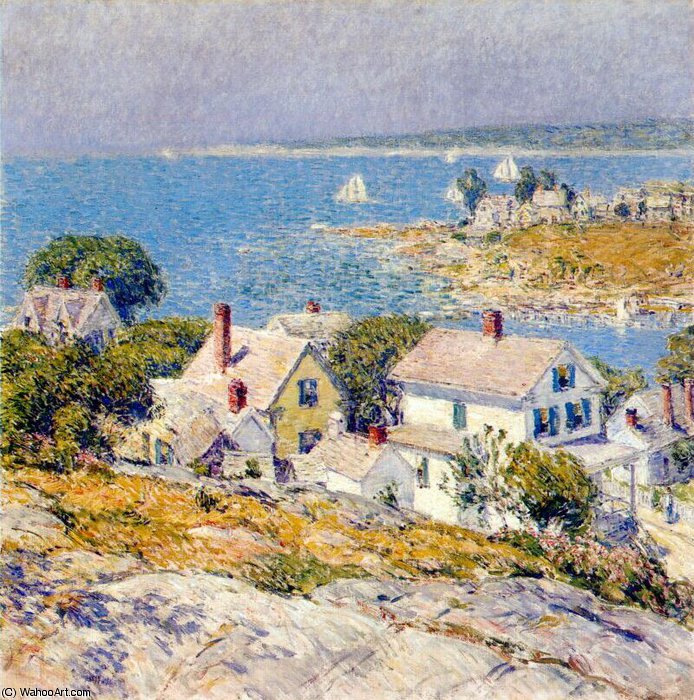
Frederick Childe Hassam’s “new england headlands” stands as a quintessential embodiment of the American Impressionist movement, capturing not merely a picturesque coastal scene but also a profound reflection on the spirit of its time. Painted in 1899, this artwork exemplifies Hassam's distinctive approach to portraying landscapes—a method rooted in observation and imbued with an emotional resonance that distinguishes it from more academic traditions.
Born in Boston on October 17, 1859, Hassam’s artistic trajectory defied conventional paths. Unlike many of his peers who pursued formal training abroad, he cultivated his talent through self-discipline and practical experience, initially establishing himself as an illustrator for publications like *Harper's Weekly* and *Scribner’s Monthly*. This formative period instilled within him a meticulous attention to detail and a knack for crafting narratives within visual compositions—skills that would become central to his artistic vision. Though he ventured to Paris in 1886, seeking inspiration from European art movements, Hassam's heart remained firmly anchored in the American landscape. He wasn’t simply attempting to reproduce what he saw; rather, he sought to convey a feeling—a sense of tranquility and connection to nature that resonated deeply with his contemporaries.
The painting itself depicts a serene coastal vista dominated by rolling hills overlooking the Atlantic Ocean. Scattered houses cling to the hillside, their facades bathed in warm sunlight, creating a harmonious blend of architectural form and natural beauty. The harbor below bustles with activity—boats bob gently on the water’s surface, reflecting the azure sky—suggesting a vibrant pulse of life amidst the stillness of the landscape. Hassam skillfully employs loose brushstrokes and dappled light to achieve an ethereal effect, characteristic of Impressionism's preoccupation with capturing fleeting moments of perception. The palette is dominated by muted greens, blues, and yellows, subtly blending together to evoke the atmosphere of a summer afternoon.
Beyond its aesthetic appeal, “new england headlands” carries symbolic weight. Hassam’s depiction of the American coastline speaks to the burgeoning optimism of the late Victorian era—a period marked by industrial progress and expanding horizons. The hillside houses symbolize stability and tradition juxtaposed against the dynamism of the sea, representing the evolving identity of America as it embraced modernity while preserving its heritage. Furthermore, the artist's masterful use of light contributes to a feeling of warmth and comfort, inviting viewers into the scene’s tranquil embrace.
Hassam’s technique—primarily oil on canvas—is executed with remarkable precision. He meticulously layered thin glazes of pigment onto the surface, building up color gradually to create depth and luminosity. The brushstrokes are visible yet blended seamlessly, resulting in a textured surface that captures the subtle nuances of light and shadow. This approach aligns perfectly with Impressionism’s desire to move beyond mere representation toward conveying subjective experience—a goal that Hassam achieved with unparalleled grace and artistry.
“new england headlands” continues to inspire admiration for its evocative beauty and intellectual depth. Its enduring appeal lies in its ability to transport viewers back to a bygone era while simultaneously reaffirming the timeless allure of nature’s grandeur. It serves as a powerful reminder that art can transcend time, capturing not only visual splendor but also the emotional essence of human experience—a legacy firmly established by Frederick Childe Hassam's masterful contribution to American Impressionism.