A Visionary Encounter: The Ethereal World of Frederick Stuart Church
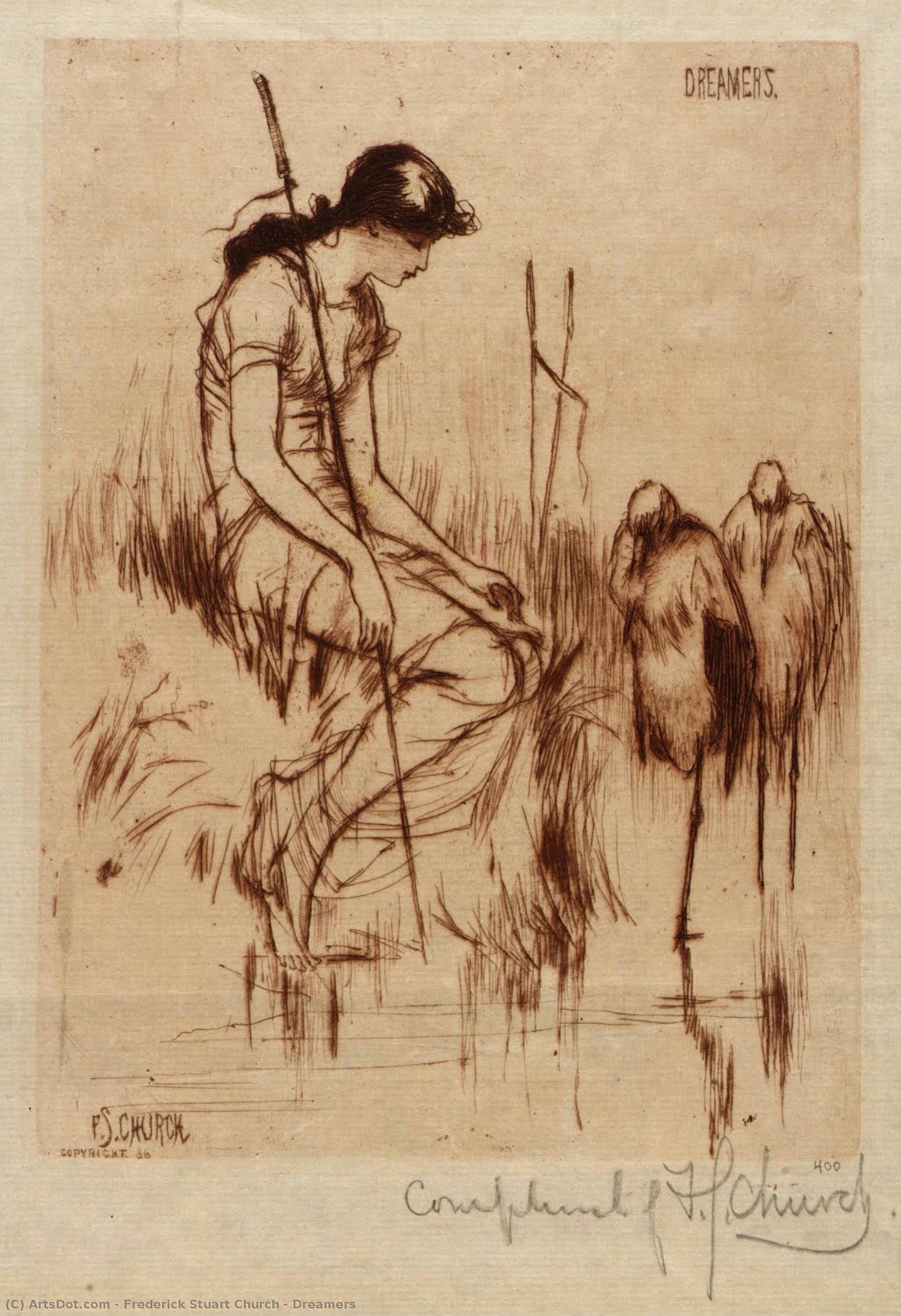
In the delicate interplay of light and shadow found within Dreamers, we encounter the profound mastery of Frederick Stuart Church, an artist who possessed the rare ability to bridge the gap between the tangible world and the realm of symbolic allegory. Painted in 1886, this captivating work invites the viewer into a quiet, pastoral sanctuary where the boundaries between humanity and nature begin to dissolve. The scene centers on a woman seated gracefully upon the earth, her gaze fixed with an intimate, almost spiritual intensity upon a bird perched before her. This is not merely a depiction of a moment in time; it is an invitation to contemplate the deep, unspoken connections that bind all living creatures within the tapestry of existence.
Church’s technique, refined through his rigorous training at the Academy of Design in Chicago, allows for a breathtakingly soft rendering of texture and atmosphere. The grassy expanse surrounding the central figures feels alive, breathing with the quiet energy of an afternoon spent in reverie. As the eye wanders across the canvas, it discovers other avian companions—one resting near the right periphery and another drifting into the background—creating a sense of depth and a layered narrative of companionship. The presence of other figures in the distance adds a layer of social complexity to the scene, yet they remain secondary to the profound, silent dialogue occurring between the woman and her feathered interlocutor.
Symbolism and the Romantic Spirit
To understand Dreamers is to understand the late 19th-century fascination with Symbolism and the Romantic movement. Church was far more than a mere illustrator; he was a storyteller who used animals as vessels for moral and emotional truths. In this piece, the birds serve as much more than decorative elements; they act as messengers of the subconscious, representing the fleeting nature of thoughts and the purity of the soul. The woman’s contemplative posture suggests a state of "dreaming" while awake—a hallmark of the era's fascination with the inner life and the spiritual dimensions of the natural world.
For the discerning collector or interior designer, this painting offers an unparalleled emotional resonance. Its palette, characterized by the soft, organic tones of the late Victorian era, provides a sense of tranquility and timelessness that can anchor any sophisticated space. Whether placed in a sunlit study or a quiet library, a high-quality reproduction of Dreamers serves as a window into a more contemplative age. It is a piece that does not merely decorate a wall but enriches the atmosphere of a room, prompting guests to pause, reflect, and perhaps, like the figures within the painting, lose themselves in a moment of beautiful, silent dreaming.