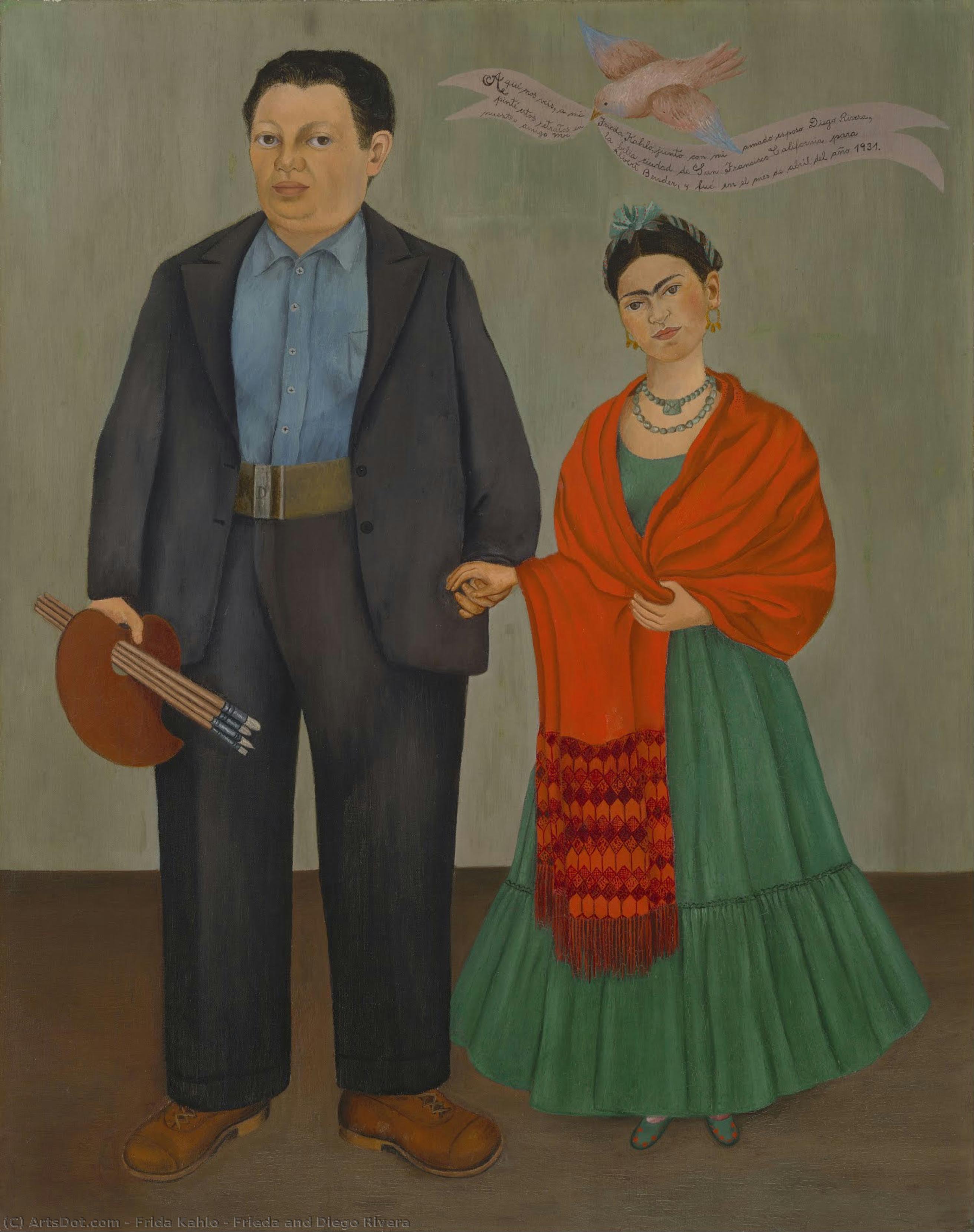
The painting exemplifies Kahlo’s innovative approach to portraiture, considering Rivera's considerable height and age difference compared to Kahlo. It underscores the importance of individual expression within a broader context of modern art history.
Explore Frida Kahlo's iconic art (1907-1954): self-portraits, surrealism & Mexican heritage. Discover themes of identity, pain, resilience & her feminist legacy.
Explore SFMOMA's iconic modern & contemporary art collection – featuring Matisse, Picasso, Warhol & more! Discover groundbreaking exhibitions and architectural marvels in San Francisco’s SoMa district.
A Dialogue Between Resilience and Iconography: Frida Kahlo’s “Frieda and Diego Rivera”
This striking portrait by Frida Kahlo, completed in 1931 during her transatlantic journey with Diego Rivera to San Francisco, transcends mere representation; it embodies a profound meditation on identity, partnership, and the artist's unwavering gaze at the monumental figure of modernism. More than just capturing two individuals standing together, Kahlo meticulously crafted an image laden with symbolic gestures that speak volumes about her artistic vision and the broader anxieties surrounding femininity within the burgeoning art world of the early 20th century.
The Compositional Dance: Scale and Gesture
Kahlo’s masterful use of scale is immediately arresting. Rivera dominates the canvas, positioned firmly on the floor plane—a deliberate assertion of his stature as a celebrated muralist and intellectual powerhouse. Conversely, Kahlo herself appears diminutive beside him, seemingly suspended in space, anchored only by Rivera's outstretched hand. This visual juxtaposition isn’t merely accidental; it underscores Kahlo’s awareness of Rivera’s influence and her desire to situate herself within the context of his artistic legacy. The tilt of Kahlo’s head toward Rivera is equally significant—a gesture of acknowledgment and deference, yet simultaneously conveying a quiet defiance, hinting at an unspoken dialogue between woman and man, artist and icon.
Style and Technique: Sparse Ornamentation, Powerful Emotion
Kahlo eschews elaborate ornamentation characteristic of many portraits of her era, opting instead for a restrained aesthetic that prioritizes emotional resonance over superficial grandeur. Her technique—primarily oil paint on canvas—is characterized by meticulous detail and subtle tonal variations, reflecting Kahlo’s painstaking approach to capturing the essence of her subjects. The muted palette contributes to the painting's contemplative mood, allowing the viewer to focus on the expressive faces and gestures of Kahlo and Rivera. Notably, Kahlo employs traditional compositional devices – scale, perspective—to elevate her subject matter within a larger artistic framework.
Historical Context: Femininity Amidst Modernism
“Frieda and Diego Rivera” emerges from a pivotal moment in art history—the rise of modernism and the burgeoning debate surrounding the role of women artists. Kahlo’s decision to portray herself alongside Rivera, a towering figure of Mexican muralism, is itself a subversive act. It acknowledges Rivera's influence while simultaneously asserting Kahlo’s own artistic voice within a predominantly male domain. The banderole bearing the inscription “Here you see us…” serves as a declaration of independence—a testament to Kahlo’s refusal to conform to societal expectations and her unwavering commitment to portraying herself authentically, confronting pain and vulnerability with unflinching honesty.
Symbolism: Palette, Brush, and Gesture
The inclusion of Rivera's palette and brush is particularly potent symbolism. These tools represent his artistic vocation and intellectual prowess—a visual shorthand for the creative force that defines him. Kahlo’s hand clasping Rivera’s symbolizes intimacy and connection, yet also subtly underscores her position as subordinate to his dominant presence. The doves perched above the couple are emblems of peace and hope—a poignant reminder of the enduring power of love amidst adversity. Ultimately, “Frieda and Diego Rivera” is a masterpiece of understated emotion and symbolic richness, cementing Frida Kahlo’s place as one of the most compelling voices in 20th-century art.