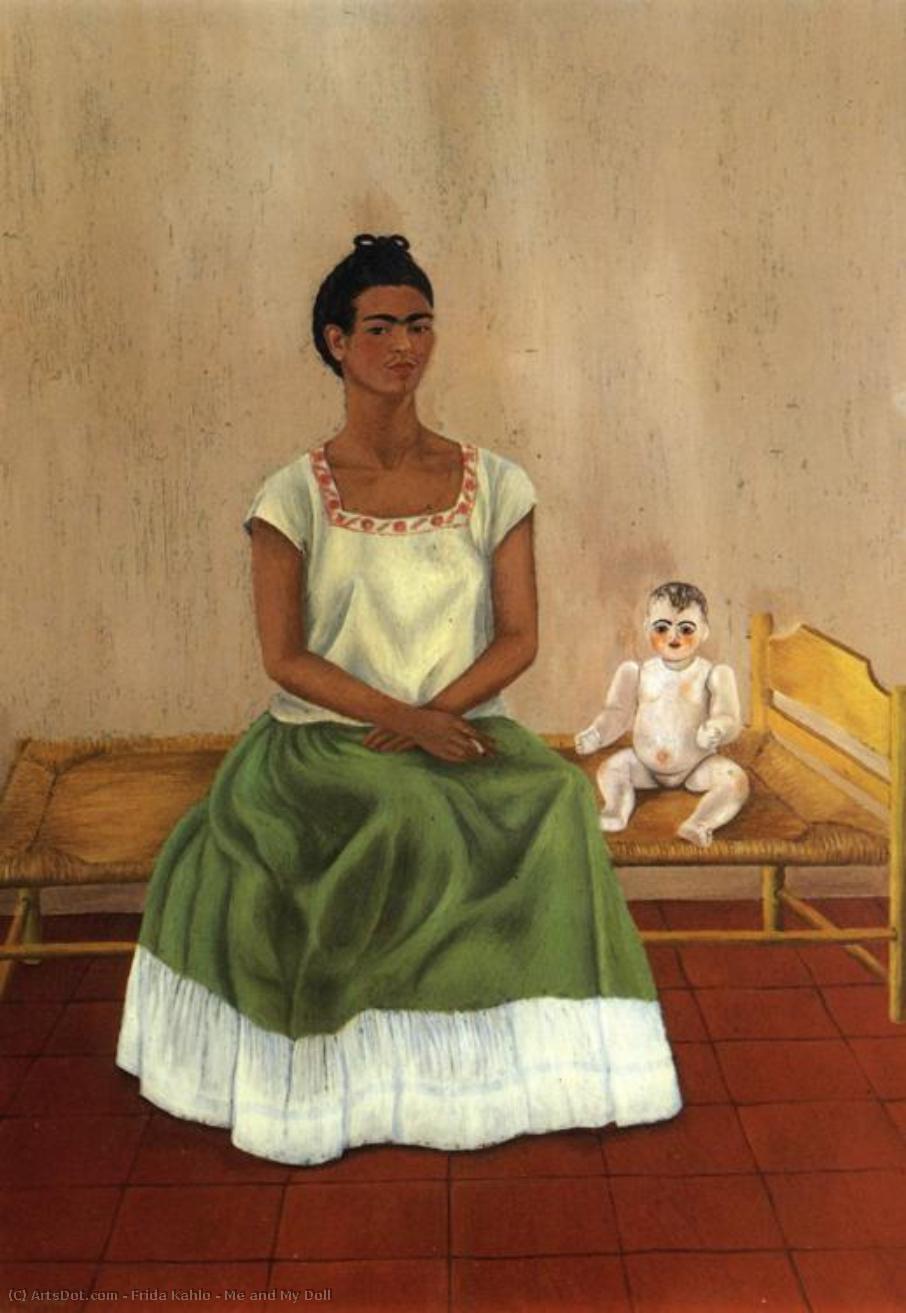
A Tender Reflection on Motherhood and Resilience: Frida Kahlo’s ‘Me and My Doll’
Frida Kahlo's “Me and My Doll,” painted in 1937, transcends mere portraiture; it embodies a profound meditation on femininity, vulnerability, and the enduring spirit of motherhood. This striking artwork captures Kahlo seated serenely upon a simple wooden bench against a muted yellow wall adorned with patterned tiles—a deliberate choice mirroring the aesthetic traditions of Mexican folk art. The composition prioritizes Frida herself, establishing her as the focal point and immediately commanding the viewer’s gaze. Linear lines dominate the visual landscape, delineating the contours of Frida's figure, the bench, and the architectural backdrop, while organic shapes – particularly those found in the folds of Kahlo’s skirt and the subtle curves of her torso – imbue the scene with warmth and naturalism.
- Style: The painting adheres to a realist style infused with elements characteristic of Mexican muralism and folk art traditions. Bold colors are eschewed in favor of muted tones, reflecting Kahlo’s preference for understated beauty and conveying a sense of quiet contemplation.
- Technique: Executed in oil on canvas, “Me and My Doll” showcases Kahlo's masterful brushwork—visible strokes contribute to textural richness and depth, particularly noticeable in the fabric of her dress and skin tones. This technique lends an immediacy and authenticity to the depiction, mirroring the tactile qualities found in traditional Mexican art forms.
- Historical Context: Created during a period marked by Kahlo’s ongoing physical struggles following a debilitating bus accident—a trauma that profoundly shaped her artistic vision—the painting serves as a testament to her unwavering determination to portray life's complexities with unflinching honesty. It reflects the broader cultural preoccupation with themes of suffering and perseverance prevalent in Mexican art history.
The inclusion of a doll – Kahlo’s infant son Diego Rivera Jr.—represents more than just a child; it symbolizes innocence, vulnerability, and the nurturing role of motherhood—themes central to Kahlo's artistic exploration of identity and experience. The doll’s presence alongside Frida underscores her steadfast connection to familial bonds amidst adversity. Symbolically, Kahlo utilizes visual cues to convey resilience and inner strength—a characteristic that resonates powerfully with viewers today.
“Me and My Doll” is a poignant reminder of Kahlo's ability to transform personal pain into artistic brilliance, inviting contemplation on themes of femininity, motherhood, and the enduring human spirit.