The Enigmatic Gaze: Frida Kahlo’s “Self Portrait with Stalin”
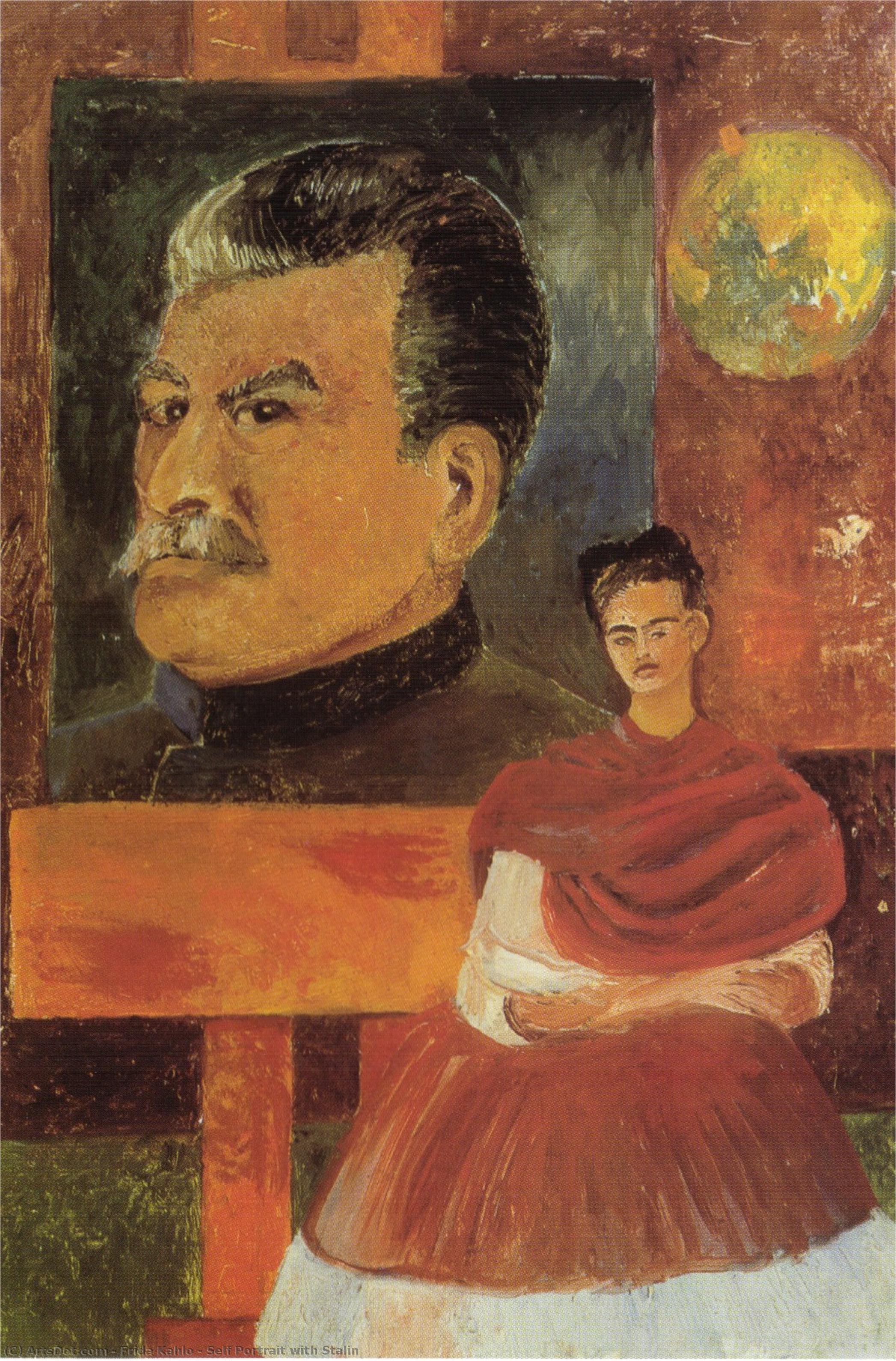
Frida Kahlo's "Self Portrait with Stalin," painted in 1954, is not merely a depiction of the artist; it’s a complex and unsettling meditation on power, ideology, and the fraught relationship between personal identity and political allegiance. This relatively small canvas – measuring just 59 x 39 centimeters – holds within it a potent visual dialogue that continues to resonate with viewers today. The painting immediately draws attention to Frida herself, posed in a vibrant red dress, her arms crossed in a gesture of both defiance and introspection. Her gaze is directed firmly towards a large portrait of Joseph Stalin hanging in the background, an image rendered largely indistinct – his face obscured, yet his presence undeniably commanding. This deliberate ambiguity is crucial; it’s not about celebrating Stalin, but rather about confronting him, interrogating his authority, and revealing the artist's own conflicted position within the turbulent political landscape of her time.
Painted during a period when Kahlo was grappling with declining health and shifting political alliances – she had recently undergone multiple surgeries and was increasingly disillusioned with the Communist Party – “Self Portrait with Stalin” offers a rare glimpse into her inner turmoil. The choice of Stalin as the subject is particularly striking, given Kahlo’s known Marxist leanings and her admiration for communist ideals. However, the painting isn't a straightforward endorsement; instead, it suggests a critical engagement with the realities of power and the potential dangers of totalitarian regimes. The red dress, typically associated with revolution and passion, here feels tinged with unease, juxtaposed against the imposing figure of Stalin – a symbol of oppression and control.
Primitivist Style and Symbolic Resonance
Executed on masonite, a relatively inexpensive material that allowed Kahlo to work quickly and directly, “Self Portrait with Stalin” exemplifies her distinctive primitivist style. This approach, characterized by bold colors, simplified forms, and an emphasis on symbolic representation rather than meticulous realism, was deeply rooted in Mexican folk art traditions. Kahlo drew inspiration from pre-Columbian imagery and indigenous motifs, infusing her work with a sense of cultural pride and a rejection of European artistic conventions. The painting’s palette is deliberately vibrant – reds, blues, and yellows dominate – creating a visually arresting effect that mirrors the intensity of Kahlo's emotional experience.
Beyond the stylistic elements, “Self Portrait with Stalin” is laden with symbolism. The positioning of Frida in relation to Stalin—her gaze fixed upon him—suggests a confrontation, a questioning of his authority and legacy. The obscured face of Stalin adds another layer of complexity, hinting at the unknowability of power and the potential for manipulation. Some art historians have interpreted the painting as an allegory for Kahlo’s own internal struggles – her battle with illness, her complex relationship with Diego Rivera, and her attempts to reconcile her personal identity with broader political ideologies.
A Window into a Complex Era
Created in 1954, “Self Portrait with Stalin” reflects the anxieties and uncertainties of post-World War II Europe. The Cold War was intensifying, and ideological divisions were deepening across the globe. Kahlo’s painting serves as a poignant reminder of this era's political tensions and the challenges faced by artists attempting to navigate complex social and political landscapes. It is a testament to her ability to transform personal experience into powerful artistic statements, offering viewers a unique perspective on history and human nature.
At ArtsDot, we are proud to offer meticulously crafted oil painting reproductions of “Self Portrait with Stalin,” allowing art enthusiasts to bring this iconic work into their own homes. Each reproduction is created by skilled artisans using traditional techniques, ensuring that it captures the essence of Kahlo’s original vision with remarkable fidelity. Explore our collection today and discover a piece of art history that continues to provoke thought and inspire dialogue.