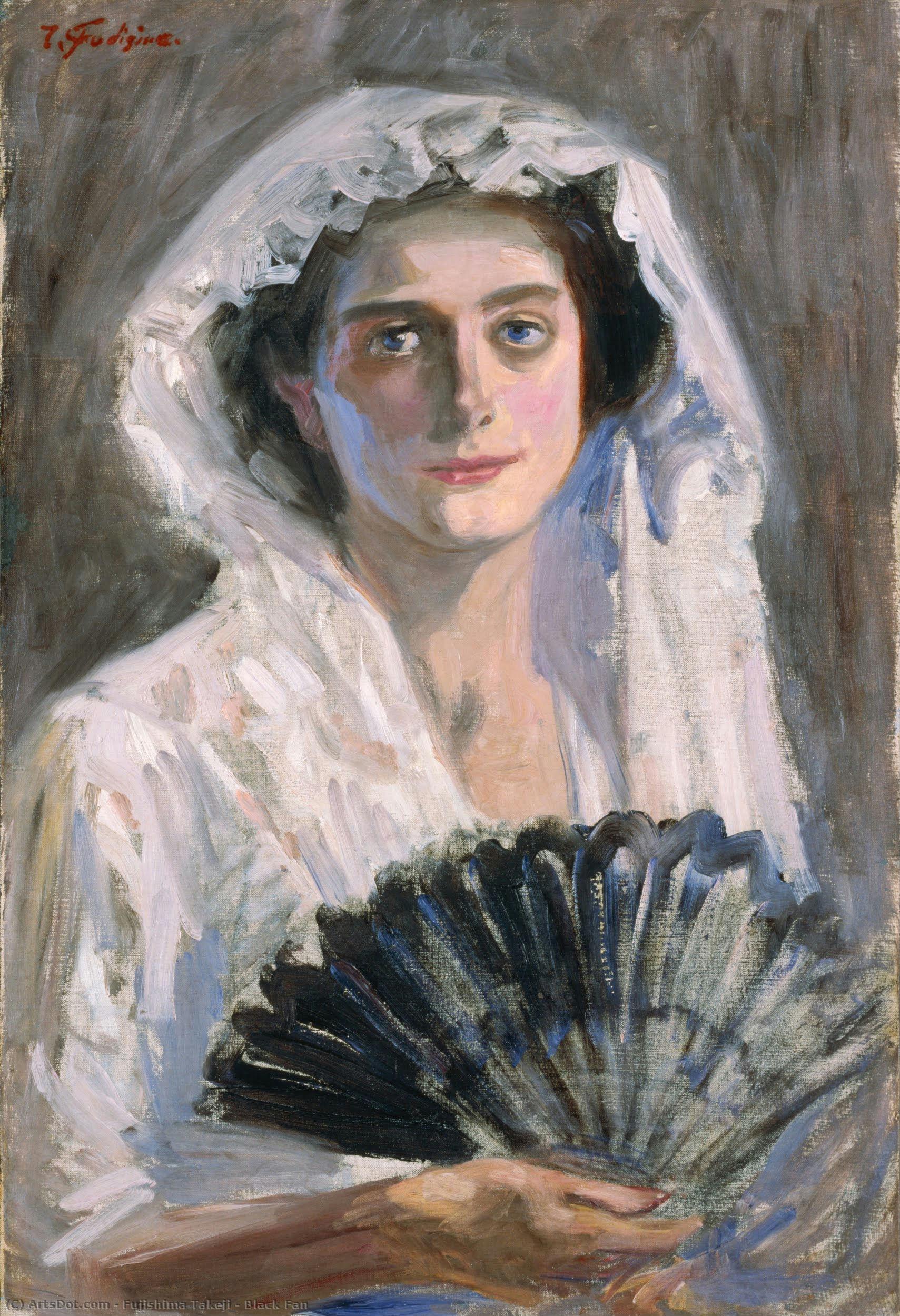
Fujishima Takeji's 'Black Fan,' painted in 1909, showcases a woman gracefully adorned with a white veil and clutching a black fan. Inspired by the taste for Spanish culture, the painting utilizes vibrant hues and dynamic brushstrokes to convey elegance and mystery, embodying the artist’s signature style.
Discover Fujishima Takeji (1867-1943), a pivotal figure in Japanese Yōga painting. Explore his romantic, post-impressionist & Art Nouveau masterpieces like 'Mourning for Butterflies,' bridging Eastern and Western art traditions.
Explore Impressionist dreams & modern visions at Artizon Museum Tokyo! Featuring masterpieces by Monet, Van Gogh & Picasso alongside Japanese art and Ancient Greek ceramics – a cultural journey awaits.
The Enigma of Black Fan
To gaze upon Fujishima Takeji's "Black Fan" is to step directly into a moment suspended between cultures and memories. This magnificent painting, executed in 1909, captures a portrait of profound mystery embodied by a woman adorned with an ethereal white veil. The subject commands attention not merely through her presence, but through the exquisite tension held within the objects she carries—most notably, the striking black fan. Fujishima’s connection to this piece was deeply personal; it remained with him until his final days, suggesting that the canvas itself served as a tangible anchor to cherished memories of Italy, a place that clearly resonated profoundly within his artistic soul.
A Tapestry of Color and Technique
Technically, the painting is a masterclass in controlled contrast. While Fujishima worked with what might appear to be a restricted palette, it is precisely the deliberate placement of vibrant hues that elevates the work from mere depiction to high art. Observe the luminous quality achieved through his use of translucent blue for shadows, juxtaposed against the startling brightness of pink highlighting her left cheek. These accents draw the eye immediately, guiding the viewer across the delicate contours of her face. The contrast between the stark white veil and the deep void of the black fan is breathtaking; the brushwork applied to both elements possesses a palpable sense of speed and contained power, suggesting an almost kinetic energy barely restrained.
Symbolism and Cultural Echoes
The interplay of these symbolic elements—the veil, the fan, the Italian setting—suggests a rich confluence of influences. The white veil and the black fan are often interpreted by scholars as reflecting a distinct taste for Spanish aesthetics, lending the portrait an air of exotic drama. Her gaze, directed outward toward the viewer, is not confrontational but rather deeply intriguing, inviting speculation about her thoughts. Coupled with the striking features—the firm red lips set against the cool blue of her eyes—the painting becomes less a likeness and more an allegory for veiled emotion and cultural exchange.
Bringing Italian Romance Home
For the collector or designer seeking to infuse a space with the romance of turn-of-the-century European artistry filtered through Japanese genius, "Black Fan" offers unparalleled depth. Its scale, spanning impressively across the frame, ensures it functions as a monumental focal point. Owning a reproduction allows one to possess not just a painting, but a narrative—a story of an artist bridging worlds, capturing the fleeting beauty of a moment steeped in foreign allure and personal devotion. It is a piece that whispers tales of sun-drenched Italian afternoons and artistic obsession.