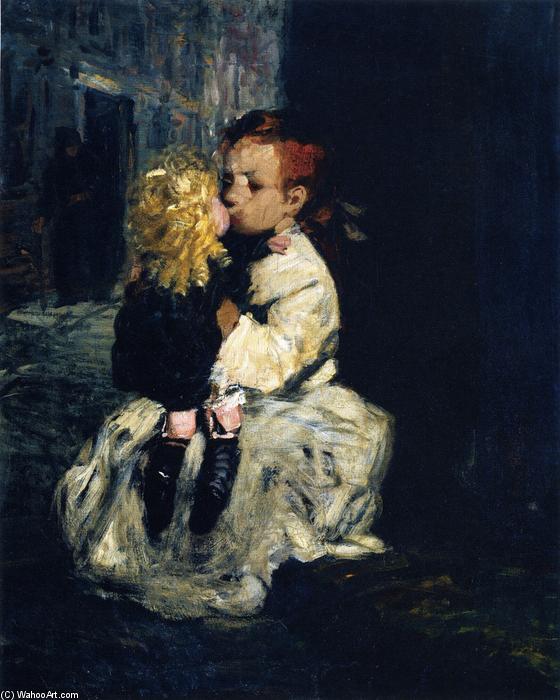
Admire 'The Little Madonna' by George Benjamin Luks (1907). A captivating black & white portrait of children, capturing innocence and affection. Hand-painted reproduction available.
Discover George Luks (1867-1933), a leading figure of the Ashcan School, renowned for his gritty and vibrant depictions of early 20th-century American urban life. Explore his powerful paintings today!
Explore American art from Copley to Pollock at the Addison Gallery of American Art in Andover, MA! Free admission & diverse collections including photography & ship models.
A Tender Moment Captured in Black & White: Exploring George Benjamin Luks’s “The Little Madonna”
George Benjamin Luks (1867 – 1933), a pivotal figure in American Realism, didn't merely depict scenes; he wrestled them onto canvas with unflinching honesty and profound empathy. Born in Williamsport, Pennsylvania, to Polish and German immigrant parents, Luks’s formative years instilled within him an unwavering commitment to portraying the realities of ordinary life – a dedication that would define his artistic legacy. Before dedicating himself to painting, he collaborated with his brother as vaudeville performers, cultivating a keen observational eye honed by witnessing the dynamism and vulnerability inherent in performance itself. This experience profoundly shaped his approach to art, informing his ability to capture not just what was seen but also what felt.
The Artwork: A Portrait of Innocence
“The Little Madonna,” completed in 1907, exemplifies Luks’s signature Ashcan School style – a movement that rejected academic conventions and championed gritty depictions of urban life. The painting portrays two young girls embracing on the cheek, bathed in soft light within an interior setting. Their postures convey tenderness and affection, capturing a fleeting moment of connection amidst the complexities of existence. The artist's masterful use of black and white lends the image a timeless quality, emphasizing form and texture rather than coloristic illusion. The simplicity of the composition underscores the profound emotional resonance of the scene.
Technique & Style: Ashcan Realism at Its Finest
Luks employed meticulous brushwork to achieve remarkable detail, particularly in capturing the subtle nuances of facial expressions and drapery folds. He utilized thick impasto – applying paint thickly onto the canvas – creating a palpable sense of physicality and texture that distinguishes his work from more polished styles prevalent during the period. The deliberate absence of color contributes significantly to the painting’s mood; it forces viewers to focus on the interplay of light and shadow, amplifying the emotional impact of the image. This technique reflects Luks's belief in conveying truth through direct observation and honest representation.
Historical Context: Embracing Urban Decay
“The Little Madonna” emerged during a period of significant social upheaval in America – the Progressive Era – characterized by growing concerns about poverty, inequality, and urban blight. The Ashcan School artists deliberately rejected idealized representations of society, choosing instead to depict the realities faced by marginalized communities. Luks’s work served as a powerful critique of Victorian morality and aspiration, presenting an alternative vision rooted in compassion and understanding for those struggling to survive amidst challenging circumstances. It stands as a testament to the enduring power of art to provoke reflection and inspire empathy.
Symbolism & Emotional Impact: A Celebration of Human Connection
Beyond its technical brilliance, “The Little Madonna” resonates deeply with viewers due to its evocative symbolism. The embrace between the girls represents unconditional love and affection – values championed by Luks’s humanist worldview. The muted palette reinforces this sentiment, conveying a sense of serenity and vulnerability. More than just a depiction of two children, the painting speaks to universal themes of innocence, compassion, and the beauty found in simple human connections. It invites contemplation on the importance of empathy and reminds us that even amidst hardship, moments of tenderness can illuminate our lives.
Conclusion: An Enduring Legacy
George Benjamin Luks’s “The Little Madonna” remains a cornerstone of American Realism, demonstrating his unwavering commitment to portraying the human condition with unflinching honesty and profound sensitivity. Its enduring appeal lies in its ability to capture a poignant moment of connection—a testament to Luks's artistic vision and a timeless reminder that beauty can be found even within the darkest corners of our world. Hand-painted reproductions offer an opportunity to experience this masterpiece firsthand, preserving its emotional impact for generations to come.