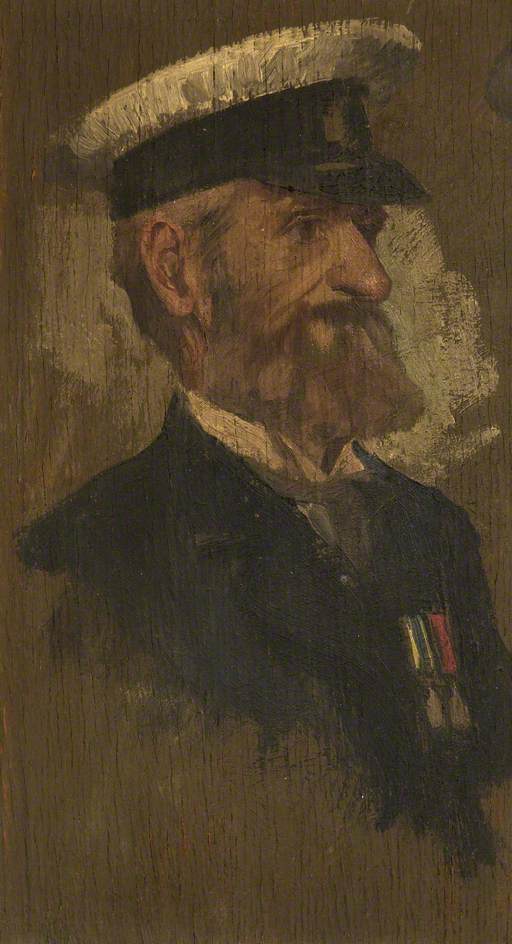
George Edmund Butler’s Portrait of Rifle Brigade Sergeant
The painting “E. Gillard, Rifle Brigade” by George Edmund Butler (1872–1936) stands as a testament to the artist's dedication to documenting the realities of World War I through evocative landscapes and portraits. Executed around 1920, this oil on panel captures Sergeant E. Gillard, a soldier serving with the Rifle Brigade, in a strikingly realistic depiction that transcends mere representation—it aims to convey a profound sense of character and resilience amidst the backdrop of conflict. Butler’s artistic journey began in Southampton, England, where he absorbed influences from Impressionism and Neo-Romanticism before embarking on a transformative relocation to Wellington, New Zealand, in 1883. This move cemented his connection to the burgeoning artistic spirit of Australasia and fueled his ambition to hone his craft through rigorous academic training at Otago University.
Butler’s stylistic approach leaned heavily toward Luminist painting—a movement characterized by its emphasis on capturing atmospheric conditions and conveying a sense of tranquility despite depicting subjects in challenging circumstances. The artist skillfully employs muted tonal palettes, dominated by earthy browns and greens, mirroring the rugged terrain of New Zealand during the war years. These colors aren't merely decorative; they serve to heighten the emotional impact of the portrait, fostering contemplation on themes of duty, fortitude, and the enduring spirit of the human condition. Butler’s meticulous brushwork—visible in the textured surface of the panel—captures subtle nuances of light and shadow, lending depth and realism to Gillard's visage.
The composition itself is carefully considered. Gillard is positioned centrally within a landscape setting—a deliberate choice that underscores his connection to both the individual and the collective experience of war. The soldier’s gaze directs upwards, suggesting introspection and perhaps longing for solace amidst the hardships faced by those on the front lines. Butler's attention to detail extends beyond mere anatomical accuracy; he subtly incorporates symbolic elements into the scene—the posture of Gillard embodies unwavering resolve, while the surrounding foliage symbolizes hope and regeneration.
Beyond its aesthetic merits, “E. Gillard, Rifle Brigade” holds significant historical importance as one of Butler’s official war artist commissions for the New Zealand Expeditionary Force (NZEF). This project demanded a commitment to portraying not only the physical landscape but also the psychological state of soldiers—a task Butler undertook with remarkable sensitivity and artistic integrity. The painting exemplifies the Luminist tradition's ability to convey emotion through visual observation, cementing Butler’s legacy as a pivotal figure in New Zealand art history and offering viewers a poignant glimpse into the spirit of a nation confronting its greatest challenge.
- Artist: George Edmund Butler
- Born Year: 1872
- Death Year: 1936
- Birth City: Southampton
- Birth Country: United Kingdom
Additional Research Links
Artwork Details
Title: E. Gillard, Rifle Brigade
Date: c.1920
Medium: Oil on panel
Dimensions: H 22.7 x W 12.9 cm
Accession Number: K6349.5.5
Acquisition Method: Bequeathed by Alderman James Fuller Eberle, 1939
Collection: Bristol Museums, Galleries & Archives
Image Information
Copyright Information
© Bristol Museums, Galleries & Archives