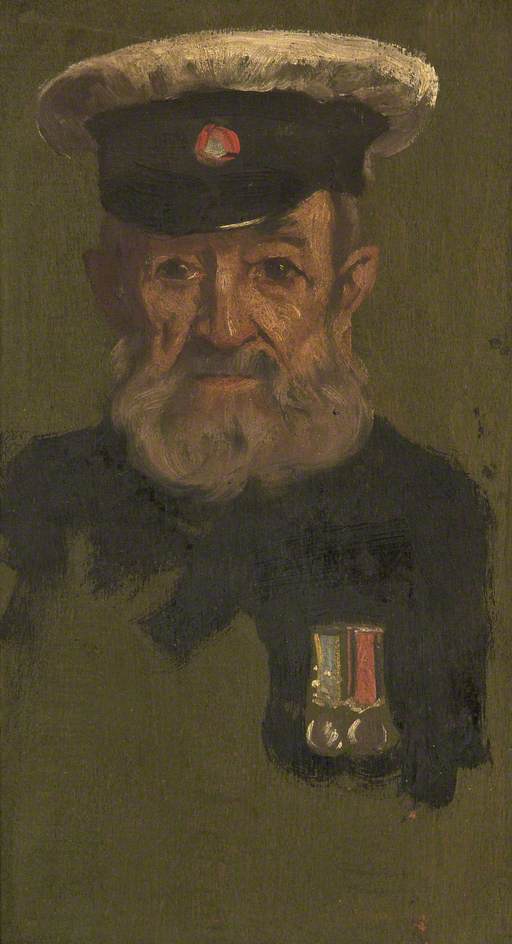
A Portrait of Quiet Authority: J. Smith, 4th RA by George Edmund Butler
George Edmund Butler’s “J. Smith, 4th RA” is more than just a portrait; it's a carefully constructed tableau of understated power and dignified contemplation. Painted in 1920, during the twilight years of the Edwardian era, this oil-on-canvas work offers a rare glimpse into the character of a military officer – a man whose authority isn’t proclaimed through grand gestures but rather radiates from a quiet confidence etched onto his face and reflected in his bearing. The painting immediately draws the eye to its subject: a distinguished gentleman, identified as J. Smith, 4th Royal Artillery, presented against a subtly textured green background that suggests both the formality of military life and the verdant landscapes of New Zealand – Butler’s adopted homeland.
Butler's artistic approach is characterized by a remarkable restraint. He eschews dramatic lighting or elaborate ornamentation, instead favoring a muted palette dominated by deep browns, blacks, and subtle greens. This deliberate simplicity allows the viewer to focus entirely on the subject’s face – a study in wrinkles, lines, and the gentle curve of his lips that speak volumes about experience and wisdom. The artist's brushwork is precise yet fluid, creating a sense of texture and depth while maintaining an overall feeling of calm and control. Notice how Butler captures the subtle play of light on Smith’s uniform, highlighting its rich fabric and emphasizing the officer’s status.
The Artist’s Journey: A New Zealand Perspective
Understanding George Edmund Butler requires acknowledging his unique life story – a journey that intertwined British artistic training with a deep connection to New Zealand. Born in Southampton in 1872, he emigrated to Wellington at the age of eleven, an experience that profoundly shaped his artistic sensibilities. This relocation instilled within him a keen appreciation for the landscapes and people of Aotearoa, which would later inform much of his work. Butler’s formal training included studies at prestigious institutions like the Antwerp Academy, but it was in New Zealand that he truly found his voice as an artist, developing a distinctive style rooted in observation and empathy.
Crucially, Butler's career took a significant turn during World War I when he was appointed an official war artist for the New Zealand Expeditionary Force (NZEF). This role provided him with unparalleled access to the realities of conflict, documenting the experiences of young men far from home. “J. Smith, 4th RA” can be viewed as a microcosm of this broader project – a portrait that transcends mere likeness and embodies the stoicism and resilience demanded by military service. The painting’s quiet dignity reflects the values Butler sought to capture in his wartime observations.
Symbolism and Emotional Resonance
Beyond its technical merits, “J. Smith, 4th RA” is rich in symbolic meaning. The medal pinned to Smith's chest – a clear indication of distinguished service – represents not only military achievement but also honor, loyalty, and sacrifice. The captain’s hat, a traditional symbol of authority, reinforces the officer’s position within the ranks. However, Butler avoids portraying Smith as an imposing figure; instead, he presents him as a man of quiet strength and unwavering resolve.
The painting's emotional impact is subtle yet profound. It evokes a sense of respect for the individual and a poignant awareness of the burdens carried by those who serve their country. There’s a feeling of melancholy, perhaps reflecting the realities of war and the passage of time, but also an underlying current of hope – a testament to the enduring spirit of humanity. The gaze of the subject is direct yet not confrontational, inviting the viewer into a moment of quiet contemplation.
A Legacy in Reproduction: Bringing Butler’s Vision to Life
Reproductions of “J. Smith, 4th RA” offer an exceptional opportunity to experience the artistry and insight of George Edmund Butler firsthand. The meticulous detail captured by Butler's brushwork is faithfully reproduced in high-quality prints, allowing viewers to appreciate the nuances of his technique and the depth of his artistic vision. Whether displayed in a private study or incorporated into a larger collection, this portrait serves as a powerful reminder of a remarkable artist and a significant chapter in New Zealand’s cultural heritage. Consider commissioning a hand-painted reproduction – a truly unique way to honor Butler's legacy and bring this evocative work into your own space.