A Nocturnal Symphony in Shadow and Light
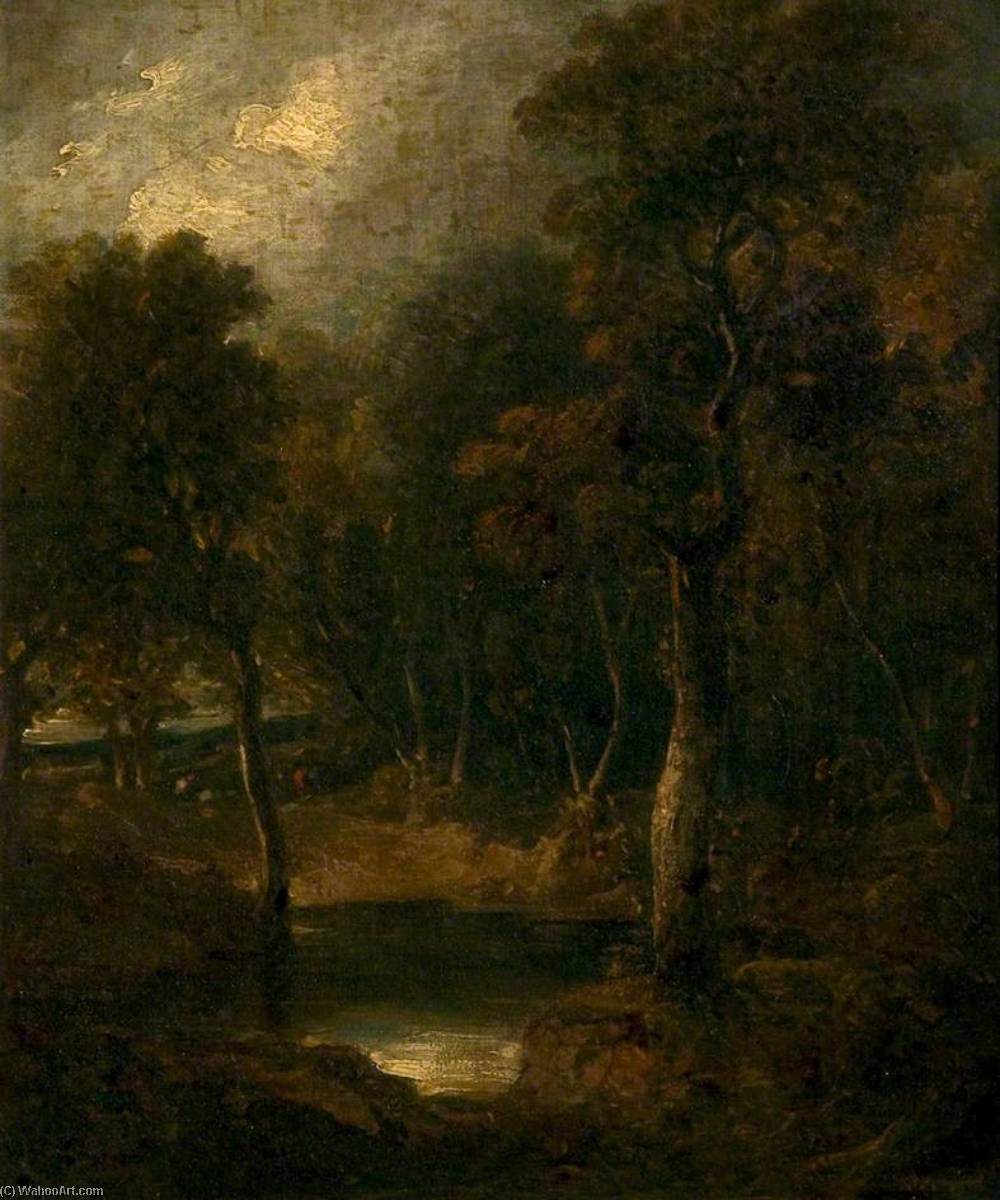
In the quiet depths of George Howland Beaumont’s Wooded Landscape, one finds oneself transported to a realm where the boundaries between reality and dream begin to dissolve. Painted around 1810, this evocative work captures a dense, primordial forest clinging to the edge of a silent riverbank. The composition is masterfully orchestrated to evoke a sense of profound solitude; there is no human presence to disrupt the sanctity of the scene, only the rhythmic interplay of ancient trees and the subtle movement of water. The palette is dominated by a somber, nocturnal spectrum of deep umbers, mossy greens, and obsidian blacks, creating an atmosphere that is at once mysterious and deeply tranquil. As the eye wanders through the thicket, it encounters a diffused, ethereal glow—perhaps the soft light of a hidden moon—which dances upon the water’s surface, providing a singular point of luminous relief amidst the surrounding gloom.
The technique employed by Beaumont is a testament to the expressive power of the Romantic movement. Rather than striving for the clinical precision of topographical realism, the artist utilizes a loose, painterly approach that prioritizes emotional resonance over mere imitation. Visible, textured brushstrokes build layers of pigment upon the canvas, lending a tactile quality to the foliage and a sense of organic vitality to the river’s edge. This heavy emphasis on texture allows the viewer to feel the ruggedness of the bark and the fluid weight of the water. The flattened perspective, characteristic of the era's landscape traditions, draws the observer into a more intimate, almost claustrophobic encounter with nature, forcing a confrontation with the sublime power of the untamed wild.
Symbolism and the Romantic Spirit
Beyond its visual allure, Wooded Landscape serves as a profound meditation on the human condition and our relationship with the natural world. Within the context of early 19th-century Romanticism, the darkness of the forest can be interpreted as a symbol of introspection or the vast, unexplored territories of the subconscious mind. The river, flowing steadily through the shadows, acts as a powerful metaphor for transition, time, and the inexorable flow of life. There is a palpable tension between the heavy, grounded presence of the trees and the fleeting, ephemeral light reflecting off the water—a duality that speaks to the struggle between permanence and change.
For the discerning collector or interior designer, this piece offers more than just aesthetic beauty; it provides an emotional anchor for a space. Its moody, atmospheric qualities make it an ideal centerpiece for a study, a library, or a sophisticated lounge where one seeks to cultivate an environment of reflection and quiet grandeur. As a high-quality reproduction, it brings the historical weight and soulful depth of Beaumont’s vision into the modern home, offering a window into a bygone era of artistic passion and a timeless appreciation for the mysteries held within the shadows of the natural world.