Discover George Romney (1734-1802), the celebrated British portrait painter of high society! Explore his elegant style, captivating portraits & muse, Emma Hamilton. Shop reproductions now!
Discover England's rich history at English Heritage! Explore iconic castles, palaces & gardens across the UK. Family fun, events & heritage await – plan your visit today!
The Quiet Dignity of Domestic Industry
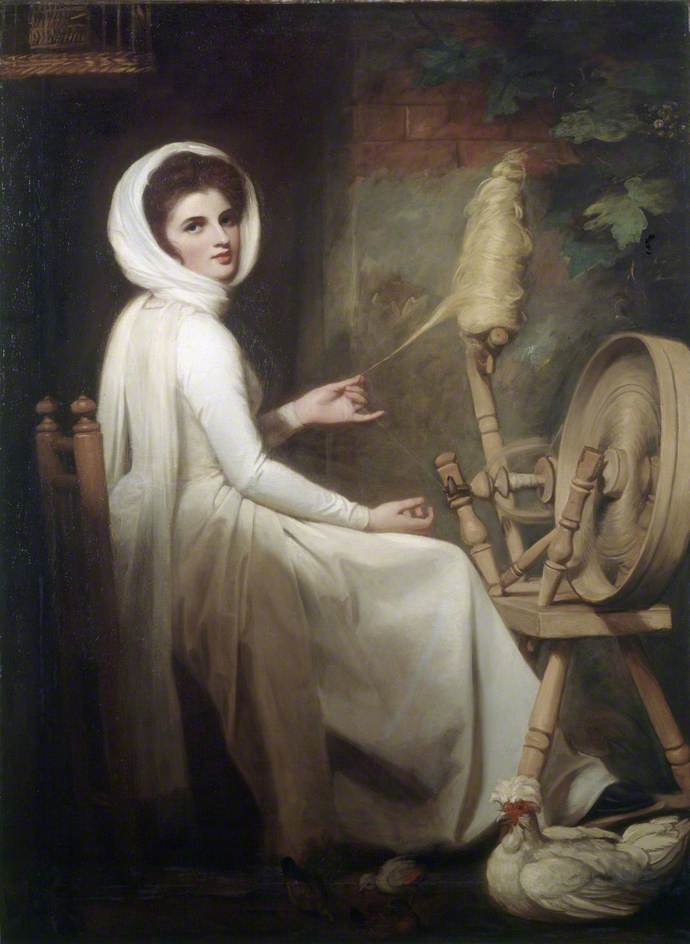
To gaze upon George Romney's depiction of Emma Hart as The Spinstress is to step into an exquisitely rendered moment of 18th-century domestic life. This portrait transcends a mere likeness; it is a carefully composed meditation on labor, femininity, and the quiet dignity inherent in skilled craft. The sitter occupies the center stage, bathed in what appears to be diffused, almost ethereal studio light. Her gentle gaze meets the viewer’s eye with a composure that speaks volumes of her station and spirit. Romney masterfully frames this moment, allowing the tools of her trade—the spinning wheel and spindle—to become integral parts of her narrative, rather than mere props.
A Study in Texture and Form
Technically, the painting is a testament to Romney's skill with oil on canvas. One can almost feel the contrast between the materials depicted: the smooth, luminous fall of Emma Hart’s creamy white drapery against the implied roughness of the wooden chair and the intricate mechanics of the spinning wheel. The artist employs soft, flowing lines to define the organic curves of the human form, which are beautifully juxtaposed against the more rigid, circular geometry of the machinery. While the background recedes into a muted shadow, creating an illusion of depth through tonal contrast, it is the subtle interplay between these defined and undefined spaces that gives the piece its sophisticated visual rhythm.
Historical Echoes and Symbolic Weight
Painted around 1785, this work situates itself firmly within the tradition of formal portraiture, yet imbues it with a distinctly modern resonance. The title itself, 'The Spinstress,' elevates the act of spinning from mundane chore to symbolic representation. In the context of Georgian society, such depictions often served to idealize female virtue and industry. Romney captures this societal expectation—the notion that a woman’s worth was intrinsically linked to her domestic diligence. Yet, Emma Hart herself possesses an inner life suggested by her expression, hinting at a spirit that is perhaps more complex than the yarn she spins.
Bringing the Salon Home
For the discerning collector or interior designer, this reproduction offers far more than just decoration; it offers conversation. The palette—dominated by soft creams, muted browns, and deep background shadows—is inherently harmonious, allowing it to anchor a room with historical gravitas without overwhelming contemporary decor. Imagine its presence in a drawing-room or study: the subtle narrative of industry meeting portraiture adds an intellectual layer to any space. It invites contemplation on time passing, skill maintained, and the enduring grace found within everyday pursuits.