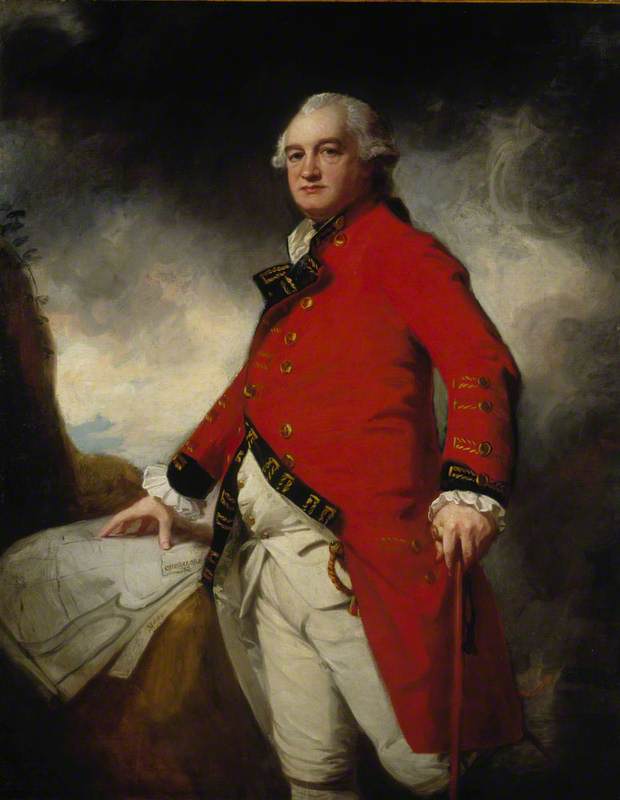
George Romney's Portrait of Major General James Stuart – A Study in Command
This meticulously rendered portrait, measuring 151 x 119 cm and dating from 1787, offers a compelling glimpse into the life and character of Major General James Stuart, Commander-in-Chief in Madras. Executed by the esteemed George Romney – a master of British portraiture whose career spanned nearly four decades – the painting transcends a simple likeness to become a carefully constructed statement about power, duty, and the burdens of leadership. Romney’s skill is immediately apparent in his masterful handling of light and shadow, creating a sense of depth and volume that draws the viewer into Stuart's presence. The artist’s attention to detail, from the intricate folds of the red coat adorned with gold buttons to the texture of the wig, speaks volumes about his dedication to capturing not just appearance but also personality.
- Subject: Major General James Stuart, a prominent figure in British military administration during the late 18th century.
- Artist: George Romney, renowned for his ability to portray aristocratic subjects with both dignity and psychological insight.
- Date: 1787 – A pivotal year in British history, reflecting the ongoing influence of the East India Company and its military endeavors.
Technique and Style – The Romney Touch
Romney’s style is characterized by a restrained elegance and a remarkable ability to convey subtle emotions through carefully observed details. He employed a technique rooted in classical portraiture, utilizing smooth brushwork and precise modeling to achieve a polished finish. Note the delicate rendering of Stuart's face – the slight furrow of his brow suggests contemplation, while the direct gaze invites scrutiny. The use of warm, earthy tones—ochres, browns, and reds—creates a sense of solidity and gravitas, reinforcing the subject’s authority. Romney’s approach was influenced by his time studying in Paris, evident in his understanding of composition and perspective, yet he tempered this influence with a distinctly British sensibility.
Symbolism and Context – Maps and Military Might
The inclusion of maps in the foreground is not merely decorative; it's deeply symbolic. They represent Stuart’s command responsibilities within Madras, highlighting his role as a military strategist and administrator. The horse, subtly placed in the lower portion of the painting, further emphasizes this connection to power and control – a visual shorthand for military prowess. Painted during a period of significant British expansion and colonial ambition, the portrait reflects the prevailing attitudes towards empire and the importance of projecting strength abroad. The cloudy sky adds an element of foreboding, perhaps hinting at the challenges and uncertainties inherent in leadership.
Emotional Impact – A Portrait of Responsibility
Beyond its historical significance, this painting possesses a powerful emotional resonance. Romney skillfully captures Stuart’s demeanor as one burdened by responsibility, yet radiating an aura of quiet confidence. The portrait invites us to contemplate the weight of command and the sacrifices demanded of those who lead. It is a testament to Romney's ability to transform a military figure into a compelling human subject, ensuring that Major General James Stuart remains a potent symbol of leadership and strategic thinking. This reproduction offers a unique opportunity to own a piece of art history, capturing not just an image but also the essence of a remarkable man.