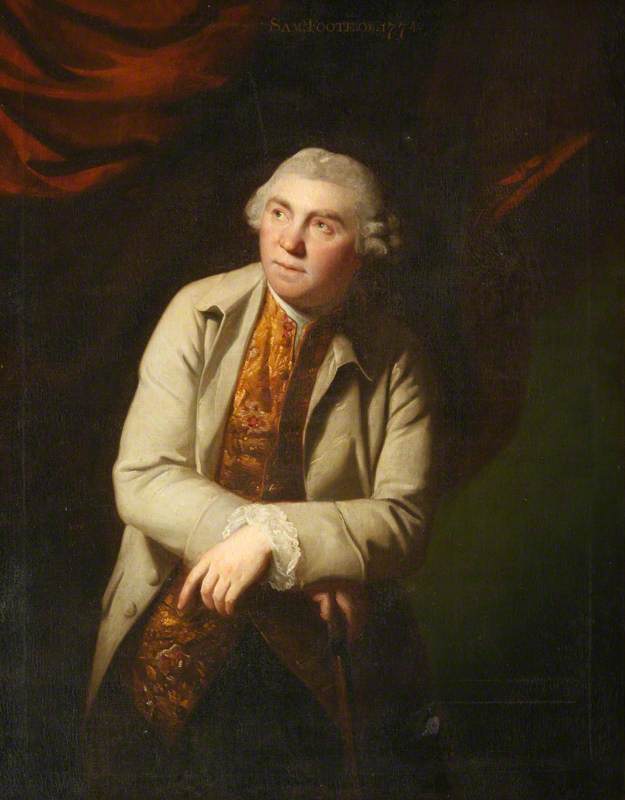
A Portrait of Wit and Grace: Samuel Foote by George Romney
George Romney’s “Samuel Foote (1720–1777) (after Joshua Reynolds)” is more than a simple likeness; it's a carefully constructed tableau of theatrical persona, social standing, and the subtle artistry of 18th-century portraiture. Executed in the Rococo style, a hallmark of Romney’s oeuvre, this painting captures the renowned comedian Samuel Foote at his most captivating – a man radiating both intelligence and a mischievous charm. The work stands as a testament to Romney's ability to distill character onto canvas, mirroring the influence of his mentor, Sir Joshua Reynolds, while imbuing it with his own distinctive sensibility.
Reynolds’s “Grand Style” prioritized idealized beauty and formal grace, often depicting subjects in opulent settings. Romney, however, subtly departs from this rigid approach. While acknowledging Reynolds's foundational techniques – the meticulous rendering of fabrics, the careful attention to detail in Foote’s attire – Romney introduces a sense of immediacy and relaxed observation. The red curtain, a theatrical device, isn’t merely a backdrop; it actively engages with the composition, drawing the viewer into Foote’s world of performance. The two figures in the background, partially obscured, hint at a social context, suggesting Foote's life beyond the stage – perhaps a moment of respite or interaction within his circle.
The Man and the Master: Samuel Foote and Joshua Reynolds
Samuel Foote (1720–1777) was a celebrated English comedian, playwright, and actor, renowned for his rapid-fire delivery, exaggerated gestures, and satirical wit. He dominated London’s stage during the latter half of the 18th century, captivating audiences with his improvisational skills and memorable characters. His portrait by Romney is not simply a representation of Foote's appearance; it aims to capture the essence of his theatrical presence – the alertness in his eyes, the slight smirk playing on his lips, the confident posture that commanded attention.
The painting’s genesis lies in Reynolds’s own portrait of Foote, painted a decade earlier. Romney's version isn’t a slavish copy but rather an interpretation, a reimagining through the lens of his own artistic vision. Romney subtly alters details – the lighting, the composition, the expression – to create a work that feels fresh and dynamic, reflecting his own style while honoring Reynolds’s legacy. The choice to depict Foote seated suggests a moment of contemplation or preparation for performance, adding layers of narrative depth.
Technique and Detail: Romney's Approach
Romney’s skill as a portraitist is immediately evident in the meticulous rendering of Foote’s clothing. The white silk suit, adorned with vibrant red accents, showcases the artist’s mastery of texture and color. The fabric appears to shimmer under the light, demonstrating Romney's ability to capture the subtle nuances of surface quality. Note also the careful attention paid to the details – the lace collar, the buttons, the folds in the sleeves – each element contributing to a sense of realism and sophistication.
Furthermore, Romney’s use of chiaroscuro—the dramatic contrast between light and shadow—creates a strong sense of volume and depth. The soft lighting highlights Foote's face, emphasizing his features while subtly obscuring the background figures. This technique not only adds visual interest but also directs the viewer’s attention to the central subject – the captivating figure of Samuel Foote himself. Romney’s brushwork is remarkably controlled, conveying a sense of precision and refinement that aligns with the ideals of the Grand Style, yet tempered by his own artistic sensibility.
A Window into Georgian Society
“Samuel Foote (1720–1777) (after Joshua Reynolds)” offers a valuable glimpse into Georgian society – a world of theatrical entertainment, social hierarchies, and refined aesthetics. Foote’s presence in the painting speaks to the importance of comedy and performance within this era. The portrait itself becomes a symbol of status and accomplishment, reflecting Foote's success as a popular entertainer. It is a beautiful example of how art could both document and celebrate the cultural landscape of 18th-century England.