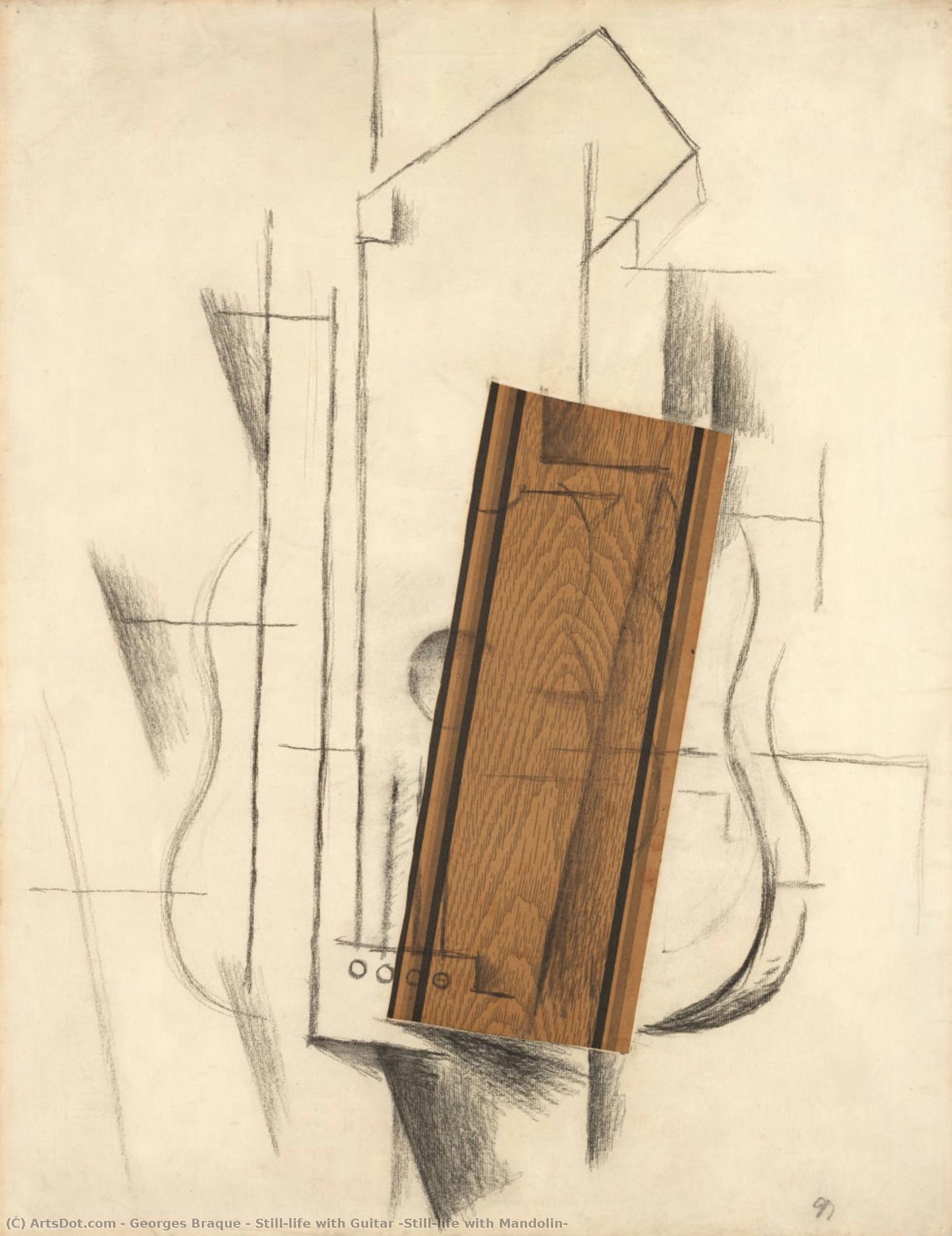
A Moment Frozen in Time: Exploring Braque’s Still Life with Guitar
Georges Braque's "Still Life with Guitar (Still-life with Mandolin)," painted in 1912, is more than just a depiction of musical instruments; it’s a pivotal snapshot of the burgeoning artistic revolution taking shape at the dawn of the 20th century. This deceptively simple composition—a wooden guitar resting upon a case, surrounded by familiar domestic objects—is a cornerstone of Cubism's development and offers a fascinating glimpse into Braque’s innovative approach to form, space, and representation. The work immediately draws the eye with its stark black and white palette, a deliberate choice that amplifies the textures and geometric qualities of the scene, stripping away any illusion of traditional depth or perspective.
The Genesis of Cubism: Deconstructing Reality
Born in Argenteuil, France, in 1882, Georges Braque’s artistic journey was deeply rooted in the practicalities of his family's trade as house painters and decorators. This early exposure to materials and construction techniques profoundly influenced his later work. He initially trained at the École des Beaux-Arts, but it was through encounters with artists like Marie Laurencin and Francis Picabia that he began to question established artistic conventions. Braque’s collaboration with Pablo Picasso during this period proved utterly transformative. Together, they embarked on a radical experiment: to dismantle traditional representation and reconstruct reality from multiple viewpoints simultaneously. “Still Life with Guitar” exemplifies this process perfectly; the guitar isn't presented as a single, unified object but rather fragmented into geometric planes, each reflecting a different angle of observation. This technique, central to Cubism’s development, challenged viewers to actively engage with the artwork and piece together its form.
Symbolic Layers: Music, Domesticity, and the Artist's Eye
The inclusion of a guitar—a symbol of artistry, leisure, and perhaps even melancholy—within this carefully arranged still life is particularly intriguing. Braque’s choice to depict a mandolin, rather than a more common guitar, adds another layer of complexity. Musical instruments were frequently featured in the “papier collés” (cut and pasted papers) created by Braque and Picasso, often imbued with sinuous profiles and allusions to the feminine form. The surrounding objects—chairs, a table, and other domestic items—ground the scene in a recognizable reality while simultaneously contributing to the overall sense of disorientation. The placement of the figure on the left, partially obscured, suggests an observer, inviting us to contemplate the artwork alongside him, adding a layer of narrative depth.
A Legacy of Innovation: Reproduction and Beyond
“Still Life with Guitar (Still-life with Mandolin)” remains a seminal work in art history, demonstrating Braque’s pioneering role in the development of Cubism. ArtsDot offers meticulously crafted hand-painted reproductions that capture the essence of this groundbreaking piece—its stark contrasts, its geometric precision, and its profound sense of artistic innovation. Whether you are an art enthusiast seeking to expand your collection or an interior designer searching for a unique statement piece, our reproduction provides an authentic representation of Braque’s vision, bringing this pivotal moment in modern art into your space. Explore the full artwork details and high-resolution images on our website to experience the enduring power of this remarkable painting.