Georges Braque ( BRA(H)K; French: [ʒɔʁʒ bʁak]; 13 May 1882 – 31 August 1963) was a major 20th-century French painter, collagist, draughtsman, printmaker and sculptor. His most notable contributions were in his alliance with Fauvism from 1905, and the role he played in the development of Cubism.
A Fragmented Reflection: The Soul of Synthetic Cubism
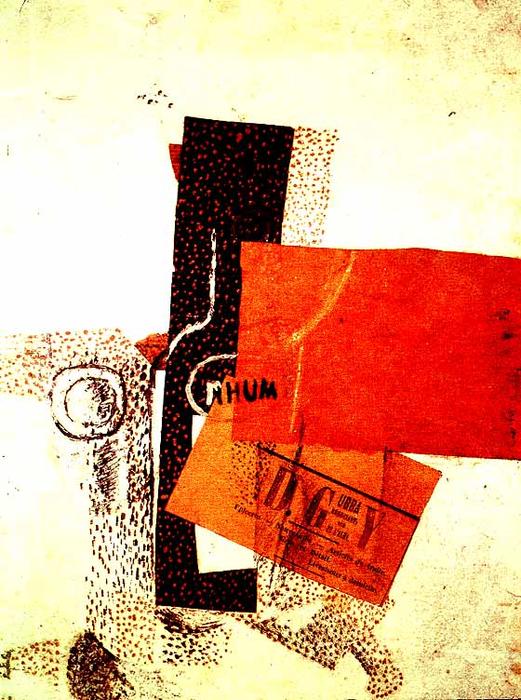
In the quiet, revolutionary atmosphere of 1914, Georges Braque captured more than just a still life; he captured the very fracturing of modern perception. The Bottle of Rum stands as a profound testament to the era of Synthetic Cubism, a period where the boundaries between reality and abstraction began to dissolve into a beautiful, geometric dance. This masterpiece does not merely present an object for observation; it invites the viewer into a meticulously crafted puzzle, where light, shadow, and form are deconstructed and reassembled to challenge our fundamental understanding of space.
To gaze upon this work is to witness the transition from the analytical dissection of objects to a more decorative and layered approach. Unlike the earlier, more clinical stages of Cubism, Braque’s work here embraces a richer, more tactile aesthetic. Through the masterful use of papier collé—the technique of gluing paper templates onto canvas—Braque achieved a remarkable sense of depth and texture. The subtle tonal variations and the precise layering of shapes create an illusion of complexity that draws the eye inward, making it an exquisite focal point for any sophisticated interior seeking intellectual depth and visual intrigue.
Symbolism and the Geometry of Emotion
At the heart of the composition lies the bottle itself, a central figure that serves as much more than a simple vessel for spirits. In Braque’s hands, the bottle becomes a symbol of containment and the hidden; it represents the repressed or the obscured truths that lie beneath the surface of our daily lives. The surrounding elements—the scattered circles, squares, and shifting planes—act as a rhythmic accompaniment to this central theme, creating a sense of movement that feels both structured and spontaneous.
<
p>The emotional impact of
The Bottle of Rum is one of profound contemplation. Painted amidst the mounting anxieties of World War I, the painting reflects a world in flux, where traditional certainties were being dismantled by the forces of history. There is a tension within the canvas, a balance between the stability of geometric forms and the fragmentation of the subject matter. For the collector or the designer, this piece offers a unique emotional resonance: it provides a sense of ordered complexity that can anchor a room with its quiet strength and historical gravity.
A Timeless Addition to the Modern Collection
For those looking to curate a space that speaks to the history of modernism, a high-quality reproduction of this Braque masterpiece offers unparalleled inspiration. The artwork’s ability to harmonize bold geometric shapes with subtle, earthy tones allows it to integrate seamlessly into various design aesthetics, from minimalist contemporary galleries to richly textured, classical studies. It is not merely a decoration; it is an invitation to engage with the very moment when art broke free from representation to find its own truth.