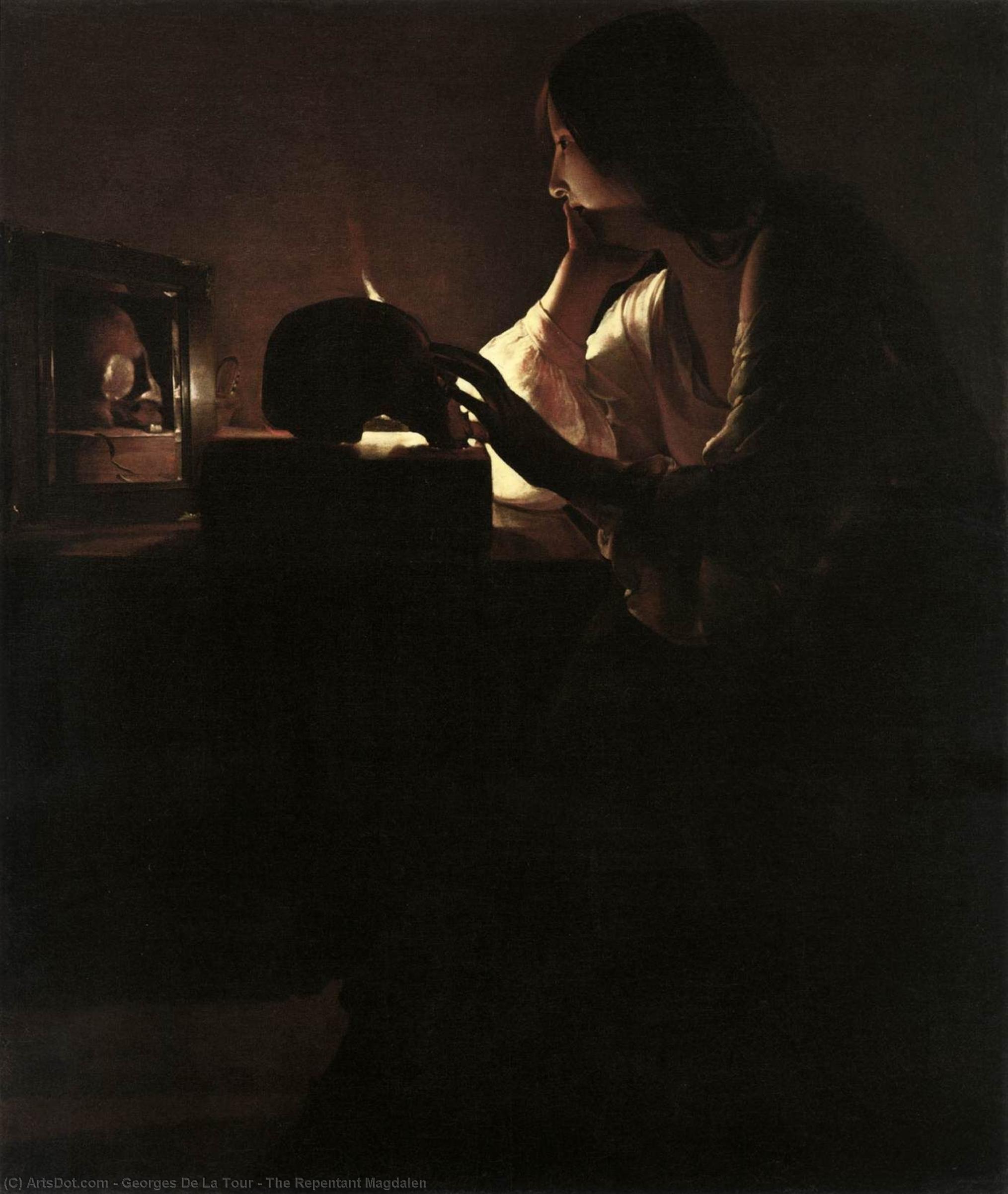
Delve into Georges de La Tour’s evocative depiction of Mary Magdalene, rendered in exquisite Baroque style. Explore its symbolism—death, faith, and repentance—expressed through masterful chiaroscuro lighting and serene composition.
Georges de La Tour: Luminosity, Spirituality & Realism in Baroque Painting
Georges de La Tour (1593-1652) stands as one of the most distinctive voices within the French Baroque—a movement characterized by dramatic theatricality and opulent grandeur. Yet, amidst this visual spectacle, De La Tour’s oeuvre possesses a singular quietude, an almost meditative stillness that draws viewers into profound contemplation. Unlike many of his contemporaries who embraced flamboyant displays of virtuosity, De La Tour cultivated a style rooted in meticulous observation and masterful manipulation of light—a technique he termed “tenebrism”—that would solidify his reputation as a pioneer of Baroque painting. Born in Vic-sur-Seille, Lorraine, De La Tour’s early life remains shrouded in some mystery, though scholarly speculation suggests formative influences from the artistic milieu of Italy, particularly Caravaggio. His father was a baker—a humble profession that contrasts sharply with the spiritual depth evident in his artwork—and his mother's lineage hints at aristocratic connections, subtly shaping his artistic sensibility.
- Early Training & Influences: De La Tour’s formative years were marked by exposure to Italian Baroque painting, notably Caravaggio’s groundbreaking use of chiaroscuro (the dramatic interplay between light and dark). Caravaggio's influence is palpable in De La Tour’s compositions—particularly the stark contrasts of illumination that define his scenes—creating an atmosphere of solemn grandeur.
- Style & Technique: De La Tour perfected tenebrism, a technique wherein darkness dominates the canvas, punctuated by pools of intense light. This method wasn't merely stylistic; it served as a powerful tool for conveying emotion and spiritual truth. He achieved this effect through painstaking layering of glazes—thin coats of translucent paint—allowing him to build up color gradually while maintaining tonal consistency.
- Religious Themes & Symbolism: De La Tour’s artistic output was overwhelmingly devoted to religious subjects, reflecting the fervent piety of his era and aligning with the Counter-Reformation's emphasis on visual piety. His paintings frequently depict biblical narratives—such as Saint Mary Magdalene—characterized by serene figures bathed in ethereal light, conveying a sense of spiritual grace and contemplation.
- Notable Works: Among De La Tour’s most celebrated masterpieces are “The Fortune Teller,” “Saint Mary with the Sleeping Child,” and “The Repentant Magdalen.” Each painting exemplifies his signature style—characterized by luminous interiors, symbolic objects (like skulls and candles), and a profound psychological realism that transcends mere depiction.
- Legacy & Rediscovery: De La Tour’s work had largely faded from public consciousness until the late 19th century when it experienced a significant revival thanks to the efforts of art historians like Maurice Quentin de La Tour, who championed his artistic achievements and helped disseminate knowledge of his oeuvre. Today, De La Tour's paintings are housed in museums across Europe and America—testament to their enduring beauty and intellectual depth.
The Repentant Magdalen: A Study in Dramatic Light & Spiritual Reflection
“The Repentant Magdalen,” painted circa 1637, exemplifies De La Tour’s mastery of tenebrism and his ability to imbue seemingly simple scenes with profound spiritual significance. The painting depicts Mary Magdalene seated at a table illuminated by a single candle—a focal point of intense luminescence that dominates the upper half of the canvas—contemplating a skull resting upon her lap. This juxtaposition of light and darkness isn’t merely decorative; it serves as a visual metaphor for confronting mortality and grappling with questions of repentance and redemption.
Composition & Technique: De La Tour employs a pyramidal composition, positioning Mary Magdalene centrally while anchoring the scene with architectural elements—a dark wall and table—that heighten the dramatic effect. The meticulous layering of glazes creates an astonishingly realistic depiction of texture—particularly evident in the folds of Mary Magdalene’s dress and the surface of the skull—underscoring De La Tour's commitment to artistic precision.
Symbolism: Beyond its visual splendor, “The Repentant Magdalen” is laden with symbolic references that resonate deeply within Christian iconography. The candle represents divine illumination—the enlightenment gained through faith and repentance—while the skull serves as a reminder of human mortality—a solemn contemplation of death’s inevitability. The mirror reflects the skull, symbolizing introspection and confronting one's own failings. Mary Magdalene’s gaze is directed inward, suggesting an engagement with her inner turmoil and spiritual transformation.
Exploring De La Tour’s Artistic Vision
Georges de La Tour’s artistic vision transcended mere imitation of Caravaggio; he sought to distill the essence of Baroque spirituality into a form that was both aesthetically compelling and intellectually stimulating. His paintings are characterized by an unparalleled sensitivity to psychological nuance—capturing subtle expressions of emotion and conveying profound moral contemplation. De La Tour's work continues to inspire artists and collectors alike, securing his place as one of the most influential figures in French Baroque art.