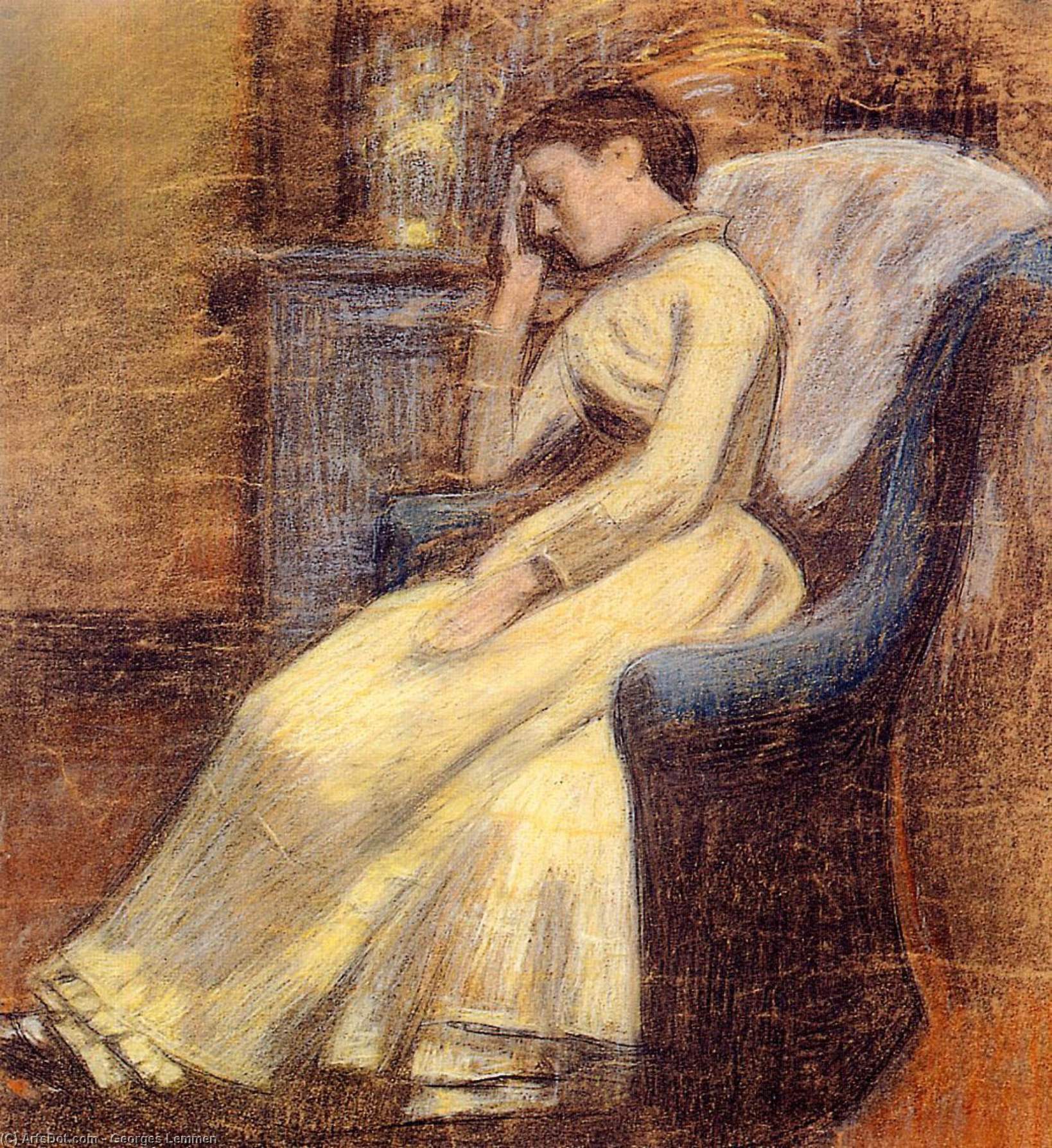
The painting
Julie Lemmen Sleeping in an Armchair by
Georges Lemmen is a remarkable example of Post-Impressionist art. Created in 1884, this piece showcases the artist's unique style, which blends elements of Realism and Post-Impressionism. The painting features a portrait of a woman sitting in a chair with her head resting on her hand, appearing to be asleep.
Artistic Style and Technique
Georges Lemmen's use of bold lines and vibrant colors gives the painting a sense of energy and movement. The subject's face is serene, with a subtle smile, conveying a sense of peace and tranquility. The background of the painting features a couch and a table nearby, as well as a clock hanging on the wall, adding depth and context to the scene.
Post-Impressionism was a predominantly French art movement that developed roughly between 1886 and 1905. It emerged as a reaction against Impressionists' concern for the naturalistic depiction of light and color.
Georges Lemmen's work is a prime example of this movement, with its emphasis on distorted forms and exaggerated colors.
- The painting is characterized by its use of bold lines and vibrant colors.
- The subject's face is serene, with a subtle smile, conveying a sense of peace and tranquility.
- The background of the painting features a couch and a table nearby, as well as a clock hanging on the wall, adding depth and context to the scene.
Handmade oil painting reproductions of
Julie Lemmen Sleeping in an Armchair are available at https://ArtsDot.com. These reproductions are created by talented oil painters who use high-quality materials to ensure that the final product is identical to the original painting. For more information on Post-Impressionism, visit
/art/list/?Filter=A@D3CR9H-Post-Impressionism-Art-Movement. To learn more about
Georges Lemmen and his work, visit
https://en.wikipedia.org/wiki/Georges_Lemmen.
The
Indianapolis Museum of Art and the
Musée D'Orsay are just a few examples of museums that feature Post-Impressionist art. These museums offer a glimpse into the world of
Post-Impressionism and the artists who defined this movement.