Discover Georges Seurat (1859-1891), the pioneer of Pointillism & Neo-Impressionism! Explore 'A Sunday on La Grande Jatte' and his revolutionary color theory capturing modern life. Shop hand-painted reproductions!
Georges Seurat’s “Harvester”: A Study in Precision and Quiet Reflection
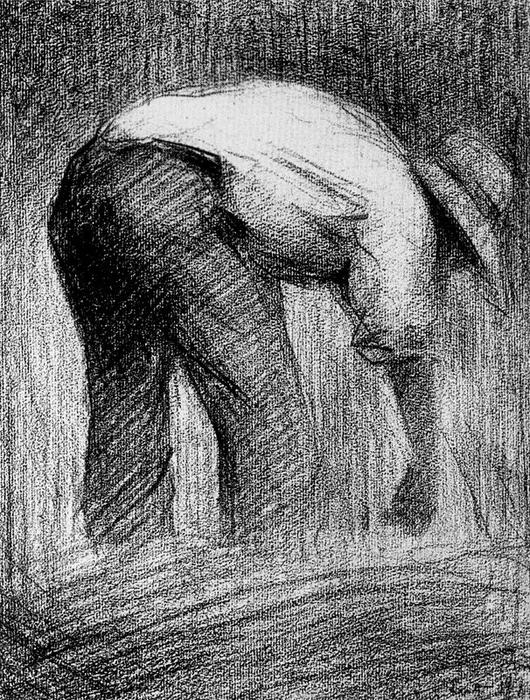
Georges Pierre Seurat (1859-1891), a name synonymous with innovation within Impressionism, irrevocably altered the course of modern art through his pioneering technique – Pointillism. More than just a stylistic choice, it represented a profound intellectual commitment to scientific observation and a daring reimagining of how color could be perceived by the eye. This meticulous depiction of “Harvester,” executed in graphite on paper, encapsulates the essence of Seurat’s artistic vision: a restrained beauty born from painstaking detail and imbued with subtle emotional resonance.
Composition and Technique – The Language of Light
The artwork presents a deceptively simple composition centered around a solitary harvester figure positioned against an indistinct, textured background that fades into darkness. However, beneath this apparent stillness lies a complex interplay of visual elements meticulously crafted through short, closely spaced pencil lines—the hallmark of Seurat’s Pointillist method. Rather than blending colors directly onto the canvas, Seurat applied tiny dots of pigment – primarily shades of gray – to create an illusion of luminosity and depth. This technique, rooted in optical theory championed by Eugène Chevreuil and Michel Hessayon, aimed to capture the way light scatters across surfaces, mimicking the retinal experience with remarkable accuracy. The curved lines delineating the harvester’s back subtly convey movement and posture, emphasizing the physical labor inherent in the subject matter.
Historical Context: Impressionism's Legacy and Seurat's Departure
Seurat emerged from the vibrant milieu of Impressionism—a movement that celebrated fleeting moments of sensory experience and prioritized capturing atmospheric effects above all else. Artists like Claude Monet and Pierre-Auguste Renoir championed this approach, rejecting academic conventions in favor of spontaneity and immediacy. Yet, Seurat recognized limitations within Impressionism’s focus on subjective perception. He sought to transcend mere sensation by grounding his art in scientific principles, specifically Helmholtz's theory of color vision. This intellectual pursuit fueled his desire to develop a method that could objectively reproduce the visual world—a goal that positioned him as a crucial bridge between Impressionism and Post-Impressionism. “Harvester” stands as testament to this transformative influence, reflecting Seurat’s unwavering dedication to exploring the boundaries of artistic expression.
Symbolic Resonance: Labor, Resilience, and Monochrome's Quiet Power
The depiction of the harvester figure itself carries symbolic weight. Representing agricultural toil and perseverance—themes prevalent in Impressionist landscapes—the posture embodies resilience and determination. Simultaneously, the monochromatic palette—primarily grayscale—amplifies the artwork’s contemplative mood. Unlike Impressionists who embraced vibrant hues to convey emotion, Seurat deliberately eschewed color, opting for a tonal range that evokes feelings of solemnity and introspection. This deliberate restraint underscores the artist's belief that beauty could be found not only in visual spectacle but also in subtle nuances of tone and texture—a philosophy that continues to inspire artists today.
Emotional Impact: A Moment Frozen in Time
“Harvester” transcends mere representation; it invites viewers into a quiet meditation on human effort and the passage of time. The textured surface created by Seurat’s pencil strokes evokes a tactile quality, mirroring the physicality of agricultural labor. More importantly, the artwork communicates an unspoken emotion—a sense of melancholy tempered by dignity—through its understated composition and tonal harmony. It's a piece that speaks volumes without uttering a word, capturing a fleeting glimpse into the human condition with remarkable sensitivity and precision. Like many preparatory sketches from Seurat’s oeuvre, “Harvester” exemplifies his commitment to exploring artistic possibilities while maintaining an unwavering focus on scientific observation—a legacy that secures its place as one of the most enduring symbols of Impressionism's transformative influence.