A Portrait of Earnest Simplicity: Exploring Seurat's *Le Petit Paysan en Bleu ou Le Jocker*
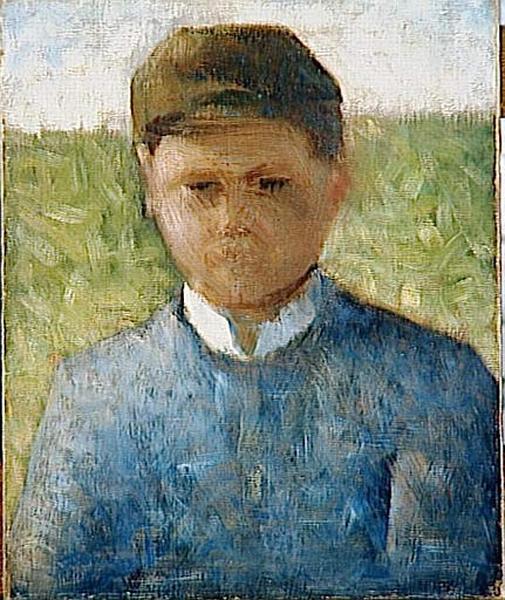
Georges Pierre Seurat’s Le Petit Paysan en Bleu ou Le Jocker (The Little Peasant in Blue or The Jester) is more than just a portrait; it’s a meticulously constructed meditation on observation, scientific rigor, and the quiet dignity of rural life. Painted in 1883-1884, this work represents a crucial moment in Seurat's development as a pioneer of Pointillism, a technique that would forever alter the course of modern art. The subject, a young man – often interpreted as a peasant or ‘jock’ (a rural entertainer) – is rendered with an almost unsettling precision, his gaze direct and unwavering, drawing the viewer into a silent exchange.
- Subject & Composition: The painting's strength lies in its deceptively simple composition. Seurat eschews dramatic poses or elaborate settings, instead focusing on a single figure presented against a subtly rendered landscape. This deliberate restraint amplifies the impact of the subject’s directness and the meticulous detail of his attire.
- Technique – The Language of Points: Seurat's mastery lies in his application of Pointillism, a revolutionary technique where tiny dots of pure color are applied to the canvas. Viewed from a distance, these individual points coalesce into an illusion of tone and form, creating a shimmering effect that captures the nuances of light with remarkable accuracy. This wasn’t merely about applying paint; it was about harnessing scientific principles – specifically, optical mixture – to achieve a heightened sense of realism.
Historical Context: Bridging Impressionism and Modernity
Painted during a period of intense artistic experimentation in Paris, Le Petit Paysan en Bleu ou Le Jocker sits at the crucial juncture between Impressionism and Post-Impressionism. While influenced by the Impressionists’ focus on capturing fleeting moments of light and color, Seurat pushed beyond mere optical observation to develop a systematic approach rooted in scientific theory. He was deeply interested in the work of Eugène Chevreul, a chemist who had studied how the eye perceives color, and sought to apply these principles to his art. This pursuit reflects a broader intellectual climate of the late 19th century, characterized by a fascination with science and technology.
- The Rise of Scientific Art: Seurat’s work represents a significant shift towards what would later be termed “scientific art.” He wasn't simply depicting reality; he was actively constructing it through a rigorous understanding of optics and color theory.
Symbolism & Emotional Impact
Despite its apparent simplicity, the painting is rich in symbolic potential. The young man’s serious expression suggests a quiet contemplation, perhaps reflecting on his place in society or the burdens of rural life. The blue shirt and hat – a dominant color in the composition – evoke associations with labor, humility, and the natural world. Seurat's deliberate use of muted tones contributes to a sense of melancholy and introspection, inviting viewers to consider themes of isolation and the passage of time. The painting’s emotional impact is not one of overt sentimentality but rather a subtle, almost unsettling, feeling of quiet dignity.
A Masterpiece Recreated: Bringing Seurat's Vision Home
ArtsDot offers meticulously crafted hand-painted reproductions of Le Petit Paysan en Bleu ou Le Jocker, allowing you to experience the brilliance of Georges Seurat’s technique and vision in your own space. Each reproduction is created using archival quality materials and employs skilled artisans who painstakingly recreate Seurat's Pointillist method. Whether adorning a gallery wall or serving as a focal point in an interior design scheme, this artwork offers a unique opportunity to connect with one of the most significant figures in modern art history. Order your hand-painted reproduction today and bring a touch of artistic genius into your world.