A Symphony of Light and Color
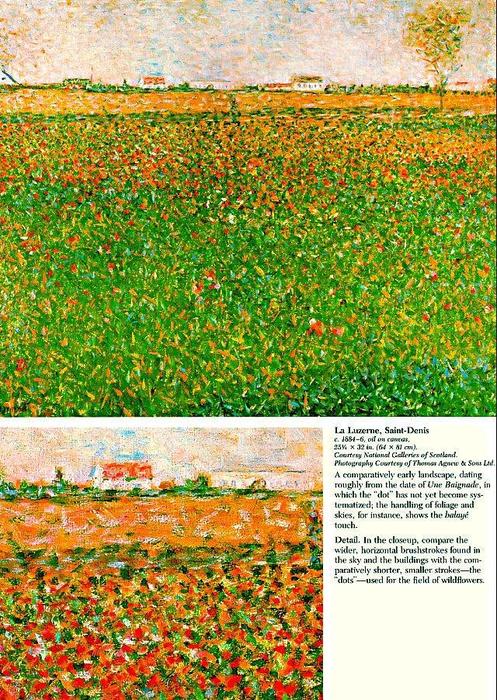
In the realm of Neo-Impressionism, few works capture the rhythmic pulse of nature as intimately as Georges Seurat’s Lucerne, also known as alfalfa field. This captivating diptych serves as a profound study of the French countryside, presenting a visual dialogue between the expansive and the minute. The upper panel invites the viewer into a vast, sun-drenched wheatfield that stretches toward a brilliant blue sky, evoking a sense of boundless freedom. In striking contrast, the lower panel draws the eye downward to an intimate, focused glimpse of poppies blooming amidst lush, verdant greenery. Through this masterful juxtaposition, Seurat creates a dynamic visual experience that oscillates between the grandeur of the landscape and the delicate beauty of a single blossom.
The true magic of this piece lies in its revolutionary technique: Pointillism. Rather than the spontaneous, sweeping brushstrokes characteristic of earlier Impressionist works, Seurat employed a meticulous scientific approach known as chromoluminarism. He applied countless tiny, distinct dots of pure color directly onto the canvas, trusting the viewer’s eye to perform the final act of creation through optical mixing. This method imbues the wheatfield and the poppies with an almost supernatural luminosity; the colors do not merely sit upon the surface but seem to vibrate and shimmer with light. For those seeking a centerpiece for a sophisticated interior, this technique offers a unique texture that changes beautifully depending on the lighting of a room, providing a sense of movement and life that traditional painting rarely achieves.
Historical Resonance and Emotional Depth
Painted in 1886, Lucerne emerged during a period of intense artistic experimentation. While Seurat drew inspiration from the Impressionists' fascination with fleeting light, he sought to ground those ephemeral moments in a more structured, permanent reality. Influenced by the color theories of Michel Eugène Chevreul, Seurat’s work represents a departure from subjective emotion toward a disciplined, almost mathematical precision. Yet, despite this scientific rigor, the painting remains deeply emotive. The choice of subject matter—a flourishing, abundant field—evokes timeless themes of growth, vitality, and the cyclical nature of life itself.
The emotional impact of the work is found in its palette. The intense greens suggest a burgeoning energy, while the sudden, passionate bursts of red and yellow from the poppies introduce a touch of warmth and spirited intensity. It is a work that balances calm with energy, making it an ideal inspiration for collectors and designers looking to introduce a sense of tranquility and organic vitality into a space. Owning a high-quality reproduction of this masterpiece allows one to bring not just a beautiful image, but a piece of art history—a moment where science and soul converged to redefine the very essence of light.