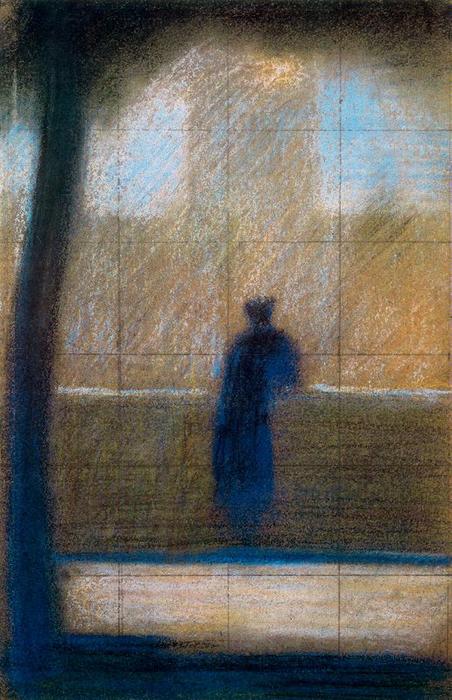
A Window Into Reflection: The Luminous Solitude of Seurat
In the heart of Belle Époque Paris, where the pulse of modernity met the quietude of the Seine, Georges Seurat captured a moment of profound stillness in “Man at a Parapet.” To gaze upon this masterpiece is to step into a world where time seems to suspend itself, caught in the delicate balance between movement and stasis. The painting presents us with a solitary figure, positioned on a stone parapet, his back turned toward the viewer as he gazes out over a tranquil expanse of water. This composition does more than merely depict a Parisian landscape; it invites us into a shared state of introspection. While other figures drift in the distant background, their presence only serves to deepen the sense of the central man’s isolation, grounding his private contemplation within the wider, bustling urban tapestry of the city.
The emotional resonance of the work lies in its ability to evoke a sense of peaceful melancholy. There is a weight to the man's posture, a quiet gravity that suggests he is not merely looking at the horizon, but searching through it. For the collector or the lover of fine art, this piece offers a sanctuary of thought. It is an ideal centerpiece for a space dedicated to reflection—a living room or a study where the eyes can wander across the canvas and find rest in its balanced, rhythmic composition.
The Science of Light: The Magic of Pointillism
What truly distinguishes “Man at a Parapet” is Seurat’s revolutionary departure from the spontaneous, often blurred strokes of his Impressionist predecessors. Instead of blending pigments on a palette to create color, Seurat employed Pointillism—a meticulous, almost scientific method known as Chromoluminarism. He applied millions of tiny, individual dots of pure pigment to the canvas, relying on the viewer's eye to optically mix these colors from a distance. This technique creates a shimmering, vibrating effect, as if the very air in the painting is alive with light.
This was not merely an aesthetic choice but an intellectual one, rooted in the optical theories of the era. By treating color as a series of rhythmic pulses, Seurat achieved a luminous precision that feels both modern and eternal. For interior designers seeking to add texture and depth to a room, the intricate detail of this technique provides a visual richness that changes depending on the light and angle of view. The painting does not just sit upon a wall; it interacts with the environment around it, casting a soft, atmospheric glow that can transform the mood of an entire interior.
A Bridge Between Eras: History and Symbolism
Created during the height of his creative powers in the late 1880s and early 1890s, this work stands as a monumental bridge between the fleeting impressions of the past and the structured abstraction of the future. Seurat sought to move beyond the subjective "moment" to find a more permanent, structural truth in art. The parapet itself serves as a powerful symbol—a physical and psychological boundary that separates the observer from the observed, the individual from the collective, and the internal world of thought from the external world of nature.
Owning a high-quality reproduction of such a seminal work allows one to bring a piece of art history into the contemporary home. It is an invitation to appreciate the intersection of scientific rigor and poetic soul. Whether placed in a minimalist modern setting or a classic, ornate gallery, “Man at a Parapet” remains a timeless testament to the beauty found in quiet observation and the enduring power of light.