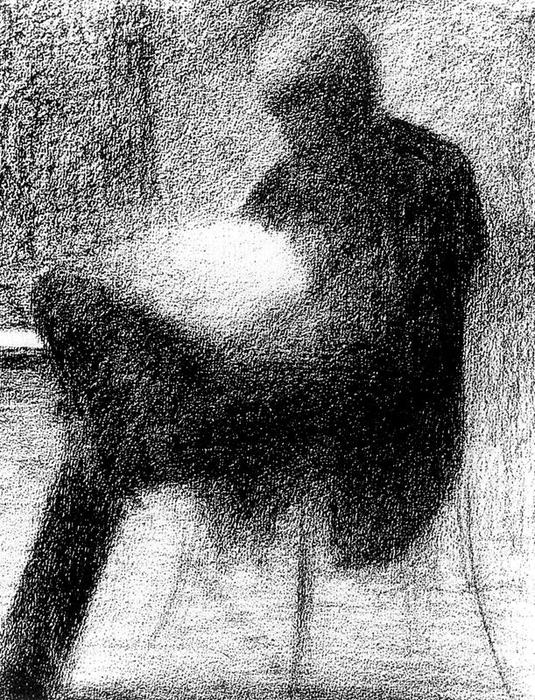
A Study in Light and Solitude: Unveiling Seurat’s “Man Reading on a Terrace”
Georges Seurat's "Man Reading on a Terrace," painted between 1883 and 1884, isn’t merely a depiction of a gentleman lost in thought; it’s a meticulously constructed meditation on perception, color theory, and the quiet dignity of modern life. Born from a profound fascination with scientific observation and a desire to move beyond the fleeting impressions of Impressionism, Seurat embarked on a radical experiment – Pointillism – transforming the canvas into an intricate mosaic of tiny dots, each imbued with its own specific hue. This technique wasn’t simply a stylistic choice; it was a deliberate attempt to capture the way light interacts with surfaces and how our eyes blend these colors subconsciously, creating a remarkably luminous effect.
The scene itself is deceptively simple: a man seated on a terrace, absorbed in a book. Yet, within this apparent stillness lies a complex interplay of formal elements. The composition is carefully balanced, drawing the eye to the central figure while subtly receding into the blurred background. Seurat’s masterful control of tonal values – achieved through variations in dot size and density – creates an illusion of depth and atmosphere, suggesting a warm afternoon sun filtering through the foliage. Notice how the dots closest to the man are darker, creating a sense of solidity and proximity, while those further away become lighter and more diffuse, contributing to the overall atmospheric perspective.
The Science of Color: Pointillism in Action
At the heart of “Man Reading on a Terrace” lies Seurat’s revolutionary approach to color. He meticulously analyzed the spectral properties of light and developed a system for creating colors by combining primary hues – red, blue, and yellow – through optical mixing. Rather than physically blending pigments on the canvas, he applied individual dots of pure color, trusting that the viewer's eye would seamlessly merge them into larger, more vibrant tones. This process is particularly evident in the dappled sunlight filtering through the trees, where a multitude of tiny dots coalesce to create an astonishingly realistic effect. It’s a testament to Seurat’s scientific rigor and his belief that art could be informed by the principles of optics.
The deliberate absence of brushstrokes is another key characteristic of Pointillism. Seurat sought to eliminate any trace of manual intervention, believing that it would detract from the purity of color and the illusion of light. Instead, he employed a fine needle to apply the dots with painstaking precision, creating an almost photographic quality to the painting. This meticulous approach reflects his desire to capture not just what he *saw*, but how he *perceived* – a deeply intellectual and analytical process.
Symbolism and the Portrait of Modernity
While seemingly straightforward, “Man Reading on a Terrace” carries subtle symbolic weight. The man’s posture—relaxed yet contemplative—suggests a moment of respite from the demands of modern life. His absorption in his book speaks to the importance of intellectual pursuits and the pursuit of knowledge – values that were increasingly valued during the late 19th century. The terrace itself, with its limited view of the cityscape beyond, can be interpreted as a metaphor for the isolation and introspection characteristic of urban existence.
Furthermore, Seurat’s choice to depict a middle-class gentleman reading is significant. It reflects his interest in capturing the everyday lives of Parisians – a departure from the traditional subjects favored by earlier artists. “Man Reading on a Terrace” isn't just a portrait; it’s a snapshot of modern society, offering a glimpse into the intellectual and emotional landscape of a rapidly changing world. The painting invites us to contemplate our own relationship with time, solitude, and the pursuit of knowledge – timeless themes that continue to resonate today.
A Legacy of Precision: Reproductions and Beyond
Today, “Man Reading on a Terrace” stands as a cornerstone of modern art. Its innovative techniques and profound insights have had a lasting influence on generations of artists. High-quality reproductions capture the luminous quality and intricate detail of Seurat’s original masterpiece, allowing viewers to appreciate its beauty and complexity in their own homes. When selecting a reproduction, consider the artist's fidelity to the original – ensuring that the subtle nuances of color and texture are faithfully reproduced. Whether as a striking centerpiece or a quiet study piece, “Man Reading on a Terrace” remains a powerful testament to Seurat’s genius and his enduring contribution to the world of art.