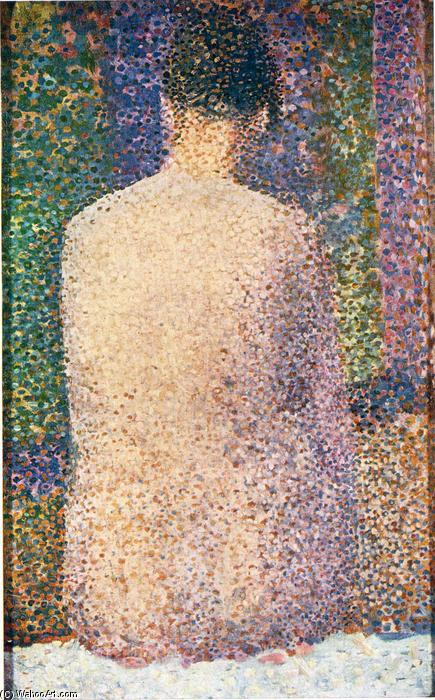
Experience the serene beauty of Georges Seurat’s Pointillist masterpiece – ‘Model from the Back,’ capturing a tranquil moment with its luminous blues and greens. Explore this iconic Impressionist work and bring artistic elegance into your home.
Discover Georges Seurat (1859-1891), the pioneer of Pointillism & Neo-Impressionism! Explore 'A Sunday on La Grande Jatte' and his revolutionary color theory capturing modern life. Shop hand-painted reproductions!
A Moment Frozen in Light: Exploring Georges Seurat’s “Model from the Back”
The painting "Model from the Back" by Georges Pierre Seurat, completed in 1886, stands as a testament to the revolutionary fervor of Impressionism's final years and embodies the groundbreaking principles of Pointillism. More than just a depiction of a seated man against a wall, it’s an exercise in scientific observation transformed into breathtaking artistic expression—a feat that cemented Seurat’s place among the titans of modern art.
The Science Behind Beauty: Understanding Pointillism
Seurat didn't simply dabble in color; he meticulously applied his knowledge of optics to achieve a luminous effect previously unattainable by Impressionists. Influenced by Eugène Chevreuil and Henri Matisse, Seurat championed Pointillism—a technique where pigment is applied in tiny dots rather than blended strokes. This seemingly simple method was underpinned by rigorous mathematical calculations designed to maximize color perception. Researchers like Michel Eugène Chevretuil had begun exploring the science of color perception, demonstrating that the human eye perceives color as a combination of wavelengths, and Seurat sought to recreate this phenomenon on canvas. By layering minuscule dots of complementary colors—primarily blues and greens—he created an illusion of shimmering light and depth, bypassing the traditional mixing process altogether. This approach prioritized scientific accuracy while simultaneously elevating painting to new heights of aesthetic sophistication.
A Portrait of Quiet Contemplation: Contextualizing the Artwork
Painted during the Belle Époque, “Model from the Back” reflects the prevailing mood of intellectual curiosity and artistic experimentation that characterized Parisian society at the time. Seurat’s work aligns with the broader movement toward abstraction, albeit subtly achieved through meticulous detail. The subject matter itself—a solitary figure—suggests introspection and stillness—themes prevalent in Symbolist art alongside Impressionism. However, unlike many Symbolists who aimed to convey emotion directly, Seurat prioritized visual precision, believing that color alone could evoke profound feelings. Consider the deliberate positioning of the model’s head turned away; this gesture invites contemplation and subtly emphasizes the importance of observation – mirroring Seurat's own artistic philosophy.
Color as Emotion: Decoding the Palette
The dominant hues—blues and greens—are not merely decorative choices but carefully considered elements contributing to the painting’s emotional impact. Blue, often associated with serenity and stability, anchors the composition while simultaneously conveying a sense of coolness. Green, symbolizing growth and renewal, introduces an element of vibrancy that balances the blues' calmness. The subtle gradations achieved through dot placement create an astonishingly realistic rendering of light and shadow—a remarkable feat considering the technique’s inherent limitations. Seurat’s masterful manipulation of color demonstrates his profound understanding of how visual stimuli can influence perception and evoke emotional responses.
A Legacy of Precision: Why “Model from the Back” Remains Relevant Today
“Model from the Back” continues to resonate with art lovers and collectors alike, not only for its stunning visual beauty but also for its pioneering spirit. It represents a pivotal moment in artistic history—a decisive step away from Impressionism’s fleeting impressions toward a more durable form of representation rooted in scientific principles. Reproductions offer an exceptional opportunity to experience this masterpiece firsthand, allowing viewers to appreciate the intricate detail and luminous quality that define Seurat's enduring legacy.