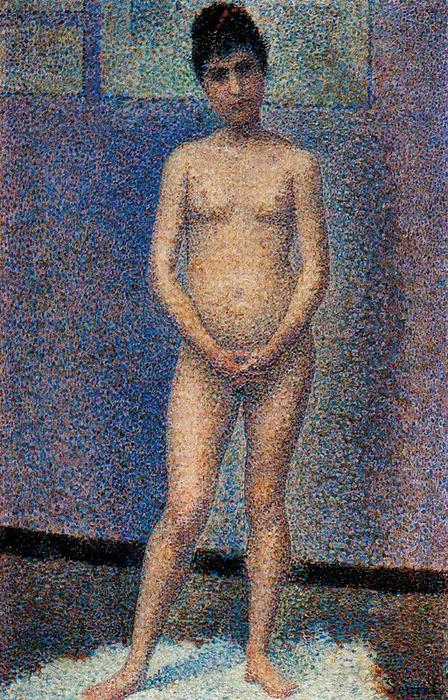
A Glimpse into Modernity: Exploring Seurat’s *Modelo de frente*
Georges Pierre Seurat’s Modelo de frente (Model Facing Forward) is a pivotal work demonstrating the birth of Neo-Impressionism and, specifically, his revolutionary Pointillist technique. This captivating nude study isn't merely a depiction of the human form; it’s an investigation into perception itself – how we see color, light, and ultimately, reality.
The Science of Seeing: Pointillism Defined
Seurat abandoned traditional blending techniques in favor of applying countless tiny, distinct dots of pure color to the canvas. This wasn’t arbitrary; it was a deliberate application of scientific color theory. He believed that optical mixing – where the viewer's eye blends these colors at a distance – would create a more vibrant and luminous effect than pre-mixed paints ever could. Up close, the painting dissolves into an almost abstract field of colored points. However, as you step back, the figure remarkably coalesces, showcasing the power of Seurat’s methodical approach.
A Modern Nude: Subject & Context
While nude figures were a common subject in 19th-century art, Seurat's treatment is strikingly modern. He eschews mythological allegories or dramatic narratives, presenting instead a straightforward study of form and light. The model’s direct gaze and unadorned pose contribute to this sense of immediacy and honesty. The simplicity of the background – likely his studio wall – further emphasizes the figure as the sole subject of artistic inquiry. This focus on observation aligns with the broader Post-Impressionist rejection of academic conventions, prioritizing the artist's subjective experience.
Emotional Resonance & Artistic Intent
Despite its seemingly objective approach, Modelo de frente evokes a subtle yet powerful emotional response. The model’s direct gaze establishes an intimate connection with the viewer, while her confident posture suggests both vulnerability and self-possession. The Pointillist technique itself contributes to this atmosphere; the shimmering surface and vibrant colors impart a feeling of vitality and transience. Seurat wasn't simply recording *what* he saw but exploring *how* he perceived it – the interplay of light, form, and color.
Seurat’s Legacy & Historical Significance
Georges Seurat (1859-1891) was a transformative figure bridging Impressionism and modern art. His development of Pointillism profoundly influenced subsequent generations of artists, impacting movements like Fauvism and Futurism. Modelo de frente stands as a testament to his innovative spirit and enduring legacy – a bold step towards abstraction and a celebration of the power of perception.
Display & Interior Design Considerations
- Lighting: This painting thrives in soft, diffused light. Avoid direct sunlight, which can diminish the subtle nuances of the Pointillist technique.
- Setting: Its modern aesthetic lends itself well to contemporary interiors. Consider pairing it with other Post-Impressionist or early Modern works for a curated gallery feel, or allowing it to stand alone as a striking focal point in a minimalist space.
- Framing: A simple, understated frame – perhaps in black, gray, or natural wood – will complement the artwork without distracting from its inherent beauty. A thin profile frame is recommended to maintain focus on the painting’s surface texture.
Modelo de frente isn't just a painting; it’s an invitation to contemplate the very nature of seeing and a powerful example of artistic innovation at its finest. It offers not only aesthetic pleasure but also intellectual stimulation, making it a compelling addition to any art collection or interior space.