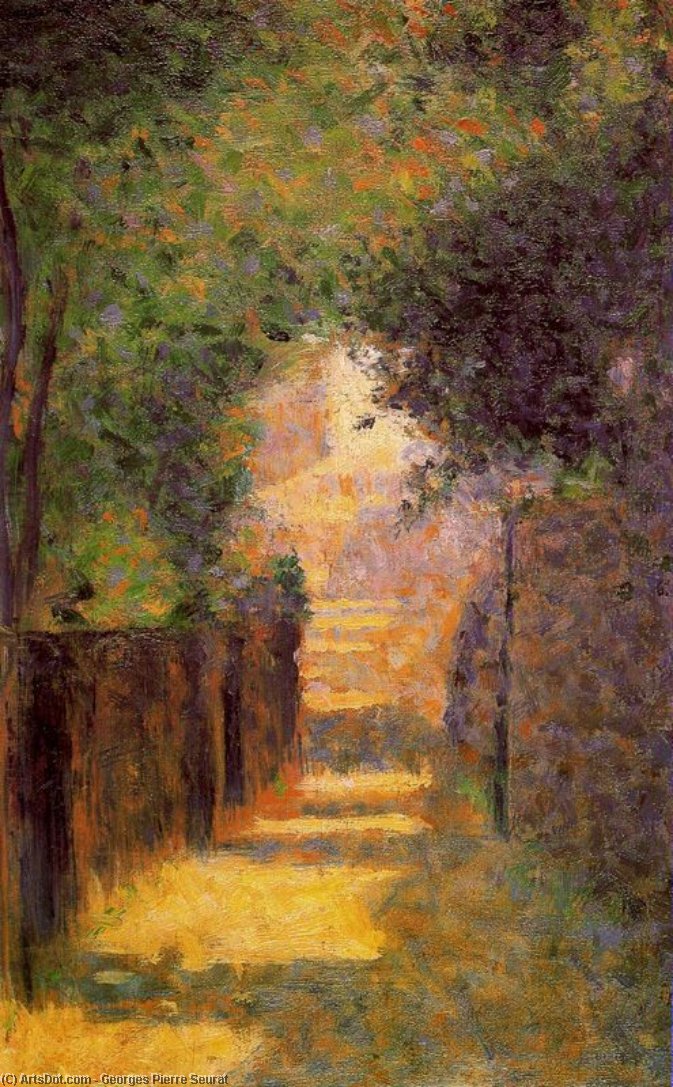
Discover Georges Seurat’s "Paris, Rue Saint-Vincent in Spring," a captivating Impressionistic landscape of Parisian beauty. Explore its pointillist technique & tranquil atmosphere.
Discover Georges Seurat (1859-1891), the pioneer of Pointillism & Neo-Impressionism! Explore 'A Sunday on La Grande Jatte' and his revolutionary color theory capturing modern life. Shop hand-painted reproductions!
A Glimpse into Spring: Georges Seurat’s Parisian Pathway
This captivating artwork by Georges Pierre Seurat transports viewers to a tranquil corner of Paris, specifically *Rue Saint-Vincent* bathed in the soft light of spring. More than just a landscape, it's an evocative impression of a fleeting moment, rendered with the meticulous observation and innovative technique that define Seurat’s artistic vision.
Impressionistic Style & Neo-Impressionist Roots
While demonstrably rooted in the Impressionist movement—evident in its focus on light and atmosphere—this piece hints at the burgeoning *Neo-Impressionism* for which Seurat would become renowned. The blurred edges, diffused lighting, and emphasis on sensory experience are hallmarks of Impressionism. However, a closer look reveals a more structured approach than many of his contemporaries. The converging lines creating depth, while softened, suggest a deliberate compositional strategy that anticipates the scientific rigor of Pointillism.
Technique & Materials
Executed in oil paints on canvas, the artwork showcases Seurat’s masterful handling of texture and color. The visible brushstrokes aren't blended seamlessly; instead, they are layered to build form and create a vibrant surface. This technique allows light to play across the canvas, enhancing the atmospheric effect and imbuing the scene with a sense of movement. The layering anticipates his later Pointillist work, where individual dots of color would be meticulously applied.
Subject Matter & Composition
The subject is deceptively simple: a narrow path or alleyway enveloped by lush foliage. The composition draws the eye inward along this pathway, creating a sense of depth and inviting exploration. Trees and greenery dominate the scene, their organic forms providing a counterpoint to the man-made structure of the street. This focus on nature within an urban setting is characteristic of Seurat’s work, reflecting his interest in capturing modern life alongside its natural surroundings.
Historical Context & Artistic Innovation
Born in 1859, Georges Seurat lived during a period of rapid change and artistic experimentation. Rejecting the traditional academic styles, Impressionists sought to capture the fleeting effects of light and color. Seurat took this pursuit further, developing his own scientific approach to painting. He studied color theory extensively, believing that optical mixing—where colors blend in the viewer’s eye rather than on the canvas—could create more vibrant and luminous results. This work represents a pivotal moment in his artistic development, bridging the gap between Impressionism and his groundbreaking Pointillist style.
Symbolic & Emotional Resonance
The pathway itself can be interpreted symbolically as a journey or exploration – both physical and metaphorical. The tranquil atmosphere evokes feelings of peace, mystery, and the beauty of nature. The soft light suggests either dawn or dusk, times often associated with contemplation and introspection. Rue Saint-Vincent in Spring isn’t merely a depiction of a place; it's an invitation to pause, reflect, and immerse oneself in the sensory experience of the moment.
For Collectors & Designers
This artwork offers a unique blend of artistic innovation and serene beauty. Its muted color palette—primarily greens, yellows, browns, and oranges—makes it incredibly versatile for interior design. It would complement both contemporary and traditional spaces, adding a touch of Parisian elegance and intellectual depth. A high-quality reproduction of this piece will bring a sense of calm and sophistication to any room. The artwork’s subtle complexity ensures that it remains engaging and thought-provoking over time, making it a valuable addition to any art collection.