A Symphony of Dots: The Luminous World of Seurat
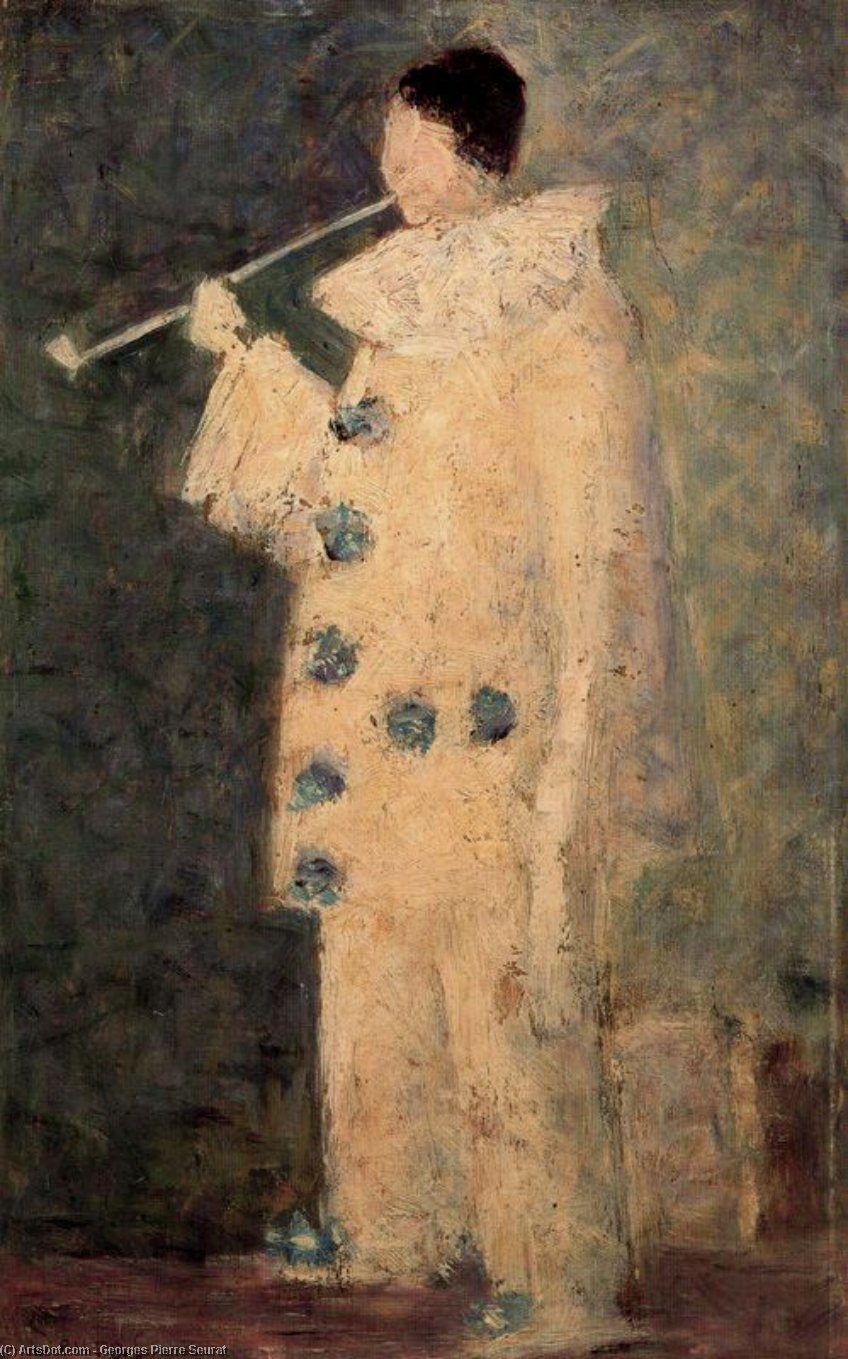
In the quiet corners of the Musée d'Orsay, there exists a moment frozen in time, captured not through sweeping gestures, but through a meticulous dance of light and science. Georges Seurat’s "Pierrot with a White Pipe" is far more than a mere portrait; it is a revolutionary manifesto rendered in pigment. Painted during the height of the late 19th century, this work serves as a cornerstone of Pointillism, a technique that sought to transcend the fleeting impressions of its predecessors by embracing the rigorous laws of optics. To gaze upon this canvas is to witness the birth of a new way of seeing, where the artist does not simply paint a subject, but reconstructs the very physics of light itself.
The brilliance of Seurat’s method lies in his rejection of traditional blending. Instead of mixing colors on a palette, he applied tiny, rhythmic pulses of pure color—individual points of pigment—directly onto the canvas. This approach, known as chromoluminarism, relies on the viewer's eye to perform the final act of creation, synthesizing these disparate dots into a shimmering, cohesive whole. The result is an ethereal luminosity that seems to vibrate with life, creating an illusion of radiance that traditional brushwork could never achieve. For the discerning collector or lover of fine art, this technique offers a depth and texture that invites endless contemplation.
The Melancholy of the Clown: Symbolism and Soul
Beyond its scientific rigor, "Pierrot with a White Pipe" is steeped in the profound emotional language of the Commedia dell'Arte. The subject, Pierrot, is an archetypal figure of theatrical tradition—the "sad clown" characterized by his innocence, vulnerability, and eternal longing. In this intimate depiction, Seurat captures the character in a state of quiet, introspective solitude. His upward gaze, directed toward an unseen point above, suggests a soul adrift in thought, perhaps yearning for a lost love or contemplating the vastness of the universe. This sense of melancholy is palpable, wrapped in the muted, earthy tones that ground the figure within a dreamlike atmosphere.
Every element within the frame contributes to this narrative of silent contemplation. The white pipe held in his hand serves as a subtle anchor to the physical world, while the soft, hooded drapery of his clothing adds a layer of mystery and weight to his presence. There is a profound stillness here, a moment of peace captured amidst the bustling energy of the modernizing world. For those looking to bring a sense of intellectual depth and historical resonance into a curated space, this piece offers an unparalleled emotional gravity.
An Enduring Legacy for the Modern Interior
For interior designers and art enthusiasts alike, "Pierrot with a White Pipe" represents a perfect marriage of classical elegance and avant-garde innovation. The painting’s subdued palette—rich in ochres, soft whites, and deep, muted shadows—makes it an incredibly versatile masterpiece for sophisticated decor. It possesses the unique ability to anchor a room with its historical weight while providing a focal point of light and texture that complements both contemporary minimalism and traditional grandeur.
Owning a high-quality reproduction of this Seurat masterpiece is an invitation to experience the intersection of art and science every day. It is a piece that rewards the close observer, revealing new layers of color and complexity with every glance. Whether placed in a sunlit gallery or a quiet study, this artwork brings with it the enduring spirit of the Post-Impressionist revolution, offering a timeless window into the beauty of light, the precision of thought, and the profound depths of the human heart.