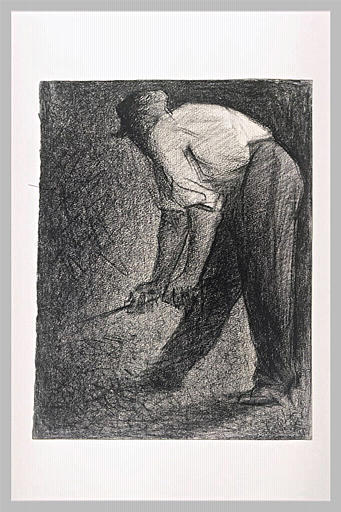
Georges Seurat’s ‘Stone Crusher,’ executed in crayon on paper, exemplifies Impressionist principles through its monochromatic palette and textured charcoal application. The artwork depicts a man engaged in stone crushing, emphasizing physical exertion and capturing the essence of rural life with scientific precision—a cornerstone of Seurat's revolutionary Pointillism technique.
Georges Seurat’s Stone Crusher: A Pioneer of Optical Impressionism
Georges Pierre Seurat (1859-1891) stands as a monumental figure in the artistic landscape of late 19th century France, irrevocably altering the trajectory of painting with his groundbreaking innovation – Pointillism. More than just a technique, it represented a radical reimagining of how artists perceived and reproduced light and color, firmly establishing him as a prophet of modern art.
“Stone Crusher,” painted around 1883-84 during Seurat’s formative years, exemplifies this revolutionary approach. Executed on paper with crayon—a medium chosen for its ability to capture tonal nuances—the artwork depicts a solitary laborer engaged in the arduous task of breaking down stone. This seemingly simple scene transcends mere representation; it embodies Seurat's meticulous observation of the natural world and his unwavering commitment to scientific principles.
Composition and Technique: Embracing Scientific Precision
- Central Focus: The composition prioritizes the figure of the worker, positioning him prominently within the frame—a deliberate decision that underscores the importance of human presence amidst the raw physicality of labor.
- Dense Texture: Seurat’s masterful application of crayon creates a remarkably textured surface, mirroring the rough materiality of stone and conveying an immediacy rarely achieved by Impressionists. The artist meticulously builds up tonal variations through overlapping strokes, mimicking the way light interacts with surfaces.
- Pointillist Illusion: Crucially, “Stone Crusher” foreshadows Seurat’s later development of Pointillism—a technique that abandons blended pigments in favor of tiny dots of color placed side by side. This method leverages Chevreul's theory of optical mixing, allowing the viewer’s eye to synthesize these dots into perceived hues and shades.
Historical Context and Symbolism: Reflecting Industrial Labor
Painted during a period marked by rapid industrialization in France, “Stone Crusher” speaks to the realities of rural life and the demands placed upon agricultural workers. The somber color palette—dominated by grayscale tones—reflects not only the physical exertion involved but also evokes feelings of fatigue and hardship. However, beyond its depiction of labor, the artwork serves as a study in human form and movement, capturing the essence of physicality with remarkable accuracy.
The artist’s deliberate choice to forgo vibrant color is significant. It aligns with Seurat's broader philosophical stance—a belief that art should strive for objectivity and capture the fundamental truths of perception. By rejecting Impressionistic subjectivity, Seurat elevates “Stone Crusher” to a testament to scientific rigor and artistic innovation.
Emotional Impact: A Momentary Glimpse into Authentic Experience
"Stone Crusher" isn't merely an image; it’s a distillation of experience—a poignant portrayal of human effort against the backdrop of the natural world. Seurat’s unwavering focus on tonal gradation and texture imbues the artwork with a palpable sense of atmosphere, inviting viewers to contemplate the dignity inherent in manual labor and the beauty found within simplicity.