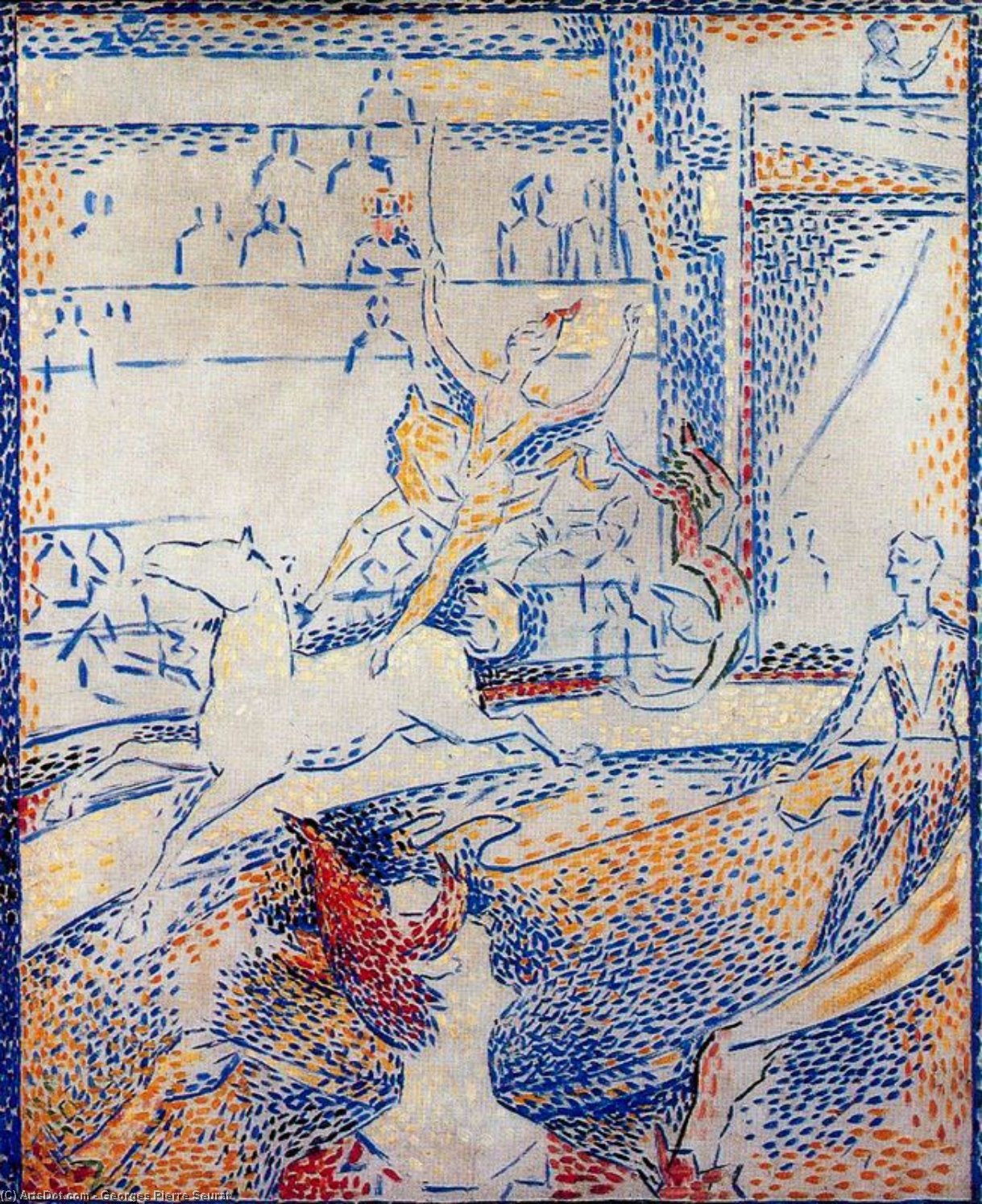
Georges Pierre Seurat - Study for "The Circus"
A captivating exploration of Impressionistic techniques and theatrical composition, featuring vibrant color palettes and meticulous detail.
Discover the brilliance of Seurat's vision – a masterful study capturing the dynamism of a circus performance.
Georges Seurat: The Architect of Light
Georges Pierre Seurat (1859 – 1891), born in Paris amidst the burgeoning artistic fervor of Belle Époque France, stands as a monumental figure in the history of modern art. His unwavering dedication to scientific observation and his revolutionary technique—Pointillism—transformed painting forever, establishing him as a pioneer of luminous precision and cementing his legacy as one of the most influential artists of his era.
The Birth of Pointillism: A Scientific Breakthrough
Before Seurat’s arrival on the artistic scene, Impressionism dominated Parisian art circles. Artists like Monet and Renoir sought to capture fleeting moments of light and color, blending brushstrokes to create an illusion of vibrancy. However, Seurat rejected this approach entirely. Inspired by Henri Poincaré’s theories on optics—specifically, the principle that the human eye perceives color not as inherent qualities but as resulting from the stimulation of cones in the retina—Seurat embarked on a radical experiment.
- The Principle: Poincaré demonstrated that color is perceived as an amalgamation of wavelengths emitted by objects.
- The Technique: Seurat meticulously divided his canvases into tiny dots—individual pigment particles—rather than blending colors directly onto the surface. This seemingly simple method demanded extraordinary patience and precision, resulting in a breathtaking effect of luminosity and depth.
A Symphony of Color and Texture
Seurat’s Pointillist paintings are characterized by an astonishing level of textural complexity achieved through painstaking application of dots. Rather than creating smooth gradients, he employed a mosaic-like arrangement of colors that subtly shifts and vibrates as the viewer perceives it. This technique wasn't merely about replicating visual sensations; it was about constructing an entirely new perceptual experience.
Notable Examples:
- A Sunday Afternoon on the Island of Saint Simon (1884): Demonstrates Seurat’s masterful handling of color and his ability to convey a sense of serene contemplation.
- The Eiffel Tower (1887): Represents Seurat's ambitious exploration of perspective and his commitment to capturing the grandeur of modern architecture.
Symbolism Beneath the Surface: Exploring Emotion Through Color
Beyond its technical brilliance, Seurat’s art is imbued with symbolic meaning. He deliberately chose colors—particularly blues and greens—to evoke feelings of tranquility and harmony, reflecting his belief in the power of color to communicate emotion directly to the viewer. The meticulous arrangement of dots wasn't simply a matter of optical illusion; it was an attempt to distill complex psychological states into visual form.
Legacy: An Enduring Influence on Modern Art
Despite Seurat’s tragically premature death from diphtheria at the age of 31, his contribution to art history remains profound. Pointillism served as a catalyst for subsequent artistic movements—including Neo-Impressionism and Futurism—inspiring generations of artists to push the boundaries of visual expression. Today, Seurat's paintings continue to inspire awe and admiration, reminding us that true artistry lies not only in skillful execution but also in intellectual curiosity and an unwavering commitment to exploring the fundamental mysteries of perception.