A Symphony of Light and Stillness
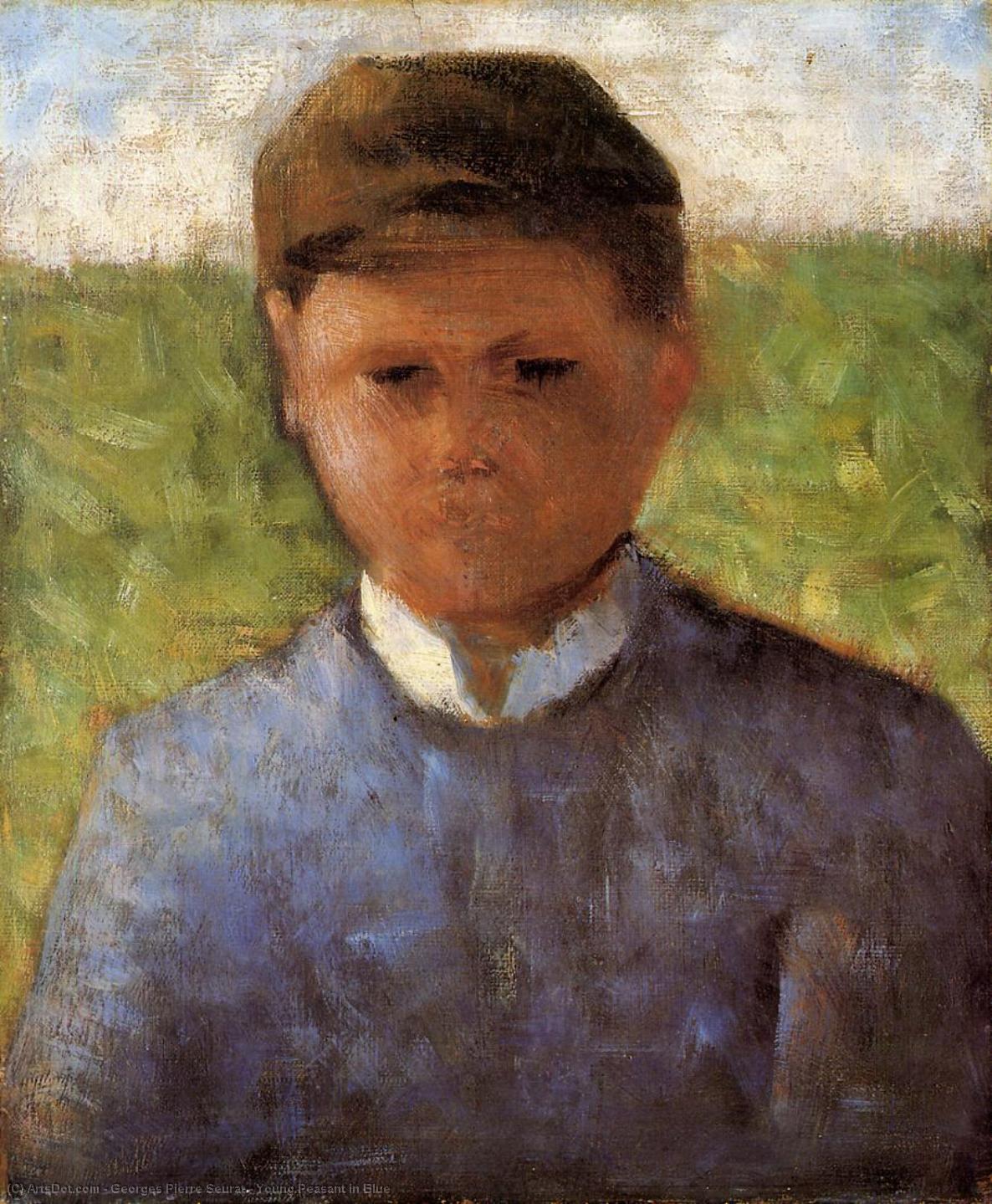
In the quietude of a sun-drenched meadow, Georges Seurat captures a moment that feels both fleeting and eternal. Young Peasant in Blue is not merely a portrait of a solitary figure; it is a profound meditation on the relationship between humanity and the natural world. The painting presents us with a young boy, his gaze steady and serious, anchored amidst a lush, verdant landscape. There is an undeniable sense of tranquility that radiates from the canvas, inviting the viewer to step away from the frantic pace of modern life and enter a realm of pastoral peace. Through his masterful command of color, Seurat transforms a simple rural scene into a luminous experience, where the air itself seems to shimmer with the warmth of a summer afternoon.
The emotional resonance of this piece lies in its delicate balance between solitude and connection. While the boy sits alone, he is deeply integrated into his environment, his blue attire acting as a cool, calming counterpoint to the vibrant greens and earthy tones of the meadow. This creates an atmosphere of contemplative stillness, making the artwork an ideal centerpiece for spaces designed for reflection, such as a quiet study, a serene bedroom, or a sophisticated lounge. For the collector or interior designer, this painting offers more than just aesthetic beauty; it provides an emotional anchor, a window into a world where time slows down and the simple essence of life is celebrated.
The Scientific Soul of Pointillism
To look closely at Young Peasant in Blue is to witness the birth of a revolution. Painted in 1881, this work sits at the fascinating intersection of Impressionist emotion and scientific precision. Seurat was far more than a painter; he was an observer of light and optics. Moving away from the spontaneous, often messy brushstrokes of his predecessors, Seurat pioneered the technique of Pointillism—a method rooted in the rigorous study of color theory and chromoluminarism. Rather than blending pigments on a palette, he applied tiny, distinct dots of pure color directly onto the canvas, trusting the viewer's eye to perform the final act of creation.
This technique, often referred to as divisionism, allows for a unique optical vibration. When viewed from a distance, these individual points of pigment coalesce into a seamless tapestry of light and shadow. The blue of the boy's shirt is not just a single shade of cobalt; it is a complex arrangement of blues, violets, and perhaps even subtle hints of orange to create a sense of depth and luminosity that traditional blending could never achieve. This meticulous approach gives the painting a structured, almost architectural quality, providing a sense of permanence and weight that distinguishes Seurat's work from the ephemeral nature of pure Impressionism.
A Legacy for the Modern Collector
For those seeking to adorn their homes with art that speaks of both intellect and emotion, a high-quality reproduction of this masterpiece offers an unparalleled opportunity. The enduring appeal of Seurat’s vision lies in its ability to harmonize the logical with the lyrical. His work serves as a testament to the power of disciplined observation, proving that through precision, one can capture the very soul of a moment. Whether placed in a contemporary gallery-style setting or a more traditional, classic interior, Young Peasant in Blue brings with it a sense of historical gravity and timeless elegance.
Investing in a hand-painted reproduction allows the textures and light-play of Seurat's original vision to be felt within your own space. It is an invitation to surround oneself with the brilliance of the late nineteenth century—a period of profound artistic transformation. As you contemplate the boy's steady gaze and the rhythmic dance of color across the meadow, you are not just looking at a painting; you are participating in a long-standing dialogue between science, art, and the human spirit.