A Symphony of Verdant Shadows
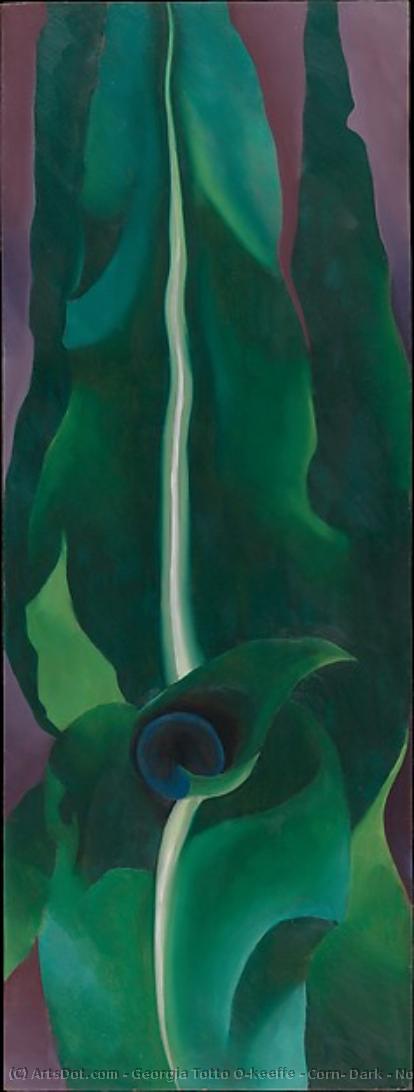
In the quiet, sun-drenched summer of 1924, Georgia O’Keeffe found herself amidst the tranquil waters of Lake George, New York, embarking on a creative journey that would redefine the boundaries of American modernism. Her work, Corn, Dark, No. 1, emerges from this pivotal era as a profound exploration of form and essence. While often associated with her iconic floral studies, this particular piece captures a different facet of her botanical fascination—the rhythmic, vertical strength of corn stalks. The painting is not merely a depiction of agricultural life but a masterful study in Precisionism, where the organic architecture of nature is distilled into its most fundamental and striking elements.
The composition is characterized by a captivating interplay of light and shadow, rendered through a palette that celebrates the depth of the natural world. O’Keeffe utilizes a restrained yet luminous range of greens—from the softest celadon to the deepest, most mysterious emeralds—to create a sense of living texture. The verticality of the subject matter provides a structural elegance that draws the eye upward, mimicking the inevitable growth and reaching toward the light. Through her deliberate use of line and color, she achieves a balance that transcends mere representation, inviting the viewer to experience the quiet vitality of the garden through an abstract lens.
Technique and the Art of Abstraction
To gaze upon this work is to witness O’Keeffe’s sophisticated command over layered impressionism. Eschewing the rigid boundaries of traditional realism, she employed a technique of building up thin glazes of oil paint, a method that imbues the canvas with an extraordinary sense of luminosity and depth. This layering allows light to appear as though it is emanating from within the very fibers of the corn stalks themselves. The brushwork, while controlled, retains a palpable energy; subtle, strategic strokes capture the way moisture clings to a leaf or how sunlight breaks across a serrated edge.
This meticulous approach creates a three-dimensional quality that is particularly striking for collectors and interior designers looking to introduce texture into a space. The painting possesses a tactile presence, where the interplay of light and shadow suggests a physical weight and a rhythmic movement. It is an exercise in controlled spontaneity, where every stroke serves the greater purpose of capturing the soul of the subject rather than just its outward appearance.
An Emotional Resonance for the Modern Interior
Beyond its technical brilliance, Corn, Dark, No. 1 carries a profound emotional weight. It embodies a sense of serenity and groundedness, making it an ideal centerpiece for those seeking to cultivate an atmosphere of contemplative peace within a home or gallery. The artwork speaks to the universal themes of growth, resilience, and the quiet beauty found in the overlooked corners of the natural world. For the discerning collector, owning a reproduction of such a piece is an opportunity to possess a fragment of art history—a moment when O’Keeffe bridged the gap between the tangible landscape and the abstract emotion.
For interior designers, this work offers unparalleled versatility. Its organic shapes and sophisticated color palette can anchor a room, providing a focal point that is both intellectually stimulating and aesthetically soothing. Whether placed in a minimalist contemporary setting or a more traditional, richly textured environment, the painting’s ability to evoke the tranquil atmosphere of Lake George ensures it remains a timeless addition to any curated collection.