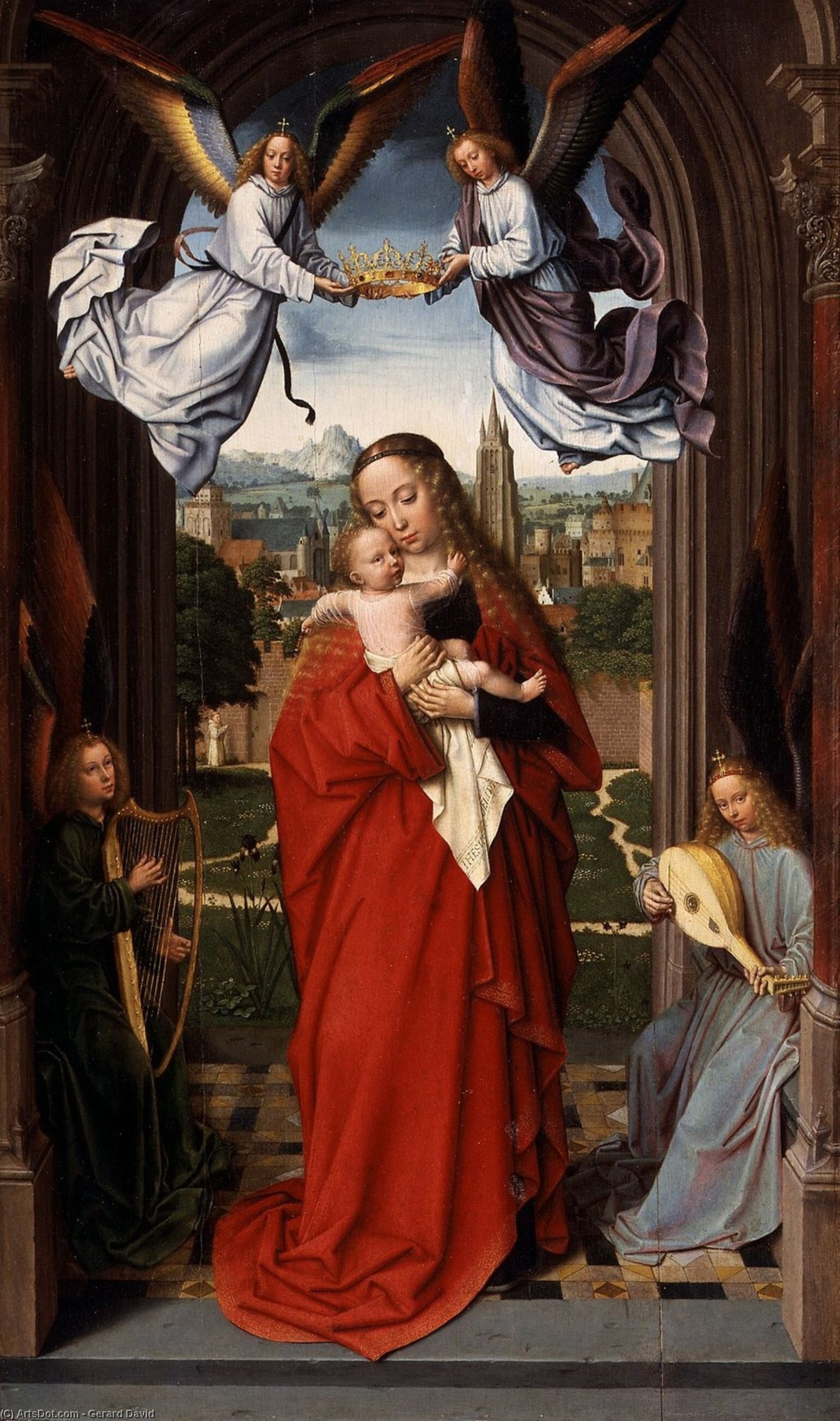
The Virgin and Child with Four Angels: A Tapestry of Faith and Divine Grace
Gerard David’s “Virgin and Child with Four Angels,” painted around 1505 in the heart of Bruges, stands as a luminous testament to the burgeoning Renaissance spirit within the Northern European art world. More than simply a devotional image, it's a carefully constructed tableau brimming with symbolic resonance and technical mastery—a miniature world rendered with an almost unsettling intimacy. The painting immediately draws the eye into its serene depths, dominated by the central figures of Mary and Christ, framed against a subtly atmospheric backdrop that hints at both earthly reality and celestial grace.
David’s approach diverges significantly from the more rigid formalism of his predecessors. While influenced by Jan van Eyck's meticulous realism – particularly evident in the delicate rendering of Mary’s robes and the luminous quality of Christ’s skin – he introduces a profound sense of depth and spatial ambiguity. The background, far from being merely decorative, feels almost dreamlike, blurring the lines between interior space and exterior landscape. This deliberate manipulation of perspective creates an immersive experience for the viewer, inviting them into the sacred narrative.
A Symphony of Color and Light
The painting’s power lies not just in its composition but also in David's extraordinary command of color and light. He eschews the stark contrasts favored by earlier Flemish masters, opting instead for a palette of warm, muted tones—rich reds, deep blues, and subtle greens—that evoke a sense of tranquility and spiritual warmth. The use of sfumato, a technique borrowed from Leonardo da Vinci, softens edges and creates an ethereal glow around Mary and Christ, further enhancing their divine presence. Notice how the light seems to emanate *from* the figures themselves, bathing the scene in a gentle radiance.
David’s brushwork is remarkably delicate and precise, particularly evident in the intricate detailing of the angels' wings and garments. Yet, beneath this surface precision lies a remarkable fluidity—a sense of movement and life that breathes vitality into the composition. The artist masterfully balances realism with idealism, creating figures that are both recognizably human and imbued with an otherworldly beauty.
Symbolism Woven into the Fabric
The painting is rich in symbolic detail, each element contributing to a complex theological narrative. The four angels surrounding Mary and Christ represent the Evangelists—Matthew, Mark, Luke, and John—who chronicled the life of Jesus. Their placement at varying heights and distances from the central figures underscores their diverse roles within the biblical story. The presence of the small figure standing in the lower left corner is often interpreted as a representation of Saint John the Baptist, pointing towards Christ – a gesture of reverence and anticipation.
The setting itself—a walled garden bathed in soft light—symbolizes Mary’s purity and virginity, while the distant view of Bruges represents the earthly realm from which Christ has emerged. The archway framing the scene further emphasizes this transition between the divine and the human. Even the musical instruments held by the angels – a harp and lute – carry symbolic weight, representing harmony and joy in God’s presence.
A Legacy of Beauty and Spiritual Depth
“Virgin and Child with Four Angels” is more than just a beautiful painting; it's a profound meditation on faith, grace, and the relationship between humanity and divinity. David’s masterful technique, combined with his innovative use of perspective and symbolism, created an image that continues to resonate with viewers centuries after its creation. It remains a cornerstone of Northern Renaissance art—a testament to the enduring power of religious imagery to inspire awe and contemplation.
Reproductions capture much of this beauty, offering a window into David’s world and his profound artistic vision. Consider framing your reproduction within a space that complements its serene atmosphere – perhaps a quiet corner bathed in natural light, allowing the painting's luminous quality to truly shine.