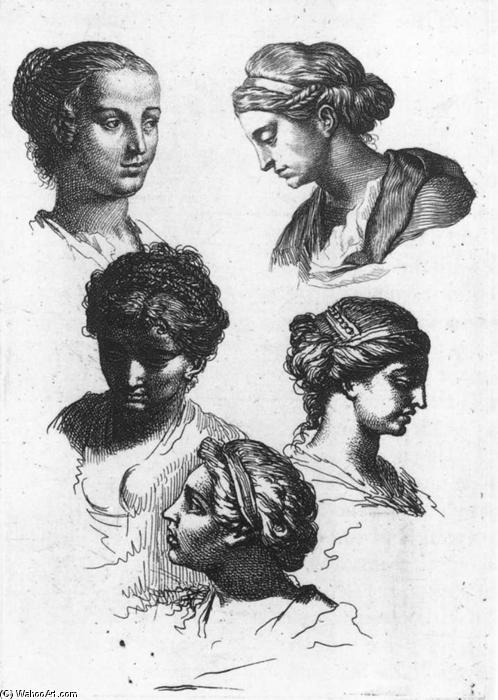
Five Female Heads by Gérard de Lairesse: A Study in Baroque Grace
Gérard de Lairesse’s “Five Female Heads,” painted around 1670, isn't merely a portrait; it’s a profound meditation on beauty, femininity, and the nascent spirit of the Baroque era. This captivating work, currently residing within the Web Gallery of Art, offers a glimpse into the mind of a master artist grappling with classical ideals while simultaneously embracing the dramatic intensity characteristic of his time. The composition itself is strikingly direct – five elegantly rendered female heads arranged in a deliberate grid, inviting viewers to contemplate each face as an individual yet united by their shared grace and composure.
Lairesse’s style leans heavily into the influence of Caravaggio and Rembrandt, artists who understood the power of light and shadow to shape perception. The painting is dominated by a muted palette of grays and whites, achieved through meticulous hatching and cross-hatching techniques – a hallmark of engraving but skillfully adapted for oil paint. This monochrome approach doesn’t diminish the drama; rather, it heightens it, forcing the viewer to focus entirely on the subtle nuances of expression and texture within each head. The artist masterfully uses chiaroscuro, creating areas of deep shadow that accentuate the contours of the faces and lending them a palpable sense of volume and depth.
A Window into 17th-Century Artistic Thought
To understand “Five Female Heads,” it’s crucial to situate it within its historical context. The late 17th century was a period of immense artistic ferment in Europe, marked by a renewed interest in classical antiquity and a burgeoning desire for realism. Lairesse, along with other artists like Peter Paul Rubens, sought to elevate portraiture beyond mere likeness, aiming instead to capture the inner lives and emotions of their subjects. This piece reflects that ambition – each head seems poised on the brink of revelation, hinting at untold stories and complex feelings.
Interestingly, Lairesse’s artistic journey was intertwined with personal struggles. He suffered from syphilis, a disease prevalent during the period, which ultimately led to blindness. The distinctive saddle-shaped nose visible in portraits like this one serves as a poignant reminder of his physical affliction, adding another layer of complexity and vulnerability to his work. His later treatises on painting, such as “Groot Schilderboek,” demonstrated a commitment to establishing a scientific approach to art, emphasizing geometry and proportion – reflecting the intellectual currents of the time.
Deconstructing the Composition: Form and Emotion
The arrangement of the heads is not arbitrary. Lairesse deliberately employs a grid-like structure, creating a sense of order and control while simultaneously suggesting a subtle tension between the figures. Each head is presented from a slightly different angle, offering varied perspectives on their facial features – a technique that invites the viewer to actively engage with the artwork and consider each face as an individual entity. The use of line is paramount; delicate lines define the contours of the eyes, noses, and mouths, while hatching and cross-hatching create tonal variations that suggest depth and volume.
Beyond technical mastery, “Five Female Heads” possesses a remarkable emotional resonance. Despite its formal restraint, the painting conveys a sense of quiet contemplation and subtle melancholy. The expressions on the faces – ranging from serene serenity to thoughtful introspection – invite viewers to project their own emotions and experiences onto the subjects. It’s a testament to Lairesse's skill that he could imbue such seemingly simple portraits with such profound psychological depth.
A Legacy of Baroque Beauty
Gérard de Lairesse’s “Five Female Heads” stands as a significant example of Baroque portraiture, showcasing the artist’s technical brilliance and his ability to capture both the beauty and complexity of the human form. Reproductions of this work continue to resonate with art lovers today, offering a glimpse into a pivotal moment in artistic history – a time when artists sought to elevate portraiture beyond mere likeness and explore the depths of human emotion through masterful technique and evocative imagery. The painting’s enduring appeal lies not only in its aesthetic beauty but also in its poignant reflection on the challenges and triumphs of the human experience.