A Symphony of Stillness: The Intimate World of Gerard ter Borch
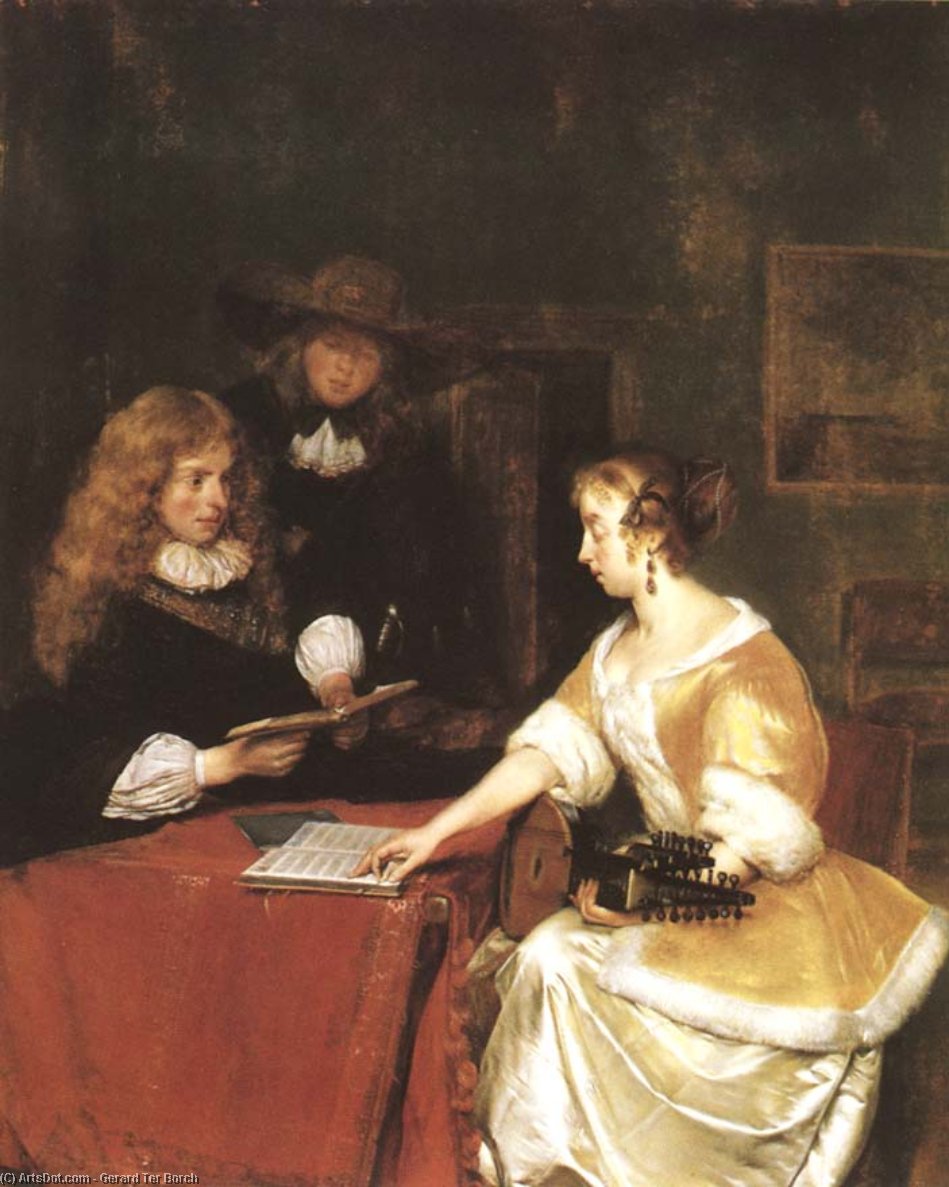
In the quiet corners of the Dutch Golden Age, few artists possessed the ability to transform a domestic moment into a profound psychological study as masterfully as Gerard ter Borch. His 1675 masterpiece, A Concert, invites the viewer into a private sanctuary of melody and companionship. The scene unfolds around a central dining table, where three figures are gathered in an atmosphere of focused, quiet devotion to music. On the left, a figure cradles a book, perhaps a collection of musical notation, while across from them, the delicate presence of a violin and a lute rests near their companions. This is not a boisterous celebration, but rather a captured breath—a moment of shared harmony that transcends the mere act of playing instruments.
The composition is anchored by a sense of grounded realism, a hallmark of Ter Borch’s pioneering genre painting. The table, occupying much of the midground, serves as the stage for this domestic drama, adorned with a simple bowl that hints at a shared meal interrupted or perhaps accompanied by song. A solitary chair stands poised at the edge of the frame, an evocative element that suggests the possibility of another guest joining the circle, or perhaps the recent departure of one. This subtle use of negative space and placement creates a narrative tension, making the viewer feel less like a distant observer and more like an unobserved guest in the room.
Mastery of Texture and Light
To behold A Concert is to witness the technical brilliance of a painter who understood that light is the soul of texture. Ter Borch was renowned for his ability to render the tactile qualities of fabric, skin, and wood with an almost supernatural precision. In this work, the soft glow illuminating the figures highlights the smooth grain of the lute and the polished surface of the violin, contrasting beautifully with the matte textures of the clothing and the heavy, lived-in feel of the indoor setting. The light does not merely illuminate; it sculptates, carving out the depth of the room and lending a three-dimensional weight to the figures that makes them feel palpably present.
For the discerning collector or interior designer, this painting offers more than just historical significance; it provides a sophisticated focal point for any curated space. The muted, earthy palette—rich with deep shadows and warm, amber tones—allows the piece to integrate seamlessly into classical or contemporary settings alike. Whether placed in a library, a formal dining room, or a quiet study, the painting exudes an aura of timeless elegance. It serves as a window into a bygone era, bringing with it a sense of calm, intellectual depth, and the enduring beauty of the Dutch tradition.
The Emotional Resonance of Harmony
Beyond the technical execution lies the emotional heartbeat of the work. There is a profound sense of tranquility embedded in the arrangement of the musicians. The interplay between the visual elements—the book, the instruments, the shared table—symbolizes the harmony that music brings to human connection. Ter Borch captures the concept of "musica reservata," the private music intended for small, intimate circles, reflecting a period where art was deeply intertwined with personal emotion and domestic stability.
Owning a high-quality reproduction of this work allows one to inhabit this atmosphere of peace daily. It is an invitation to slow down, to appreciate the subtle nuances of light and shadow, and to find beauty in the quietest moments of life. As a piece of decor, A Concert does not shout for attention; instead, it commands respect through its understated grace, making it an incomparable choice for those who seek to surround themselves with art that speaks to the soul.