A Glimpse into Dutch Eminence
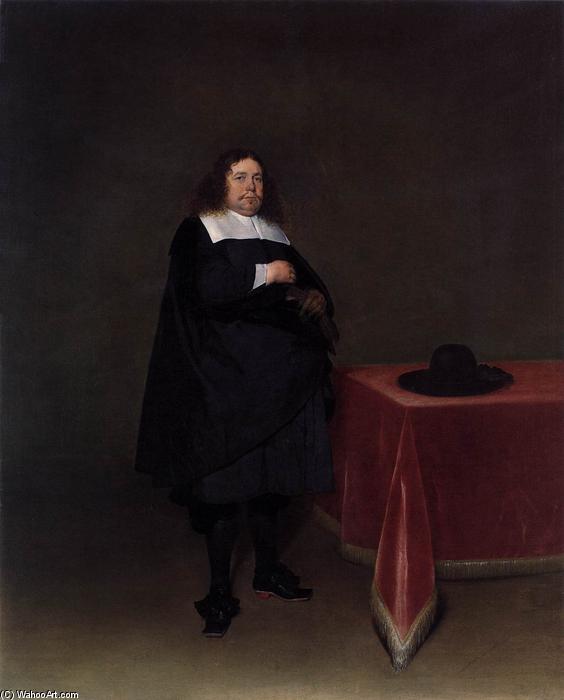
In the quiet, dignified atmosphere of the Dutch Golden Age, few portraits capture the essence of civic authority and personal grace as masterfully as Gerard ter Borch’s Burgomaster Jan van Duren. Painted in 1666, this work is far more than a mere photographic precursor; it is a meticulously crafted window into the refined world of seventeenth-century Deventer. As the viewer encounters the subject, there is an immediate sense of meeting a man of substance. The Burgomaster stands with a poised, commanding presence, his gaze meeting ours with an unflinching honesty that was the hallmark of ter Borch’s genius. This is not an idealized icon of power, but a living, breathing individual, captured in a moment of quiet contemplation that invites us into his private sphere.
The composition is a masterclass in balance and understated opulence. Clad in a deep black coat accented by crisp white trim, the subject embodies the somber yet sophisticated fashion of the Dutch merchant class. The subtle interplay of textures—the heavy weight of the fabric against the soft light—demonative ter Borch’s unparalleled ability to render material reality. Behind him, the rich, warm tones of a red table provide a striking color contrast, grounding the figure within a domestic setting that feels both intimate and stately. This careful arrangement of elements ensures that while the subject is the undeniable focus, the environment contributes to a larger narrative of stability, wealth, and social stratification.
The Mastery of Light and Shadow
To study this portrait is to witness the profound technical skill of a pioneer of Dutch genre painting. Ter Borch was celebrated for his ability to manipulate light, eschewing the grand, theatrical lighting of the Baroque in favor of a more diffused, atmospheric illumination. In Burgomaster Jan van Duren, we see the subtle application of chiaroscuro, where light and shadow dance across the subject's features to heighten the emotional depth of the piece. This technique does not merely illuminate; it sculpts, carving out the folds in his clothing and the subtle psychological nuances etched upon his face.
The artist’s brushwork is incredibly precise, capturing every minute detail with breathtaking accuracy. Whether it is the slight tilt of the hat held in his hand or the way the light catches the edge of a collar, the precision serves to create a palpable sense of realism. For the collector or the interior designer, this level of detail offers a profound sensory experience. The painting possesses an immersive quality that transcends the canvas, making it an ideal centerpiece for spaces that value sophistication, historical depth, and a touch of quiet drama.
A Legacy of Intimacy and Truth
Beyond its technical brilliance, the portrait resonates with a deep emotional truth. Ter Borch had a unique talent for taking subjects out of the grand public stage and placing them within the "sanctum of the home," revealing their inner lives and even their uncertainties. In this depiction of Jan van Duren, we feel the weight of responsibility carried by a civic leader, yet we also sense the humanity beneath the official title. It is this delicate balance between the public persona and the private soul that makes the work so enduringly captivating.
For those seeking to adorn their homes or galleries with art that inspires conversation and reflection, a high-quality reproduction of this masterpiece offers an unparalleled opportunity. It brings into a contemporary setting the prestige of the Dutch Golden Age, providing a focal point that is both intellectually stimulating and aesthetically sublime. To hang such a work is to invite the spirit of 1666 into the modern era, celebrating a time when art was used to capture not just the likeness of man, but the very essence of his character.