A Moment Suspended in Time: The Intimacy of Correspondence
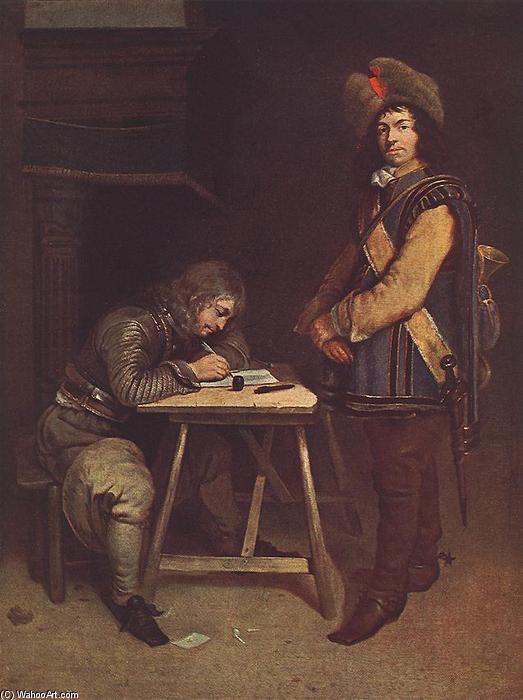
To gaze upon Gerard ter Borch's "Officer Writing a Letter" is to be invited into a hushed chamber, a private theatre where the weight of unspoken thoughts and carefully chosen words hangs palpably in the air. This painting transcends a mere depiction of two men; it captures that exquisite, fragile moment when human connection is mediated through ink and paper. The scene unfolds with an almost theatrical stillness, drawing the viewer immediately into the quiet concentration of the central figure. He sits, absorbed by his task, the quill poised as if holding not just ink, but the very essence of his intent. It speaks to a time when correspondence was a ritual, imbued with gravity and personal significance.
Mastery of Light and Genre Detail
Ter Borch, a quintessential master of Dutch genre painting, possessed an unparalleled gift for rendering domestic intimacy with luminous precision. Notice how the light seems to emanate from an unseen source, catching the sheen on the blue jacket of the standing gentleman and highlighting the rich texture of the brown coat worn by the writer. His technique is breathtaking in its subtlety; every fold of fabric, every glint off a polished surface, contributes to a sense of tangible reality. The dark background serves not as emptiness, but as a velvet curtain against which the illuminated drama of human interaction can play out with maximum dramatic effect. This meticulous attention to material detail elevates the scene from simple portraiture to profound study.
Symbolism and Social Narrative
The figures themselves are rich with unspoken narrative. The standing officer, adorned with a striking red feathered hat and holding both a sword and gloves, embodies status and military bearing—a man accustomed to public life. Juxtaposed against him is the quiet focus of the writer. This contrast suggests a dynamic interplay: perhaps the letter contains news that alters the standing man's world, or perhaps it is a dispatch detailing an event he must soon participate in. The objects—the quill, the paper, the sword—are not mere props; they are symbols anchoring the emotional weight of their relationship and the pivotal moment being documented.
Bringing the Salon Home: Reproduction for Modern Spaces
For those who wish to capture this sophisticated atmosphere within a contemporary setting, acquiring a high-quality reproduction of "Officer Writing a Letter" offers an unparalleled opportunity. It allows one to infuse a room with the refined elegance and narrative depth characteristic of the Dutch Golden Age. Whether placed in a study corner or a formal drawing-room, the painting’s inherent drama and masterful composition act as a sophisticated focal point. Owning this piece is not merely decorating; it is curating an atmosphere steeped in intellectual contemplation and historical romance.