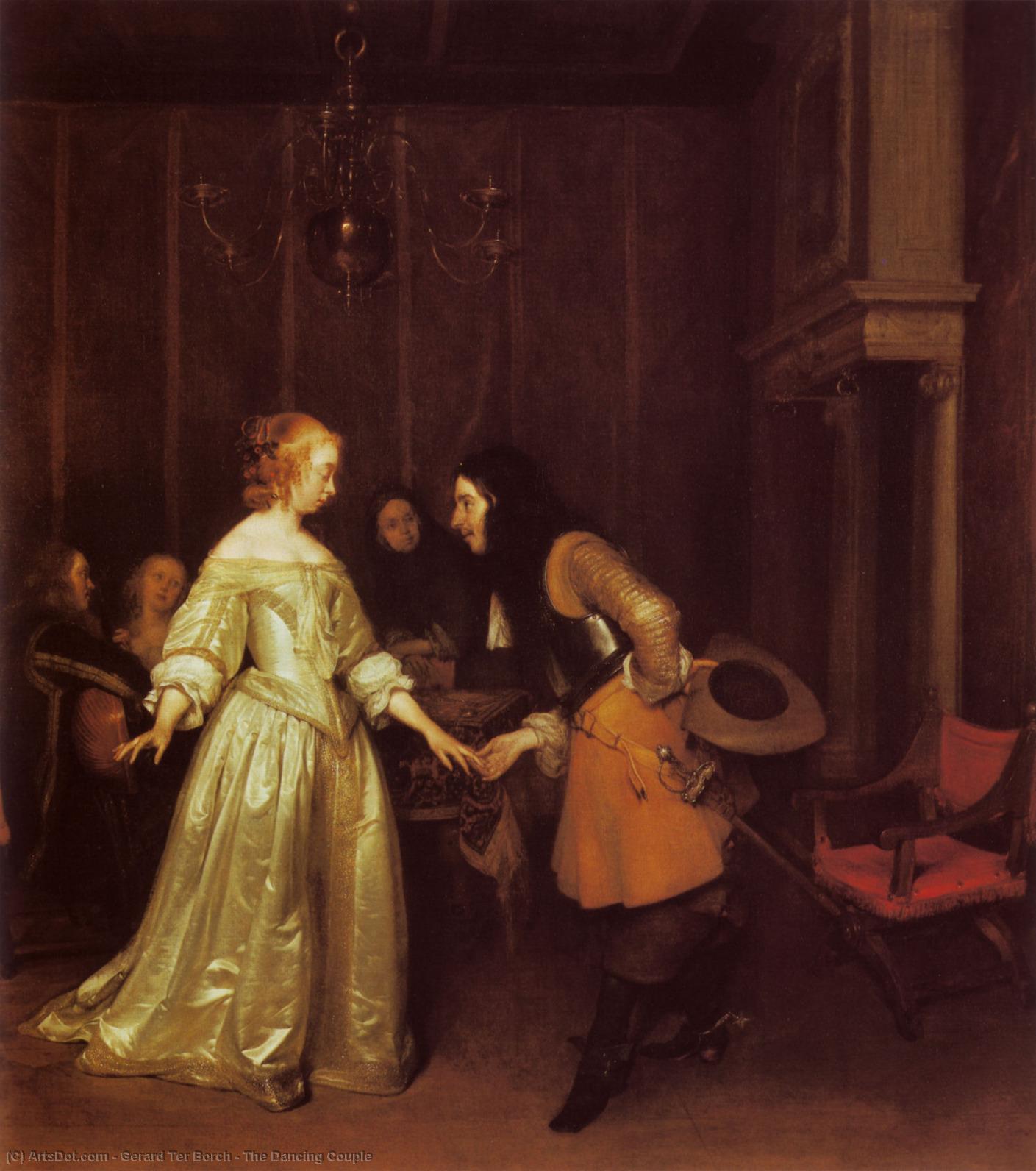
A Moment Frozen in Dutch Golden Age Grace: Gerard ter Borch’s “The Dancing Couple”
Gerard ter Borch's "The Dancing Couple," painted circa 1660, offers a rare and intimate glimpse into the social life of the Dutch Republic during its golden age. Measuring a modest 76 x 68 cm, this seemingly simple portrait belies a profound depth of observation and technical mastery that firmly establishes ter Borch as a pioneer of Dutch genre painting – a movement dedicated to depicting everyday scenes and human interactions with unprecedented realism.
The scene unfolds within the confines of a richly furnished room, dominated by a dining table and several figures engaged in what appears to be a lively gathering. The central couple, a man impeccably dressed in a dark suit and the woman radiant in a flowing white gown, are caught in a moment of poised movement, suggesting an impromptu dance or perhaps a sophisticated conversation. Their proximity speaks volumes about social status and the carefully cultivated etiquette of the era. The inclusion of other figures – one on the left, two near the center, and another to the right – adds layers of narrative complexity, hinting at relationships, conversations, and the subtle dynamics of group interaction that were central to ter Borch’s artistic concerns.
Masterful Technique: Ter Borch's Commitment to Realism
Ter Borch’s skill lies not merely in depicting a scene but in rendering it with an almost photographic precision. His technique, honed through extensive travels across Europe – including London, Germany, France, Spain, and Italy – is characterized by meticulous attention to detail and a profound understanding of light and shadow. Note the subtle variations in texture: the worn fabric of the chair, the polished surface of the table, the delicate folds of the woman’s dress. These details are not mere decorative flourishes; they contribute significantly to the painting's overall sense of realism and immediacy.
The artist employs a muted palette – predominantly browns, grays, and creams – which further enhances the scene’s atmosphere of quiet contemplation. Light plays a crucial role, illuminating key elements while casting deep shadows that add depth and volume to the figures. This masterful manipulation of light is characteristic of ter Borch's approach and elevates the painting beyond a simple portrait into a study of form and perception.
Symbolism and Social Commentary
"The Dancing Couple" transcends a mere depiction of social activity; it offers subtle commentary on the values and conventions of 17th-century Dutch society. The couple’s attire, particularly the man's formal suit, signifies wealth and status – hallmarks of the burgeoning merchant class that dominated the Dutch economy at the time. The act of dancing itself was a popular pastime among the upper classes, representing leisure, social connection, and refined taste.
Furthermore, ter Borch’s focus on capturing fleeting moments of human interaction reflects a broader trend in Dutch art during this period – a shift away from grand historical or mythological subjects towards more intimate and relatable scenes of everyday life. This emphasis on realism and psychological depth cemented ter Borch's legacy as one of the most important figures in the development of genre painting, influencing generations of artists to come.
A Timeless Piece for Your Collection
ArtsDot offers a meticulously crafted hand-painted reproduction of Gerard ter Borch’s “The Dancing Couple,” allowing you to bring this remarkable work of art into your home or office. Each reproduction is created using the highest quality materials and techniques, ensuring that it faithfully captures the original's beauty and detail. This artwork is more than just a decoration; it’s an investment in artistic heritage and a testament to the enduring power of ter Borch’s vision.