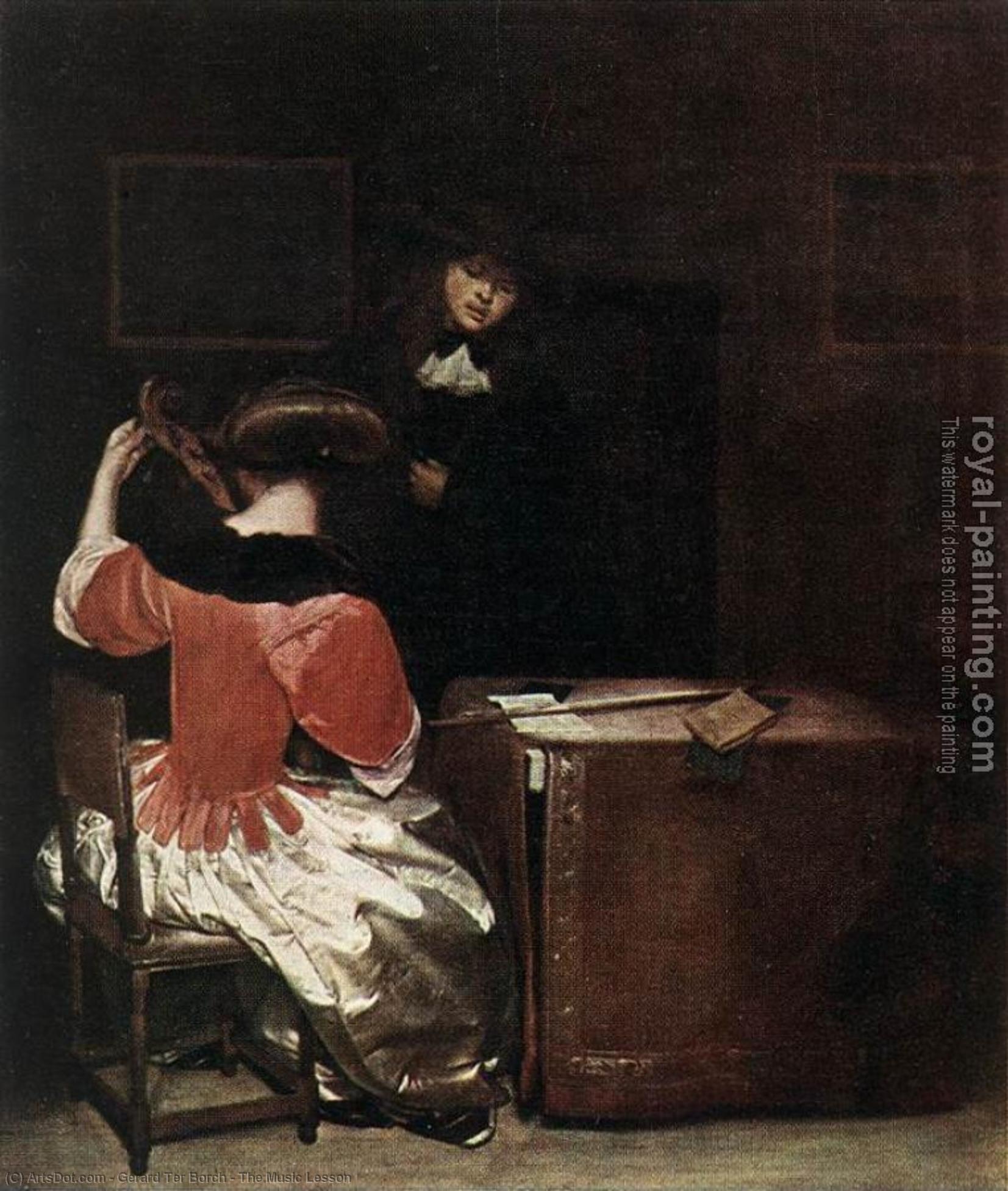
The Music Lesson: A Portrait of Intimacy and Artistic Mastery
Gerard ter Borch’s “The Music Lesson,” painted around 1670, is not merely a depiction of a musical scene; it's a profound exploration of human connection, quiet contemplation, and the subtle dance between instruction and absorption. This small-scale masterpiece, now residing within The Art Institute of Chicago, offers an intimate glimpse into a private moment, revealing layers of psychological depth rarely found in Dutch genre paintings of its era. Ter Borch’s genius lies not just in his technical skill—the meticulous rendering of fabrics, the delicate modeling of faces—but in his ability to capture the unspoken narratives that reside within seemingly simple scenes.
The painting centers on a young woman, poised at a table draped with a richly patterned rug, her attention entirely focused on the double-headed lute before her. Her posture suggests both eagerness and slight uncertainty as she receives instruction from a man standing behind her. He’s not aggressively teaching; rather, he seems to be subtly guiding, his hand lightly resting upon her shoulder – a gesture of gentle encouragement rather than forceful direction. The room itself is bathed in soft light filtering through a window, creating an atmosphere of warmth and domestic tranquility. Notice the details: the partially open window, hinting at the outside world, the tiled floor reflecting the light, and the carefully arranged objects—a jug of water, a small stool – all contributing to a sense of lived-in comfort.
A Window into 17th-Century Dutch Life
“The Music Lesson” is firmly rooted in the artistic conventions of the Dutch Golden Age. Ter Borch was a pioneer in capturing everyday life with remarkable realism and psychological acuity, moving beyond the grand historical narratives favored by many of his contemporaries. He specialized in scenes featuring members of the upper class—merchants, military officers, and women—engaged in quiet domestic activities. This focus on intimate portraits offered a refreshing contrast to the often-heroic depictions of Dutch history. The painting reflects the burgeoning interest in realism and humanism that characterized the period, as artists sought to portray the complexities of human experience with greater honesty and nuance.
The inclusion of musical instruments—the lute, a symbol of refinement and learning—underscores the importance of culture and education within Dutch society. Music was not simply entertainment; it was considered an essential part of a well-rounded upbringing, particularly for young women. The scene subtly suggests the role of music in shaping character and fostering social connections. Furthermore, the presence of another man in the background, partially obscured by the window curtain, hints at a potential romantic interest or a more complex relationship between the two figures – adding an element of intrigue to the otherwise serene composition.
Technique and Artistic Detail
Ter Borch’s technical mastery is immediately apparent. He employed a meticulous approach to rendering texture, evident in the intricate folds of the rug, the delicate sheen of the lute strings, and the subtle variations in the fabric of the woman's dress. His use of light and shadow creates a sense of depth and volume, drawing the viewer’s eye into the scene. The artist’s palette is restrained yet sophisticated, dominated by earthy tones—browns, ochres, and grays—that contribute to the painting’s overall atmosphere of quiet intimacy. Notably, Ter Borch was known for his use of *pointillé*, a technique involving numerous tiny dots to create texture and form – this is particularly evident in the rendering of the fabrics.
The artist's attention to detail extends beyond mere representation; he seems to be conveying an emotional atmosphere. The woman’s slightly furrowed brow, her focused gaze, and the man’s gentle gesture all suggest a moment of intense concentration and quiet understanding. It is this ability to capture subtle nuances of emotion that elevates “The Music Lesson” from a simple genre scene to a profound meditation on human connection.
Symbolism and Emotional Resonance
Beyond its immediate depiction, "The Music Lesson" resonates with deeper symbolic meanings. The act of teaching itself represents the transmission of knowledge, values, and traditions – a cornerstone of societal stability. The music serves as a metaphor for harmony and balance, while the quiet intimacy of the scene suggests a world beyond the public sphere. The painting’s enduring appeal lies in its ability to evoke feelings of nostalgia, curiosity, and a sense of shared humanity. It invites us to contemplate the beauty of simple moments and the power of human connection.
Reproductions of “The Music Lesson” offer a remarkable opportunity to bring this exquisite artwork into your home or office. Whether you are an art enthusiast, a collector seeking a unique addition to your collection, or simply someone who appreciates beautiful and evocative imagery, this painting is sure to captivate and inspire.