Consider researching Gesina ter Borch's influence on Gerard ter Borch's artistic vision and exploring similar works by Alfred Stevens for comparative stylistic analysis.
Explore the life & art of Gerard ter Borch (1617-1681), a Dutch Golden Age master renowned for his intimate genre paintings, capturing everyday life with remarkable realism and light. Discover 'The Letter' & more!
Rijksmuseum
(Amsterdam, Netherlands)
Explore Dutch art & history at the Rijksmuseum Amsterdam! Marvel at Rembrandt, Vermeer & Van Gogh masterpieces in an iconic landmark – a journey through 800 years of culture.
A Window Into Dutch Domestic Life: Gerard ter Borch’s “Woman at a Mirror”
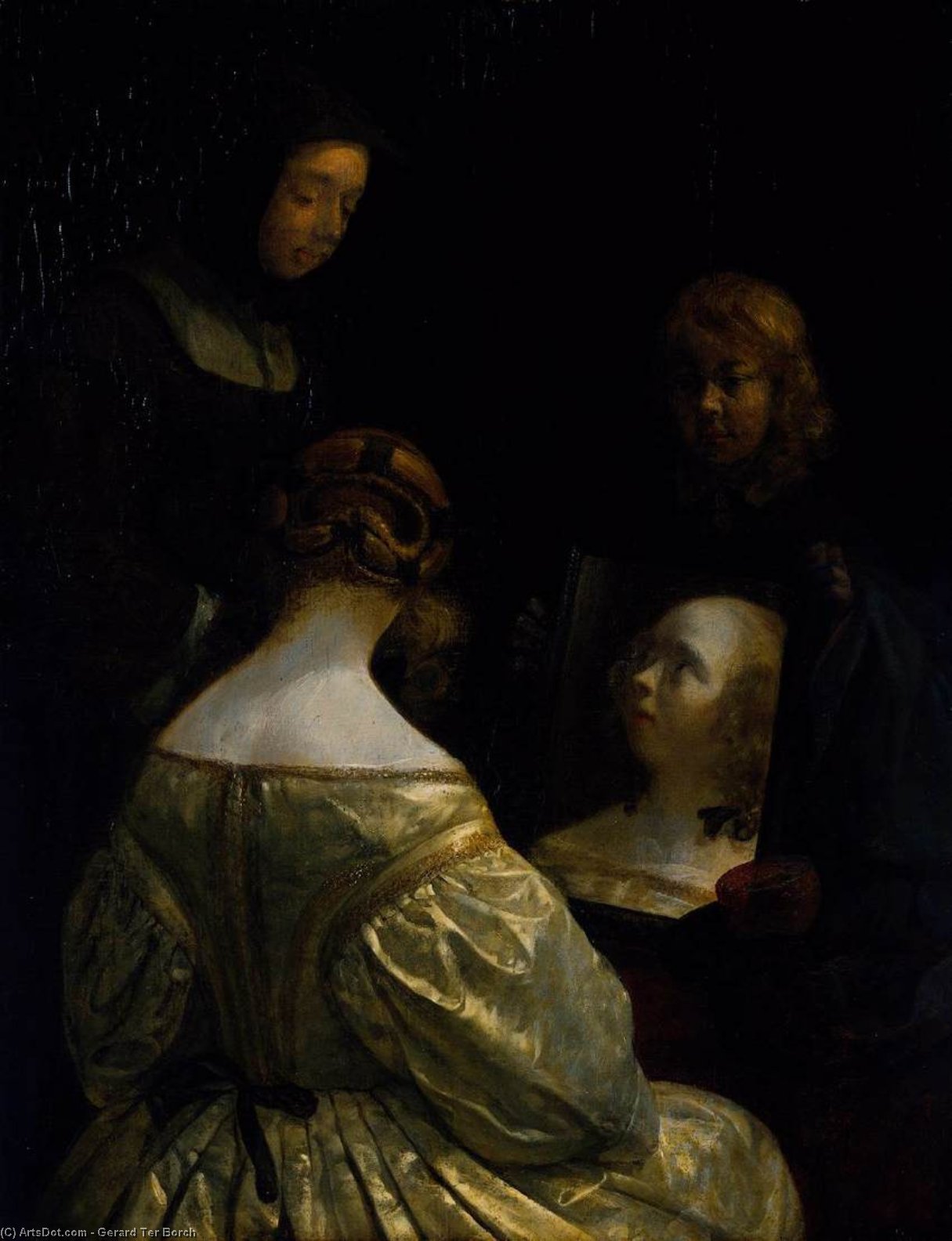
Gerard ter Borch’s “Woman at a Mirror,” painted circa 1650, stands as a cornerstone of Dutch genre painting—a genre that meticulously documented the everyday realities of affluent households during the Golden Age. More than just a portrait, it's an exquisitely crafted tableau capturing a fleeting moment of contemplation within a richly furnished interior, offering viewers a glimpse into the complexities of social etiquette and psychological nuance rarely found in earlier artistic traditions.
Subject Matter & Composition: Intimacy Within Ornamentation
The painting depicts three women—presumably members of a noble family—engaged in an activity that speaks volumes about their status: observing her reflection in a mirror. The central figure, bathed in soft light emanating from a window behind her, dominates the composition, drawing immediate attention with her gaze directed inward. Two other women stand subtly positioned behind her, their postures conveying attentive observation and quiet engagement. Ter Borch’s masterful use of perspective—a technique pioneered by artists like Albert Dürer—creates a convincing illusion of depth within the room's ornate décor. A chair sits to the left, adorned with embroidered cushions, while a dining table occupies the right side, laden with tableware and hinting at an upcoming meal – elements meticulously rendered to convey both visual splendor and social significance.
Style & Technique: Light, Texture, and Psychological Depth
Ter Borch’s distinctive style is characterized by its remarkable sensitivity to light and texture. Unlike many of his contemporaries who favored dramatic chiaroscuro—the stark contrast between light and dark—ter Borch employed a subtle gradated illumination that imbues the scene with an ethereal quality. This technique, combined with meticulous brushwork, captures the velvety sheen of fabrics like velvet curtains and cushions, as well as the delicate surface detail of porcelain figurines scattered across the table. The artist’s painstaking attention to detail extends beyond mere visual representation; he strives to convey psychological depth—the unspoken emotions simmering beneath the veneer of polite conversation.
Historical Context: Reflecting Renaissance Ideals
“Woman at a Mirror” emerged during a period marked by significant intellectual and artistic ferment—the waning influence of Mannerism giving way to the humanist ideals championed by artists like Raphael and Michelangelo. The painting reflects these trends, portraying women as intelligent, discerning individuals capable of introspection and appreciating beauty. Furthermore, it aligns with the broader fascination of Dutch painters with capturing domestic interiors—a genre that flourished in response to the burgeoning mercantile prosperity of the Republic of Amsterdam. These paintings served not only as decorative objects but also as statements about social status and moral virtue.
Symbolism: Mirrors & Contemplation
The mirror itself is laden with symbolic significance, representing self-awareness and inner reflection—themes central to Renaissance philosophy. It prompts viewers to consider questions of identity and perception, mirroring the psychological complexities inherent in human experience. The positioning of the women—one gazing inward while the others observe—further reinforces this notion of contemplation and underscores the importance of internal dialogue within a social context.
Emotional Impact: A Moment Frozen in Time
Ultimately, “Woman at a Mirror” transcends mere visual depiction; it evokes a profound emotional response. The painting’s serene atmosphere—characterized by soft light and muted colors—creates a sense of intimacy and tranquility. Yet, beneath this surface calm lies an underlying tension—the unspoken awareness of social expectations and the subtle interplay of emotions among the figures. Ter Borch's achievement is to capture not just what was seen but also what was felt—a testament to his artistic genius and enduring legacy as one of the most influential painters of the Dutch Golden Age.