A Moment of Quietude: Unveiling Gerard Terborch’s “Woman Peeling Apple”
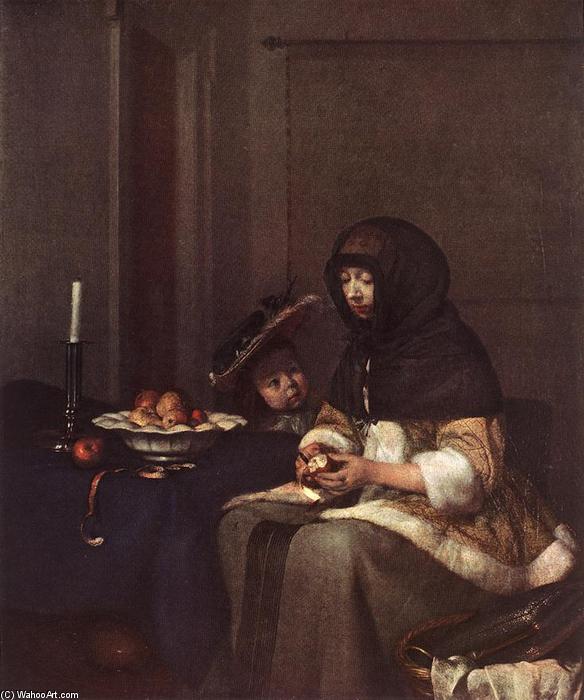
Gerard ter Borch's "Woman Peeling Apple" (circa 1650) isn't merely a depiction of domesticity; it’s a meticulously crafted window into the heart of 17th-century Dutch life, imbued with an almost unsettling intimacy. The painting immediately draws the viewer in, not with grand gestures or dramatic action, but with the quiet, contemplative scene unfolding before them – a woman, bathed in soft light, engaged in the simple act of peeling an apple while her child watches attentively. This seemingly ordinary tableau is rendered with a remarkable sensitivity to texture and emotion, hallmarks of Terborch’s distinctive style and a testament to his mastery of *tronie* painting—a genre focused on capturing psychological states and fleeting moments of human experience.
The composition itself is deceptively simple. A table dominates the foreground, laden with apples – a symbol of abundance, temptation, and even mortality in Western art tradition. The woman’s posture, slightly turned away from the viewer, creates a sense of reserve, while her focused attention on the apple suggests a deliberate act, perhaps a ritual or a cherished routine. Her clothing, dark velvet trimmed with fur, speaks to a comfortable prosperity, yet there's an underlying melancholy in her expression—a subtle hint of weariness or introspection that elevates the scene beyond mere illustration.
The Master of Subtle Detail: Terborch’s Technique
Ter Borch was renowned for his painstaking attention to detail and his ability to render textures with astonishing realism. Observe closely, and you'll notice the delicate layering of paint used to capture the sheen of the apple skin, the rough texture of the wooden table, and the soft folds of the woman’s garments. This meticulous approach wasn’t simply about accuracy; it was a means of conveying depth and atmosphere—of creating an illusion of three-dimensionality within a relatively small canvas. His use of *chiaroscuro* – the dramatic contrast between light and shadow – further enhances this effect, drawing our eye to the central figures while subtly obscuring the background details.
Furthermore, Terborch’s palette is restrained yet remarkably effective. He favors muted earth tones—browns, grays, and ochres—which contribute to the painting's overall sense of quietness and intimacy. The subtle variations in color create a remarkable sense of realism, while also lending the scene a timeless quality.
A Window into Dutch Society: Context and Symbolism
“Woman Peeling Apple” offers a valuable glimpse into the daily lives of wealthy Dutch families during the mid-17th century. The presence of the child suggests a family unit, while the abundance of apples hints at prosperity and security. However, Terborch doesn’t shy away from portraying the complexities of domestic life—the subtle tensions, the unspoken emotions, and the quiet moments of contemplation that lie beneath the surface of everyday routines.
The apple itself carries a rich symbolic weight. In Christian iconography, it represents temptation, knowledge, and mortality – reminders of both earthly pleasures and spiritual dangers. Here, its presence alongside the woman’s act of peeling suggests a meditation on these themes—a quiet acknowledgment of life's fleeting nature.
Capturing Emotion: The Legacy of Terborch
Gerard ter Borch’s “Woman Peeling Apple” is more than just a beautiful painting; it’s a profound exploration of human psychology. His ability to capture subtle emotions and fleeting moments of experience has made him one of the most admired artists of the Dutch Golden Age. Reproductions of this work, meticulously crafted to replicate the original's exquisite detail and atmosphere, offer a unique opportunity to bring this captivating scene into your home or office—a timeless reminder of the beauty and complexity of human life.