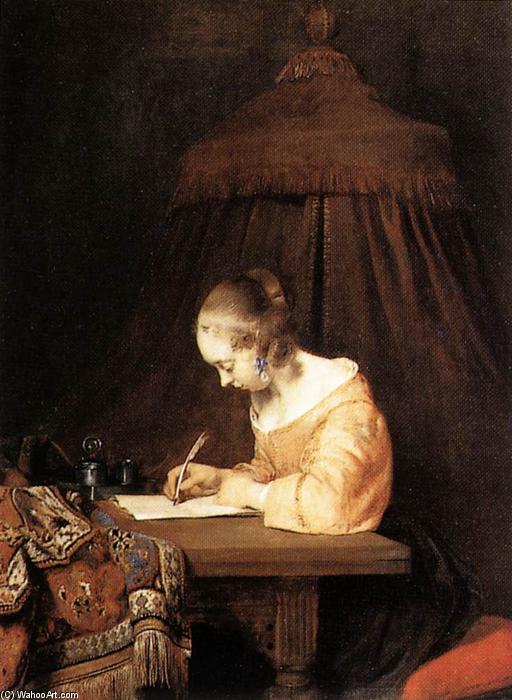
Gerard ter Borch’s ‘Woman Writing a Letter,’ created around 1655, showcases his masterful technique in capturing subtle emotions and textures. Set against a richly detailed interior, the painting portrays a woman diligently composing a letter on a polished wooden table, illuminated by soft light—a scene imbued with symbolic significance regarding purity.
A Moment Frozen in Time: The Intimacy of Ter Borch
In the quiet corners of the Dutch Golden Age, few artists possessed the ability to capture the profound weight of a single, silent moment quite like Gerard ter Borch. His masterpiece, Woman Writing a Letter, dating from 1655, serves as a breathtaking window into the private lives of the seventeenth century. As we gaze upon this scene, we are not merely observing a subject at a desk; we are voyeurs to an intimate act of communication. The composition centers on a woman lost in thought, her long hair cascading softly as she leans over a wooden table. There is a palpable sense of stillness in the room, a hush that suggests the world outside has ceased to exist, leaving only the scratch of a quill and the weight of the words being penned.
The painting is a triumph of genre painting, a style Ter Borch pioneered to elevate everyday domesticity into the realm of high art. Through his masterful command of light and shadow, he transforms a simple interior into a stage of psychological depth. The way the light catches the edge of the wooden table and illuminates the subtle textures of her dress creates a sense of tactile reality that is almost hypnotic. For the collector or the lover of fine art, this piece offers more than just visual beauty; it offers an invitation to contemplate the human condition—the longing, the reflection, and the quiet solitude that defines our most personal connections.
Mastery of Texture and Light
Technically, Woman Writing a Letter is a testament to Ter Borch’s unparalleled skill in rendering material reality. One cannot discuss this work without marveling at his ability to manipulate oil paint to mimic the sheen of satin, the grain of aged wood, and the delicate translucency of skin. The artist uses a sophisticated palette to create a sense of atmosphere, where the shadows are not merely dark spaces but rich, layered depths that provide a sense of volume to the room. This meticulous attention to detail ensures that every element—from the bottle resting near the table's edge to the positioning of the surrounding chairs—contributes to a cohesive, immersive environment.
For interior designers and decorators, this artwork represents a cornerstone of classical elegance. The muted, sophisticated tones of the Dutch palette allow the piece to integrate seamlessly into a variety of high-end settings, whether it be a contemporary gallery-style living room or a traditional study lined with books. A high-quality reproduction of this work brings with it a sense of historical gravity and a refined aesthetic that anchors a room, providing a focal point that sparks conversation and evokes a sense of timelessness.
The Symbolism of the Written Word
Beyond its technical brilliance, the painting is steeped in the subtle symbolism characteristic of the Dutch masters. The act of writing a letter in 1655 was an act of profound intimacy and vulnerability; it was a way to bridge distances and share secrets across borders. The presence of the bottle and the solitary arrangement of the chairs suggest a life lived with quiet contemplation, perhaps hinting at a longing for someone far away. Ter Borch uses these domestic objects to weave a narrative of emotional complexity, where the mundane becomes meaningful.
To possess a reproduction of this work is to bring a piece of history's most tender emotions into one's home. It is an investment in an atmosphere of peace and intellectual depth. Whether you are drawn to the historical significance of the Dutch Golden Age or the sheer aesthetic grace of the composition, Woman Writing a Letter remains an enduring symbol of the beauty found in life's quietest, most reflective intervals.