The Adoration of the Child: A Masterpiece of Dramatic Light by Gerard van Honthorst
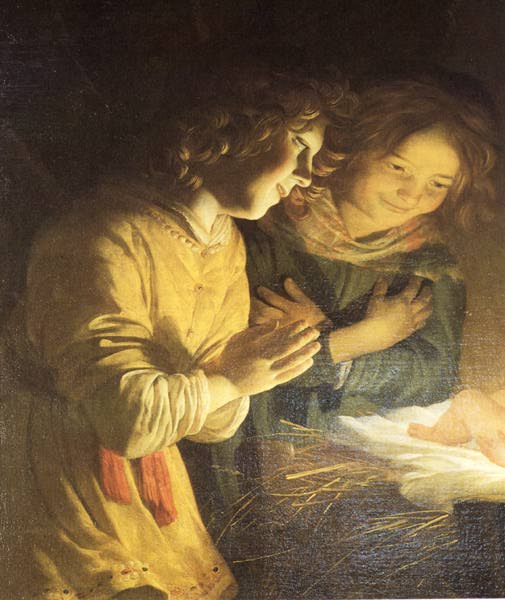
ArtsDot.com presents a captivating detail from “Adoration of the Child,” a pivotal work by the Dutch master Gerard van Honthorst, painted circa 1620. This intimate scene, likely intended as a devotional piece, offers a glimpse into a world brimming with Baroque drama and emotional intensity – hallmarks of Honthorst’s distinctive style. The painting's power resides not just in its subject matter—the tender adoration of the infant Jesus—but in the masterful manipulation of light and shadow that defines his artistic legacy.
Honthorst, deeply influenced by Caravaggio’s revolutionary use of tenebrism, employs a dramatic contrast between illuminated figures and deep recesses to draw the viewer's eye directly to the central focus: the two women kneeling before the Christ Child. Notice how the light, seemingly emanating from an unseen source, gently caresses their faces and hands, highlighting their expressions of reverence and wonder. The dark background doesn’t simply obscure; it amplifies the luminosity of the figures, creating a palpable sense of depth and volume – a technique crucial to conveying the emotional weight of the moment.
A Portrait of Devotion: Symbolism and Composition
The composition itself is meticulously crafted. The two women, positioned on either side of the infant Jesus, represent different facets of faith and devotion. One appears to be contemplating the gift in her hand, perhaps reflecting on its significance, while the other gazes upwards with a sense of awe and supplication. The inclusion of the book near the bottom right corner subtly alludes to scripture and the narrative surrounding Christ’s birth – a common element within religious paintings of the period. The bird soaring above adds an ethereal quality, suggesting a connection between this earthly scene and the divine realm, reinforcing the painting's spiritual core.
The presence of necklaces worn by the women is also significant. These were not merely decorative items; they often held symbolic meaning within religious contexts, representing piety, devotion, or even protection. The careful attention to detail in these seemingly small elements elevates the entire work, demonstrating Honthorst’s commitment to creating a truly immersive and layered experience for the viewer.
Gerard van Honthorst: A Roman Influence
Gerard van Honthorst's artistic journey is inextricably linked to his time spent in Rome. Following his formative training under his father, he embarked on a transformative pilgrimage to Italy, where he encountered the radical innovations of Caravaggio. This encounter fundamentally altered his approach to painting, leading him to embrace tenebrism and develop a signature style characterized by dramatic contrasts and emotionally charged figures. His nickname, “Gherardo delle Notti,” – Gerard of the Nights – perfectly encapsulates this association with the evocative use of darkness and light.
Unlike many artists who merely copied Caravaggio’s techniques, Honthorst skillfully adapted them to his own sensibilities, creating a unique artistic voice that resonated deeply within the Dutch Golden Age. His “Adoration of the Child” stands as a testament to this remarkable synthesis – a powerful blend of Italian Baroque drama and Dutch sensibility.
Bringing Honthorst’s Vision Home
ArtsDot.com offers meticulously crafted hand-painted reproductions of this extraordinary artwork, allowing you to experience the full impact of Honthorst's genius in your own space. Our skilled artisans employ archival quality materials and techniques to faithfully recreate every nuance of light, shadow, and detail, ensuring that your reproduction will retain its beauty and vibrancy for generations to come. Whether as a centerpiece for your living room or a thoughtful gift, this “Adoration of the Child” is more than just a painting; it’s an investment in art history and a celebration of enduring faith.