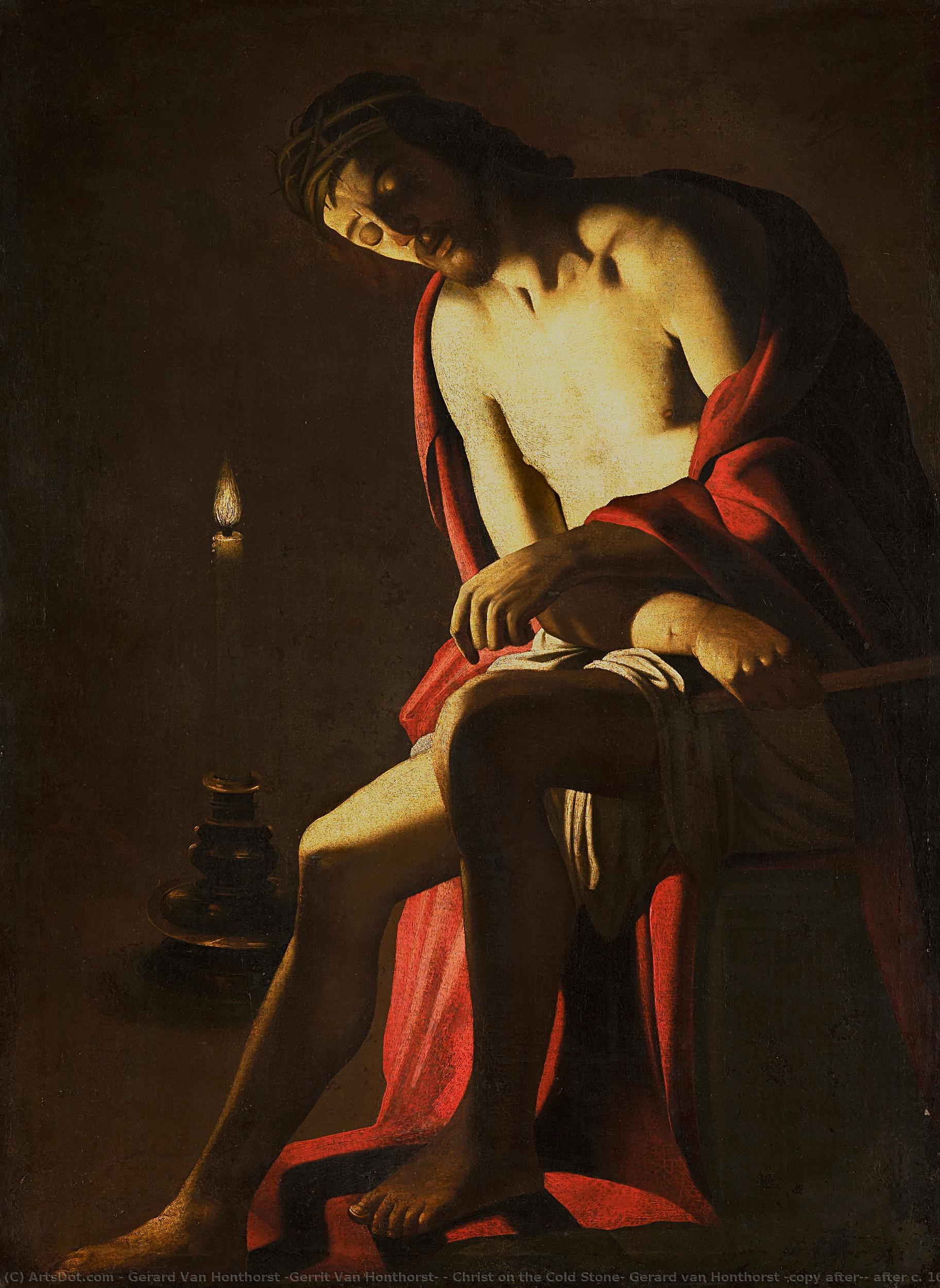
A Moment of Profound Sorrow: Christ on the Cold Stone
Gerard van Honthorst’s “Christ on the Cold Stone” is not merely a depiction of a biblical scene; it's an immersion into raw emotion and masterful technique. Executed likely around 1614, this painting immediately captivates with its dramatic use of light – or rather, the *absence* of light – a hallmark of Honthorst’s style and a direct influence from Caravaggio himself. The composition centers entirely on Christ's slumped form, his head bowed in profound sorrow, as he rests upon a rough-hewn stone. This isn’t a heroic depiction of divine power; it’s an intimate portrayal of human suffering, vulnerability, and the agonizing weight of sacrifice. The stark contrast between the illuminated flesh and the enveloping darkness creates a palpable sense of drama, pulling the viewer directly into Christ's experience.

The Language of Light and Shadow: Technique & Style
Honthorst’s genius lay in his ability to manipulate light – or *chiaroscuro* – with breathtaking precision. The single candle, strategically placed, acts as both a source of illumination and a symbolic beacon of hope within the overwhelming darkness. Notice how the light sculpts Christ's body, emphasizing every muscle and vein, lending an almost sculptural quality to his form. This meticulous attention to anatomical detail, combined with the loose, expressive brushwork, creates a remarkably realistic effect. The oil paint is applied thickly in areas, building up texture and depth, particularly evident in the folds of the drapery and the rough surface of the stone. This technique wasn’t simply about realism; it was about conveying intense emotion through the visual language of light and shadow – a defining characteristic of the Baroque style.
Historical Context & Caravaggio's Influence
Created during a period of immense artistic innovation, “Christ on the Cold Stone” reflects the burgeoning influence of the Italian Renaissance and, crucially, Caravaggio’s revolutionary approach to painting. Honthorst, like many artists of his time, traveled to Rome seeking inspiration, and it was here that he encountered Caravaggio's radical use of tenebrism – the dramatic juxtaposition of light and dark – which profoundly shaped his own artistic vision. The inclusion of the candle itself is a deliberate echo of Caravaggio’s style, further solidifying the connection between these two masters. The painting’s association with Georges de la Tour, another prominent follower of Caravaggio, highlights the widespread impact of this innovative technique across Europe.
Symbolism & Emotional Resonance
Beyond its technical brilliance, “Christ on the Cold Stone” is rich in symbolic meaning. The red drapery, a recurring motif in religious art, represents Christ’s sacrifice and the shedding of his blood. The cold stone symbolizes both the physical reality of the crucifixion and the emotional isolation experienced by Christ. The overall effect is profoundly moving – an invitation to contemplate themes of suffering, redemption, and compassion. This painting transcends mere representation; it evokes a deep emotional response, inviting viewers to connect with the human drama at its core.