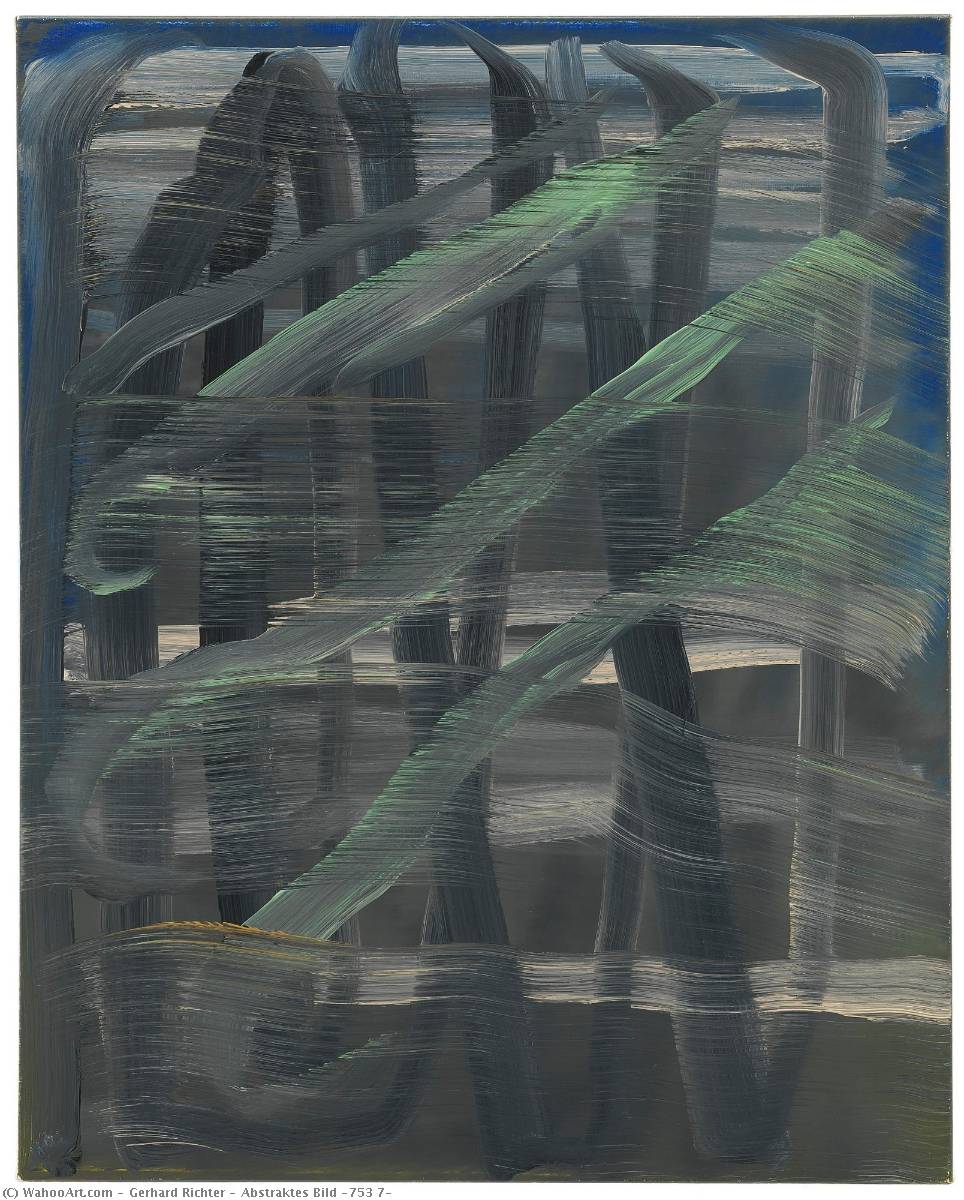
Explore Gerhard Richter's 'Abstraktes Bild (753-7)': A layered, atmospheric painting of trees and foliage, showcasing his signature blurring technique & reflecting tranquility.
Explore Gerhard Richter's art (b. 1932): abstract & photorealistic paintings, 'Capitalist Realism', color charts & more. A leading German artist influencing contemporary art.
A Meditation on Texture and Chance: Exploring Gerhard Richter’s “Abstraktes Bild (753 7)”
The artwork "Abstraktes Bild (753 7)" by Gerhard Richter stands as a testament to the enduring power of abstraction—a realm where visual sensation transcends literal representation, inviting contemplation and fostering subjective interpretation. Painted sometime in the mid-1960s, this piece embodies Richter’s signature approach: blurring techniques that deliberately undermine certainty, embracing chance and accident as integral components of artistic creation. It's a deceptively simple composition at first glance—a rectangular canvas dominated by vertical forms reminiscent of trees or dense foliage—yet beneath its surface lies a complex tapestry of visual and conceptual considerations.
The Technique of Diffusion: Richter’s Pioneering Approach
Richter’s method is instantly recognizable. He achieves his characteristic hazy aesthetic not through meticulous blending but rather through a process of scraping away paint after applying it, leaving behind subtle ridges and variations in texture. This deliberate disruption of surface smoothness isn't merely stylistic; it reflects Richter’s philosophical stance on artmaking—a rejection of illusionistic realism in favor of capturing an elusive impression. The resulting image is deliberately ambiguous, resisting precise definition and prompting viewers to engage actively with the artwork’s visual information. It speaks to a broader artistic movement concerned with exploring the boundaries between perception and reality.
Historical Context: Minimalism and German Identity
The painting emerged during a period of significant cultural upheaval in Germany following World War II. Richter's work aligns itself with the burgeoning minimalist aesthetic that sought to strip away superfluous ornamentation, prioritizing fundamental visual elements—line, color, and form—to convey emotional resonance. This stylistic choice can be interpreted as a reaction against the grand narratives of Expressionism and Surrealism, reflecting a desire for clarity and restraint amidst the anxieties of rebuilding a nation scarred by conflict. Furthermore, Richter’s artistic exploration engages with questions of German identity – grappling with memories of division and displacement—expressed through an understated visual language.
Symbolic Resonance: Foliage as Embodiment of Resilience
While devoid of representational accuracy, “Abstraktes Bild (753 7)” possesses a palpable symbolic significance. The dominant vertical forms—suggestive of trees or foliage—represent resilience and growth amidst adversity. These stylized representations evoke images of enduring strength and adaptability, mirroring the broader cultural narrative of overcoming trauma and rebuilding communities. The muted color palette—primarily blues, greens, and grays—contributes to an atmosphere of tranquility and introspection, reinforcing the painting’s emotional impact as a meditation on beauty found in imperfection.
A Legacy of Uncertainty: Richter's Enduring Influence
Gerhard Richter remains one of Germany’s most influential artists of the late 20th century, whose work continues to inspire contemporary creatives. His unwavering commitment to experimentation—particularly his pioneering use of blurring techniques—established him as a pivotal figure in abstract painting and solidified his place within the canon of modern art. “Abstraktes Bild (753 7)” exemplifies this legacy, demonstrating how an artist can harness chance and accident to generate profound visual and emotional experiences. Its enduring appeal lies precisely in its ability to provoke contemplation and invite viewers to forge their own interpretations—a testament to Richter’s belief that art should transcend mere imitation and engage directly with the human psyche.